From Confusion to Consensus
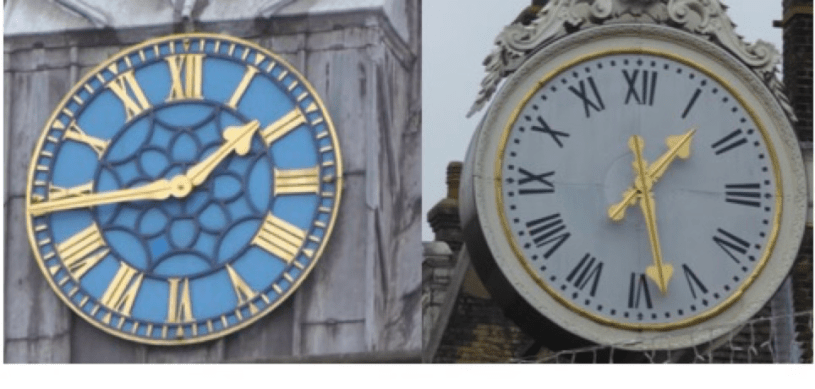
I’m pleased to report that on 10 January 2026, the cathedral and town clocks showed the same time. However, that wasn’t always the case. It wasn’t until 1852 that the press could report that Rochester had finally brought together ‘Civic Time’ and ‘Ecclesiastical Time’.
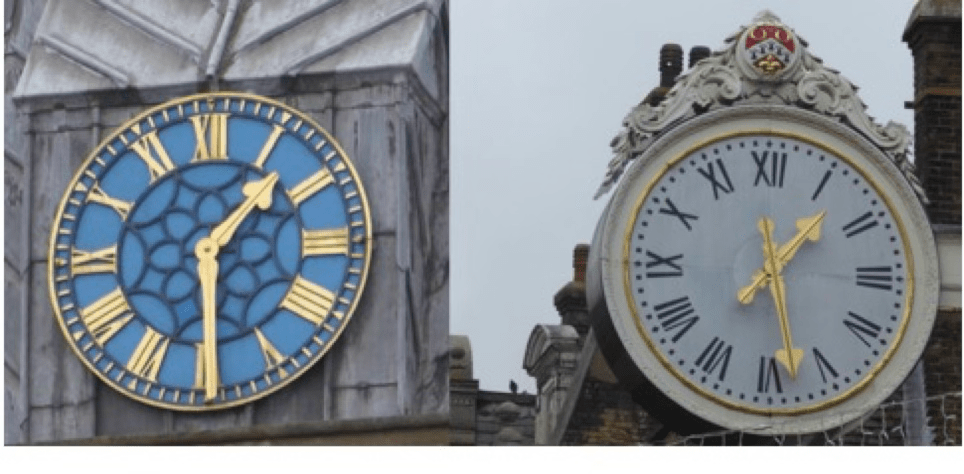
Before the unification of ‘Civic’ and ‘Ecclesiastical’ time, and the adoption of the national standard time, daily life in Britain operated to a patchwork of local clocks, each keeping its own version of solar time. Every town effectively lived by its own noon, determined by when the sun reached its highest point in the sky. This meant that the time in places only a few miles apart could differ by several minutes. The problem in Rochester was that until 1852 it could not agree on the time within itself, as the town and the cathedral had different bases for determining the time and setting their clocks.
This blog explores this story and suggests how the problem may have been resolved – by adopting the ‘clock’ of Chatham Dockyard that was probably set to Greenwich Mean Time (GMT).
________________
Prior to 1880, there was no requirement to adopt the national standard time that was based on Greenwich Mean Time. With the expansion of the railway, towns and churches slowly began to set their clocks to GMT, which was being used by railway companies to prepare their timetables. This, though, was not the case at Rochester until an agreement on what time it was was reached through the “polite and friendly offices of the Clock at the Dockyard”.
The press reported, perhaps not unexpectedly, that these differing times at Rochester caused confusion.
What was the time?
This depended on the standard or reference used to set the clocks. Today, it’s Greenwich Mean Time, where noon is set by the sun being at its highest on the Meridian Line (Longitude Zero). This, though, was not compulsory until 1880, but generally, churches and towns aligned their clocks when the town adopted Railway Time/GMT. At Rochester, though, prior to 1853, there were three-time ‘standards’.
‘Civic Time’:Until the mid-19th century, almost every town kept its own local time. This was set by reference to the sun, and known as solar time. This required midday to be set by when the sun was at its highest. This set a difference in time of about two minutes between Greenwich and Rochester, and two minutes between Rochester and Canterbury.
‘Cathedral Time’. The Church operated to ‘Ecclesiastical Time’. In the early monastic church, the day was divided into seven canonical hours for particular prayers. There were no prescribed times for these prayers as the day length would have been affected by season and latitude. By the 18th century, not all these prayer sessions were followed, and those that were were allocated a time. Over time, the schedule of prayers seems to have become less onerous. In 1711, the Chapter minutes recorded:
“that prayers begin in the morning throughout the whole year exactly when ye clock strikes a quarter past 10 in the morning and in ye afternoon from All Hallows Tide to Candlemas when it strikes a quarter past 3 and from Candlemas to All Hallows Tide when it strikes quarter past 4.” (Cited in Faith and Fabric – A History of Rochester Cathedral 604 – 1994.)
‘Dockyard Time’: On what basis the dockyard clocks were set in the 1850s has not been discovered. I suspect it could have been GMT. To have the land and ship clocks having a different reference point would have been confusing and inconvenient for a military that prides itself on discipline and order.
In reality
I suspect commerce at Rochester was based on ‘civic time’. Any confusion created was probably as a result of the town and cathedral clocks striking different times. Was that the cathedral or town clock that just struck ten?
The cathedral clock, today and probably in the past, chimes every quarter hour except between 11 p.m. and 6 a.m. The historical clock on the Corn Exchange was also designed to chime the quarter-hour. Assuming this was the case in the mid-19th century, and both clocks were set to different times, there could have been eight ‘chimings’ per hour. Not only could this have caused confusion, I suspect it could have also been quite irritating, and could have created the impression that the clocks stuck randomly.
However, I suspect, though, this was not entirely the case. As will be suggested later, the difference between Ecclesiastical and Civic Time at Rochester could have been 15 minutes. Both clocks would have, therefore, executed a quarter chime at the same time but for a different quarter! If they sounded similar on the quarter, one could not infer for certain what the correct time was without reference to a third timepiece.
The unification of time across Britain
The unification of time across Britain started with the expansion of the railway. In order to make timetables less confusing, the railway companies, in December 1847, adopted GMT, that was initially referred to as Railway Time.
At Canterbury, the cathedral clock and the town clock had been set to local solar time. A news report in 1844 recognised that the cathedral clock was 4 minutes and 16 seconds ahead of Greenwich. Such a consensus was not reached at Rochester.
There was a disparity in Canterbury between the cathedral’s clock and what was referred to as parish time, but this was put down to the age of the cathedral’s clock that could no longer ‘hold’ the correct time; it was installed around 1624, and was poorly maintained—both ‘allegations’ contested. (Kent Herald, 4 Jan. 1844.)
The need, though, for Rochester to adopt Railway Time was not essential until the railway crossed the River Medway in 1858. Once the river had been crossed, and the rail network began to connect with other communities across Kent, the timetable/Railway Time became all the more significant.
Unification of time at Rochester
The lack of agreement on what was the ‘correct time’ was a matter of some inconvenience for the inhabitants of Rochester. This would have become increasingly the case as knowing an accurate time became more important. Trains and stage/postal coaches operated to a timetable, and there were deadlines for the submission of tenders and the commencement of auctions. I also suspect that a dockyard worker arguing he wasn’t late according to a ‘Rochester time’ would have found himself qualifying for entry into the workhouse!
Matter of speculation
The tone of the news report about an agreement being reached at Rochester, over the standard to be used for establishing the time (West Kent Guardian – 4/12/1852) suggests there was some entrenchment on the part of the town and the cathedral, over whose time was to be adopted for Rochester. The fact that the parties shook hands when agreement was reached also suggests that there could have been some animosity between the respective authorities.
“Owing to the polite and friendly offices of the Clock at the Dockyard, the parties have met and shaken hands – each giving the other a pledge that in future he will act more in unison, and not strike at random, and will bring ecclesiastical and civil time together”.
Had the town adopted GMT, soon after 1847, when taken up by the railway, it is possible that the Dean & Chapter of Rochester may have also adopted GMT. However, if the town insisted on keeping its local solar time, why should the cathedral relinquish its long-held ecclesiastical time?
The fact that the report says that an agreement was reached as a consequence of the polite and friendly offices of the Clock at the Dockyard suggests that a high degree of diplomacy had been required. Also, as the press congratulated the public on the outcome, perhaps there had also been some public pressure on the parties to resolve their time differences?
What could have been the time difference?
I’ve found no reference to what the time difference was between the town and cathedral clocks. It must, though, have been significant for it to have been regarded as an inconvenience. I therefore asked ChatGPT to calculate what the difference could have been between ecclesiastical and solar time at Rochester in December.
The ‘Computer Says’ that the cathedral clock could have been about 11 minutes ahead of the town clock. This would have been large enough to cause irritation but close enough to be argued over. This difference though was also not so extreme that it could not have been overcome had the two parties been willing.
Could the difference have been 15 minutes?
In 1711, the Dean and Chapter set the time for particular services at quarter past an hour. Assuming ChatGPT’s calculation of 11 minutes is not far from correct, could the 15 minutes past the hour correspond with the ‘on-the-hour’ time of the town? A far more memorable and perhaps convenient time for worshippers?
Speculation around the solution
Although the news report does not state the basis on which the agreement was reached, I wonder if it was achieved through adopting Dockyard/Railway Time/GMT? I’ve found no news report after 1852/3 stating that Rochester subsequently moved to GMT. Could this mean that it had been adopted then?
Through both parties adopting GMT, the town and the cathedral would have needed to have adjusted their clocks. Thus done, both would have chimed the same quarter, at the same time, and in accord with GMT – so long as both clocks maintained good time. Could this have been behind the “pledge” given, when agreement was reached by the parties, to maintain their clocks and therefore ensure they did not “strike at random”?
No loss of face!
With both parties needing to make adjustments, neither the cathedral nor the civic authorities would have lost face or could claim victory. By adopting GMT, Rochester would have also been brought in line with what was happening elsewhere in the county/country.
In conclusion
I present the suggestion that prior to ecclesiastical time and civic time being brought together at Rochester, the difference in the time shown/struck by the two clocks was 15 minutes.
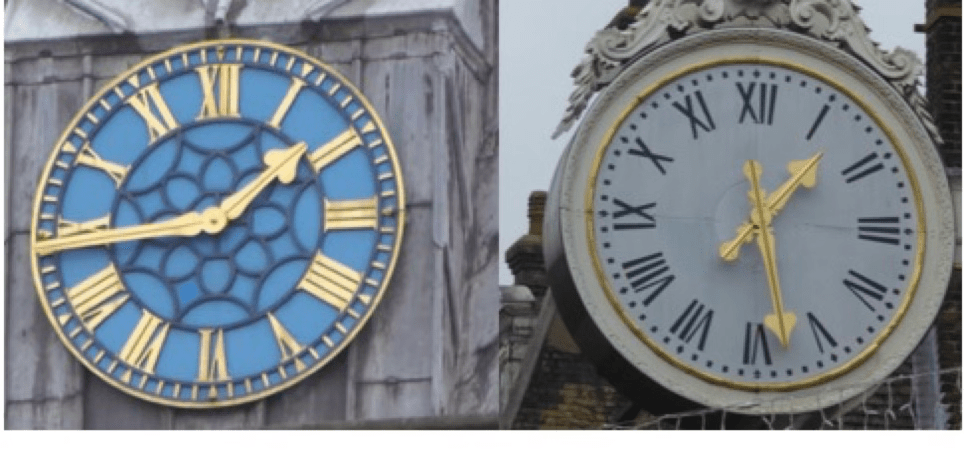
Alternative calculations or suppositions welcomed.
Geoff Ettridge aka Geoff Rambler – 9 February 2026
 Geoff Rambler's weird and wonderful Kent