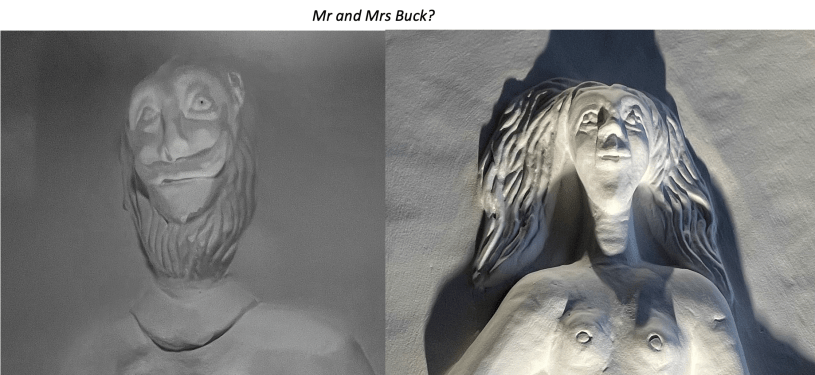
May I introduce you to Mr Peter Buck and his wife Mary – and family?
Visit Eastgate House, and you will be told there is no image of Peter Buck, who had the house built in 1590 when he was aged about 40. But is that right?
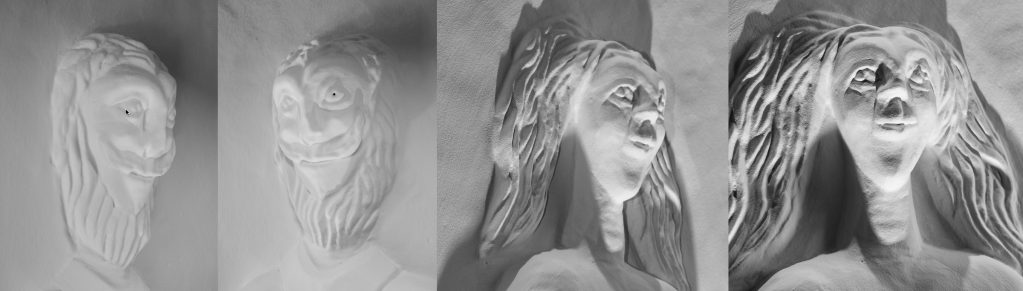
Within Eastgate House, there are three ornate plaster ceilings. Within the design of the ceilings of the two rooms on the second floor, there are four merpersons: a mermaid and merman in the first room, and a pair of Melusines in the second.
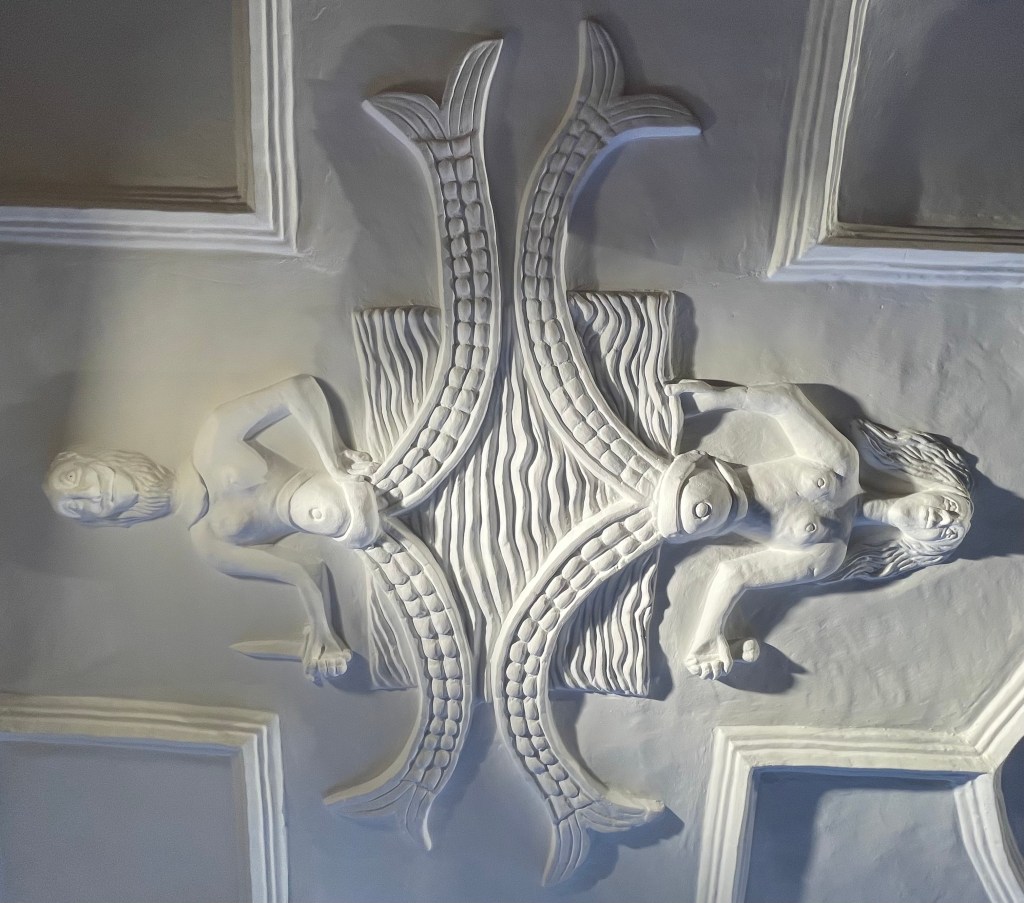
It is the Melusines that I’ve looked at most closely. Melusines are mythical creatures rather like mermaids, but having two tails. They are usually female. Unlike mermaids, which are symbols of list and vanity, Melusines in the Tudor period could be used as an allegory for a mother or provider of heirs. However, one of the pair at Eastgate House is clearly male.
It was not usual for an artist to include a likeness of the person who commissioned their work into their creation. It was also not usual for someone of wealth to commission an ‘allegorical portrait’. In these, they have their likeness added to a mythical body to symbolise some quality of the beast or person to which their head was added.
Moulds would probably have been used for the main features in the ceiling’s design. The design of the Melusine tails are particularly fine. However, it is possible that some hand-crafting was done with the facial features? By the late 16th century, artists were exploring other mediums. As we view the ceilings, we might be observing the work of an artist rather than a regular plasterer.
Mr Peter Buck
Could the face of the male Melusine, therefore, have been based on the likeness of Peter Buck, who would have commissioned the ceilings?
The sculpted face is adorned with a curled moustache and a pointy ‘Peak de Bon’ beard. Both were contemporaneous with the fashion followed in the Court of Elizabeth I. Under the head/around the neck, there is what could be a ruff. The male Melusine’s hairline also appears to have receded and it appears the be developing a ‘pot belly’; both quite possible in a man aged 40 years!
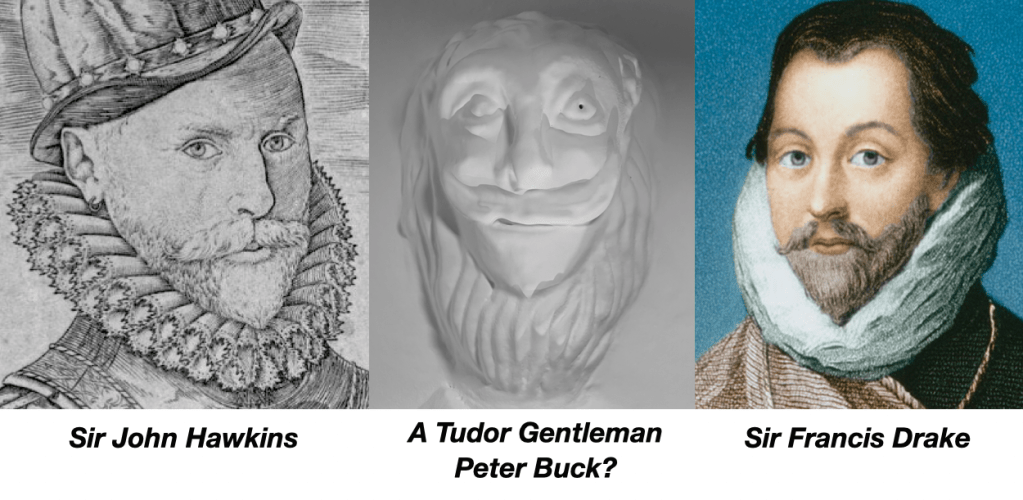
Comparing the ‘sculptured face’ with contemporaneous portraits of Sir Francis Drake and Sir John Hawkins, the similarities are noticeable. All have a Peak de Bon beard and a curled-up moustache. The ruffs of Francis Drake and the representation of a ruff surrounding the sculpted head are not dissimilar.
Clearly, the sculptured face is that a man from the Tudor period – and could quite reasonably have been based on the likeness of Peter Buck.
Mrs Mary Buck, nee Creswell?
If it has the likeness of Peter Buck could it be possible that female Melusine was based on his wife, Mary?
There is nothing in the style of the hair or facial features that are particularly notable. However, could the significance be in the fact that the female Melusine could be pregnant? Her belly appears swollen and the belly button is protruding. These are rather unusual embellishments for a generic Melusine or mermaid.
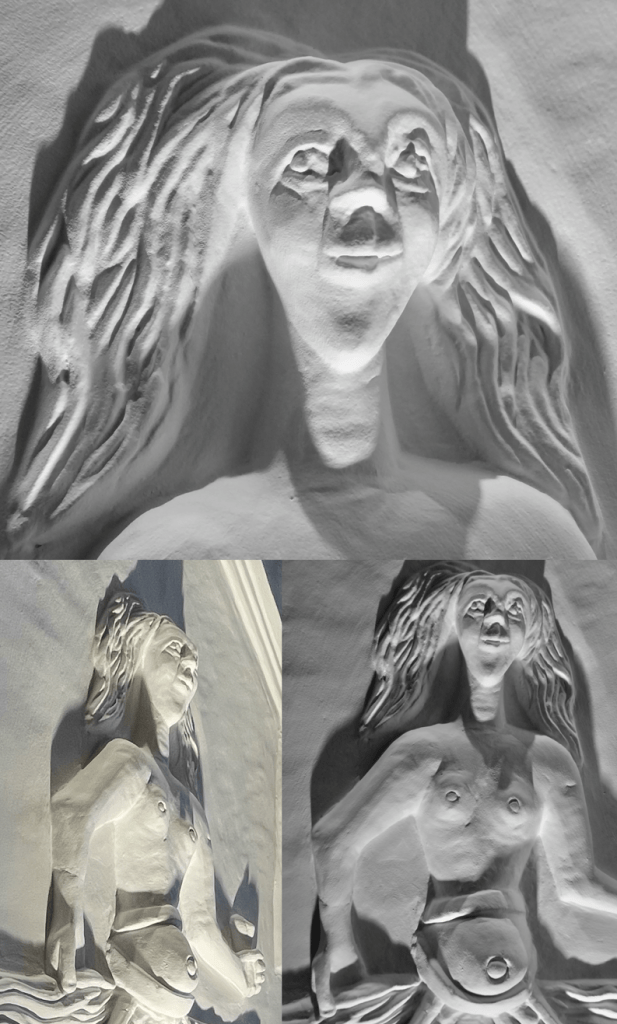
The room in which the Melusines can be found is best referred to as the Family Room. In this room, there are the coats of arms of the Bucks and Creswells, along with a (reversed) impalement of the two families. Along with the coats of arms, there is also a pair of bucks included in the design of this ceiling— a pun on the Buck family name.
Mary would have been aged about 30 when the ceiling was crafted. As she had at least nine children, being pregnant at this time is a possibility—but dates of birth of her offspring are not known to enable this to be confirmed. Including Mary’s likeness in a Melusine would have been consistent with the family theme of the room and her allegorical status as a nurturer and mother/provider of heirs for the family.
Celebrating Family
The second floor of Eastgate House would have been the family’s private apartments. The convention of the time was that the closer the relationship, the ‘deeper’ you would be welcomed into a household. As described in a previous newsletter, the ground floor would have been a public area. Peter Bucks’ study/meeting room, with a ceiling conveying his civic status—something quite unnecessary if this was a family room— is found on the first floor.
The second floor, though, would be private and the place to celebrate family. Today, we have family photos displayed in our private places at home. So why would Peter and Mary Buck not have wanted to do the same — except, of course, photography had yet to be invented? But they were having ceilings installed!
Mr Peter and Mrs Mary Buck?
I believe a case can be made for us being able to make assumptions about what Peter Buck may have looked like. The face of the female Melusine could well share a likeness with Mary, but it’s possibly safer to just assume that she was pregnant when the ceiling of this room was being crafted.
The sculpted faces may not be of the finest, but I suspect they contained sufficient similarities that would enable someone who knew the couple to recognise them.
Is it therefore possible that for over 400 years, Mr & Mrs Buck have been hiding in plain sight? Just think what they may have witnessed over the centuries – totally unrecognised, whilst covertly observing … what!?
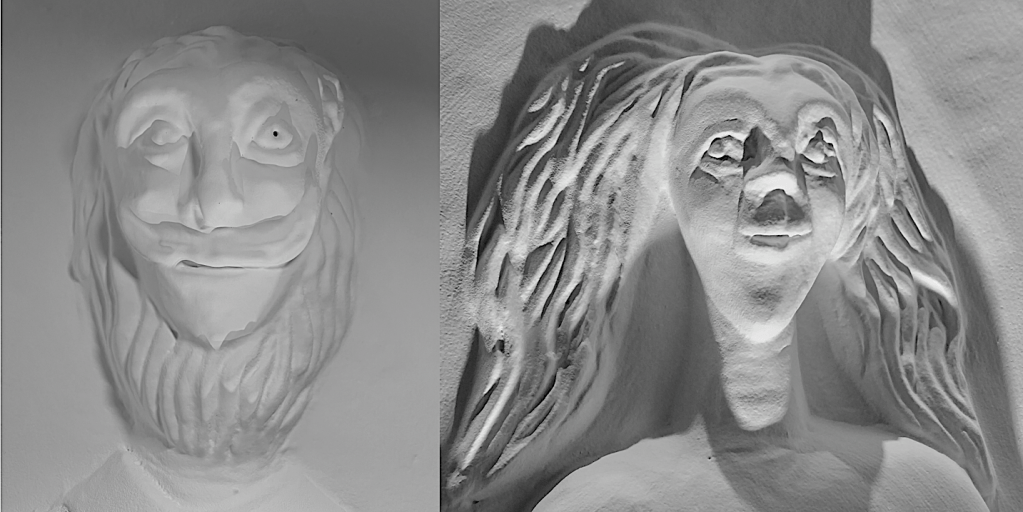
Just for fun! I asked ChatGPT to reconstruct a face based on the images I took of the Melusine faces in the ceiling of Eastgate House. I ‘told’ AI that the images were a cast of faces. I also told it that they lived in the Tudor period and that the male was middle-aged and the female was aged about 30. This is what it came up with:
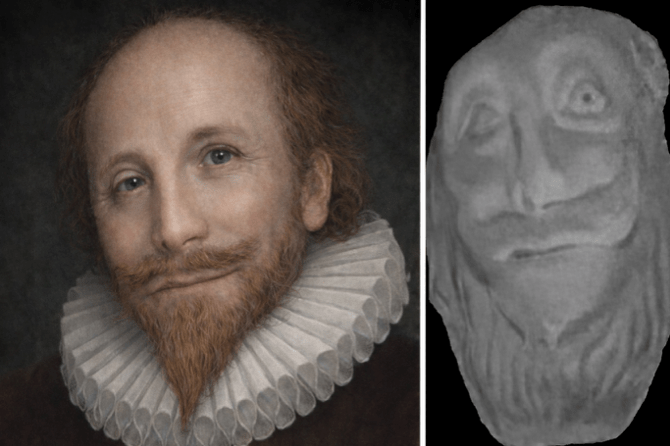
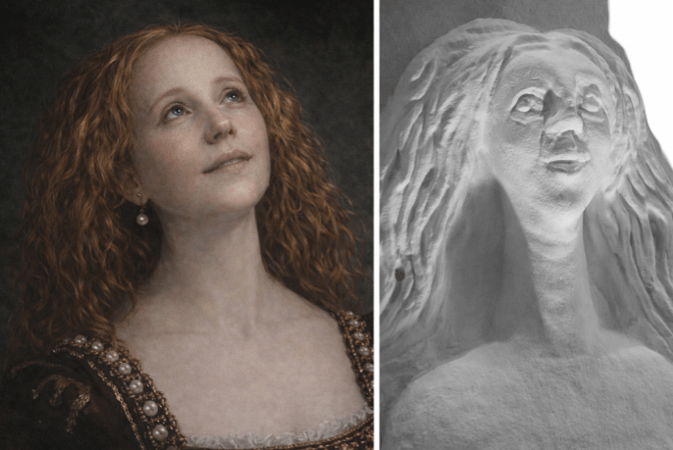
Certainly a handsome couple – but there is absolutely nothing to say this is what the possible Mr & Mrs Buck looked like.
Gallery of the Buck Family?
Considering all the faces of the merpeople on the second floor, those in the first room (Marine Room) have the faces of younger persons.
Peter Buck ll would have been about 24 when the ceiling was crafted. Could the fact that he’s portrayed holding a cutlass – part of the family crest he will inherit – be significant?
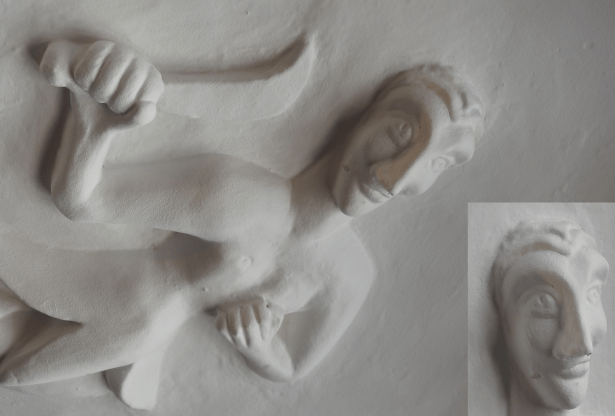
The gender of the second merperson in this room, furthest from the window, is less easy to identify. Typically, mermaids are portrayed as holding a mirror in one hand and a comb in the other – luring sailors to their doom.
This depiction is pointing rather than holding a comb. Although what is held in the left hand could be a mirror, it looks as if it’s something else. What’s being held is unclear. The pointing could have some significance for what is being held, but it doesn’t appear to be weapon. The pointing could be directional or miss-directional in the tradition of mermaid folklore.
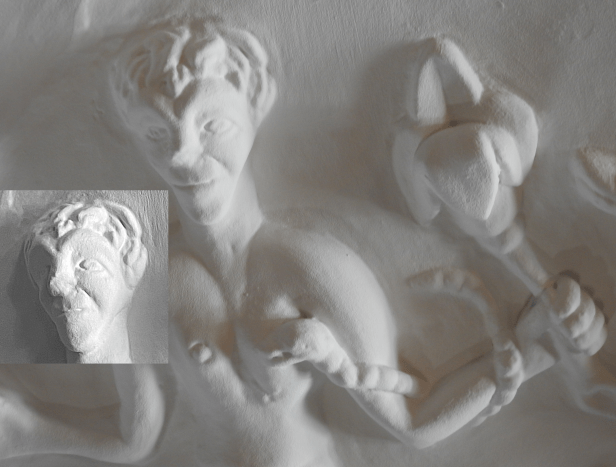
Based on the detailing on the chest and the proximity of entwinned snakes, and the lack of a recognisable weapon, I’m inclined to believe the depiction is that of a young woman. In which case, could the face of this mermaid have the likeliness to a daughter? The face is not that of a child and if it was Elizabeth, from Peter Buck’s first marriage, she would have been about 21 when the ceiling was crafted.
It is possible that the younger faces belong to the children of the Peter Buck’s first marriage. But I can also see an argument for the younger faces being those of their younger selves. The ceiling of the Memory / Marine Room depicts several limbless sea monsters – whereas in the next room two appear to have grown legs. Could the themes of the ceilings of these two rooms be about transformation?
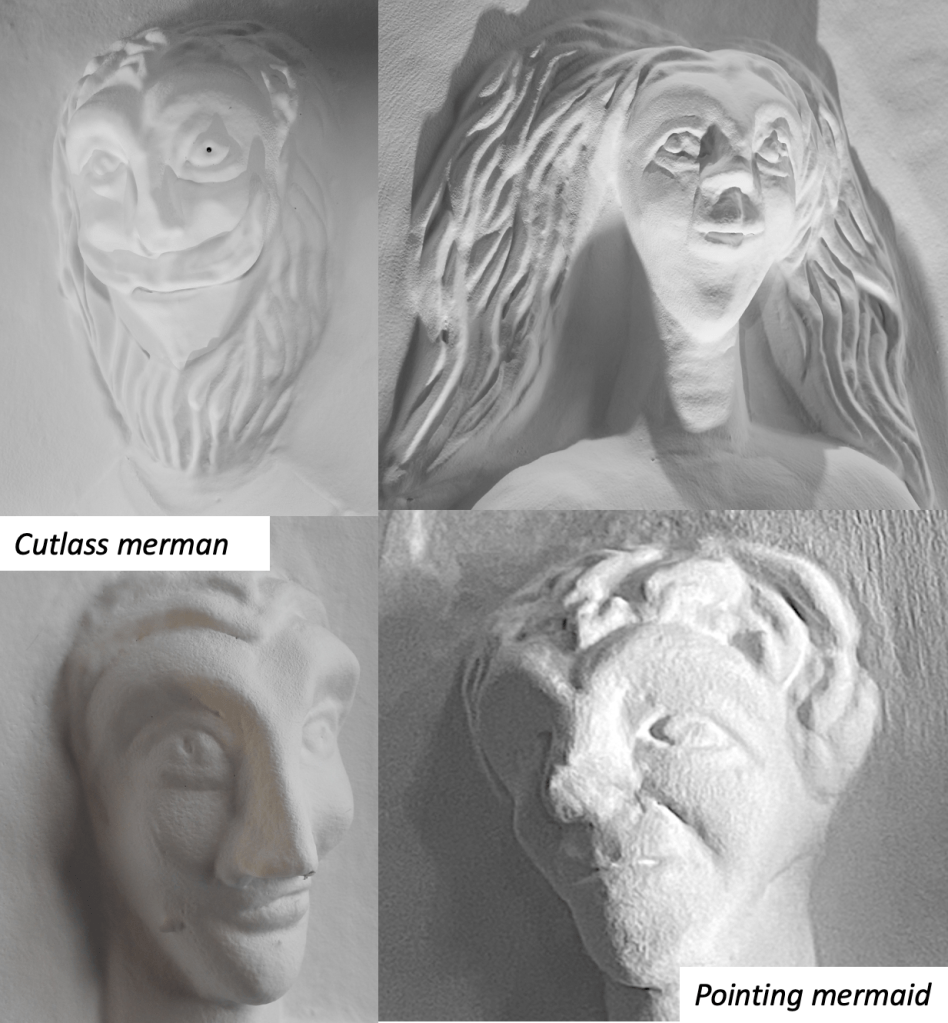
Either way, there seems to be same familial resemblance between the faces. Both female depictions have similar pointed chins. The brows of the two male figures are both high. The younger male perhaps not having the status worthy of wearing a beard?
So could the following compilation be that of likenesses of the Buck family who first resided in Eastgate House?
Sources
There are none – other than my fertile imagination!
There is no evidence underpinning my suppositions. Others may, therefore, be as right or wrong as me in drawing their conclusions. But this interpretation of the merpeople’s faces and their portrayal, does provide some food-for-thought – and it may cause people to linger longer when viewing the ceilings of these rooms – to see rather than just look?
Geoff Ettridge aka Geoff Rambler
6 April 2025. Updated 18 October 2025
http://www.facebook.com/geofframbler
Other blogs related to Eastgate House – Decoding the Ornate Ceilings of Eastgate House and Heraldic Devices at Eastgate House. These may be helpful to look at before your visit as there is no interpretation or guiding offered within the house.
[1] The Buck Family & Eastgate House – Produced by the Friends of Eastgate House 2019.
(A) The Story of Tudor Art. Christina J Faraday. 2025
 Geoff Rambler's weird and wonderful Kent
Comments are closed.