

Part 1 – The Ceilings
There are three ornate plaster ceilings in Eastgate House at Rochester, Kent, about which I’ve found little written beyond stating there were fine or magnificent. They are in three separate rooms that formed part of Phase 1 of the building of Eastgate House by Peter Buck in 1590. Having these crafted would not have been cheap and I’m certain that in commissioning the work Peter Buck and his wife, Mary Creswell, would have given some thought to the designs they wanted included in the ceilings.
In this blog I consider the heraldic devices that can be found crafted in the ornate ceilings of two of the rooms. Today they are not coloured but before the recent restoration of Eastgate house they would have been.

Eastgate House
The building of Eastgate House commenced in 1590. It was built for Peter Buck, Clerk of the Cheque and local dignity, and his second wife Mary Creswell. The decorative plaster ceilings are included in Phase 1 of the development. Over subsequent years the house was extended away from the High Street by Peter Buck’s descendants. The ceilings in the extensions were / are not decorated.
Both the Bucks and the Creswells were from arms bearing families so both coats of arms are contained within the ceiling designs. On the marriage of two such families the offspring of the marriage can apply for what is known as a ‘impaled’ coat of arms showing their family lineage.
In total there are six shields in four ‘designs’ included in the ceilings – but one has been erroneously crafted.

The shield on the left is of the Creswell family and the one on the far right the Buck family. The two middle shields are ‘impaled’ but only one is correct – the incorrect one is marked with a red cross.
Shield Design
Arms and crests, badges and supporters, are granted by letters patent issued by the College of Arms. The designs are not presented pictorially but described in words in a Blazon. Convention stated that the husband’s (Baron’s) coat of arms should be presented on the left (sinister) and the wife’s (Femme) on the right (dexter).
Whoops?
The Blazon however determines left and right from the perspective of the person holding the shield, not the one viewing it. It therefore seems possible that one of the craftsmen interpreted the instructions from the perspective of the viewer – or did he? See section on the Family Room below.
Coats of arms became important in battle or tournaments when helmets prevented facial recognition; they therefore needed to be distinguishable.
Family Crests
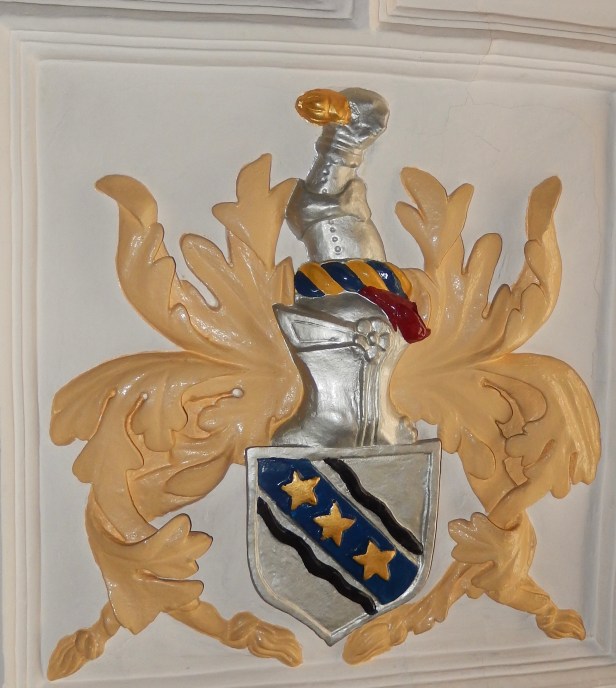
In addition to having a Coat of Arms families could have a Family Crest. The image below is of the ‘Achievement’ of Richard Bucks. This combines, if you like, the family ‘credentials’. It contains the shield representing the coat of arms, and at the top there is an arm in armour holding an item. This is the Family Crest. The helmet between the two is probably an ornament to connect the two, and the braided torse to disguise the join.
Some writers suggest that the type of helmet and the direction it faces, says something about the heraldic status of the holder. In the ‘Achievement’ below the helmet suggests the holder is an ‘Esquire’; someone with greater status than a Gentleman, but less than a Knight. The choice of style though is more likely to have been what was in fashion at the time.
“Richard Buck’s Study” – First floor of Eastgate House
In the room on the first floor now described as “Richard Buck’s Study”, there are three heraldic features:
- Peter Buck’s ‘Achievement’.
- An Impaled Creswell / Buck’s shield – the correct version with the Creswell’s portrayed on the left as you look at the shield.
- The Buck’s Family Crest – as a separate device – see below.

It is perhaps worthy to note that the ceiling of this room only contains these heraldic devices and infilling decoration. The ceilings of the two rooms on the second floor also include mythical or imaginary creatures. It therefore seems reasonable to assume that Richard Buck may have wanted to encapsulate family history / status in this larger of the three decorated rooms.
Along the two longer edges of the ceiling of this room there are three pairs of ornaments that look as if they could have beem part of the holder of a shield. Initially I thought this may have suggested an imprinting device / mould had been used in creating the ceiling design. However, when photos of each are placed next to each other there are differences in style and execution e.g.

Were this each handcrafted? Or did the Bucks go to the expense of having so many similar, but different, moulds made? Each would probably have had to handcrafted by a carpenter.
Design of the Buck Family Crest

There are a number of Bucks’ across the country with different heraldic devices / crests. It is known that the Peter Buck who built Eastgate House came from Hampshire / Southampton.[1] In Fairbairn’s Book of Crests of Families of Great Britain and Ireland. 4th Ed. Vol. 1. 1905,two ‘branches’ of the Buck family are described – one from Hampshire and another from Kent – both with similar crests.
Bucke, Kent, an arm in armour embowed ppr., garnished or, holding in the hand a cutlass arg,. hilted of the second. p84. Image 196. 10. (When the sword is described as a scimitar it may appear in heraldry through a connection with the crusades as this design originated in the middle east.)
Buck, Hants, an arm in armour embowed ppr., garnished or, holding a scimitar arg., hilted of the second. p84.
The terminology used means the arm is to be bent – embowed – the armour and cutlass / scimitar to be silver. The garnishing suggests detailing of the edges and joints were to be gold. The term ‘hilted of the second’ means the hilt (handle) was also to be the second colour – in this case gold.
An arm in armour can denote leadership qualities. In the above photo of the Buck Family Crest crafted in the ceiling, it may not be clear but the hand is the right hand, and it’s ungloved. Had the hand been in a gauntlet it would indicate military service. If the hand was holding a sword it could indicate justice. [Qualifier – there can be no certainty that these associations are correct. They are given in a number of sources – but not all of them.]
The drawing of the hand holding a sword was offered, by Fairbairn, for both the Kent and Hampshire Bucke / Buck.
A report based on a Visitation to Kent by the College of Arms in 1619, described the Buck Crest as:
“A dexter arm, embowed in armour proper, garnished or holding a cutlass argent, hilt and pommel or.” (gold)
Clearly it would be impractical to furnish a full cutlass in the ceiling’s design but showing the pommel (round knob and the end of a sword handle) would have indicated that a sword was being held.
Design of the Buck Coat of Arms
I assumed that the crests crafted in the ceiling were those of Peter Buck and his second wife, Mary Creswell – who else could they have belonged to? However, I could not find evidence to support the colouration used to colour the coats of arms prior to the restoration of the house.
In short, the colouration was correct for the Buck coat of arms that were replicated on the torc in the Buck Achievement – however I’ve found no reference to the red tassel emanating from the torc.
Representatives (Heralds) of the College of Arms made a Visitation to Kent in 1619 to check the claims of arms-bearing families in Kent. A document[2] based on this visit recorded in Latin, in respect of the Buck Family, (English translation in brackets):
Petrus Buck – de Civitate Roffensi Miles (Knights of the City of Rochester)
First marriage = Margareta filia (daughter) Christopher Haviland de Poole in com. Dorsett.
Second marriage = Maria (Mary) filia Tho’ Creswell de Odiam in com. Southampton Armigeri (armsmen).
It also described the Buck Coat of Arms:

This heraldic description translates to: on a white background (argent), a blue diagonal band (bend azure) with wavy black lines along its edges (cotised wavy sable), and three star-shaped charges (mullets) placed on the blue band.
Key points:
Argent: White colour in heraldry.
Bend Azure: A diagonal blue band across the shield.
Cotised Wavy Sable: A wavy black line running along the edges of the bend.
Mullets: Star-shaped charges, usually with five points.
Design of the Creswell Coat of Arms
It would appear that the Creswell’s also came from the Hampshire area, also had a family crest but that would have ‘belonged’ to the eldest son. Had Mary not had a brother to inherit the families ‘name’ there was provision for her family crest to have been included in the impaled crest.
As with Kent, the Heralds of the College of Arms visited Hampshire. A document[3] based on the Visitation c1622, described the coats of arms for Thomas Creswell (1535-1609) – father of Mary. There are two crests associated with the Creswells; the family tree associated with the second show the marriage between Mary and Sir Peter Buck. As Peter Buck was knighted in this illustration it was prepared after 1604. The family crests associated with these two entries are markedly different. The first with a rather aggressive mace (emblem of authority usually award to corporation; the hand is not in a gauntlet so no military association), the second with a more ‘peaceful’ cross (symbol of Christianity).


More investigation is needed to understand this, but both show the same coat of arm shields for the Creswell family
“ Argent, three bars gemelles sable”. This translates to a heraldic shield with a silver background (argent) and three pairs of close-set black bars (sable) running horizontally across it, where “gemelles” signifies that the bars are “twinned” or very close together, essentially appearing as three double bars.
There is a display of heraldry in St Michael’s Church, Heckfield, Hampshire.[4] This includes the ‘Achievement’ of the Creswells (Creswell). Again, it is not showing what the clenched fist is holding – nor does the arm appear to be armoured.

In the church are also two impaled shields pertaining to the marriage of two Creswell women (femmes). These are correctly shown as being on the left of the viewer (not holder) of the shield.
Creswell impaling Alice Haydock. Creswell Jane Baynard


“The Family Room”
In the room now described at the Family Room in Eastgate House, there is a combination of heraldic devices and mythical/imaginary creatures. This is probably the most ‘heraldic’ room in the house. The three devices comprise of the family crests of the Bucks and Creswells, at opposite sides of the room, and in the centre there is in the incorrect design, the Buck coat of arms impaling those of Mary Creswell.
Coats of Arms from the Family Room
Peter Buck Impaled Mr & Mrs Buck Mary Creswell

I’m not in a position to be disparaging, but the erroneously designed impaled coat of arms in this room does not appear to be of the same quality as the one in Peter Bucks’ Study. I therefore wonder if this ceiling was crafted by a less experienced craftsman? Or someone who didn’t know their left from their right or more accurately, their ‘sinister’ from their ‘dexter’! But coudl it also have been a ‘transcription’ problem? If the shields were made with the use of a mould, the ‘right’ becomes the ‘left’ when the moulding is placed on the ceiling.

‘Feminist Statement’?
But is it also possible that it was intentional? It is difficult to think that the break with convention was not noticed. Equally it’s hard to imagine that all the ceiling designs were executed so perfectly that they required no modifications were needed. This suggests to me that the reversed impalement could have been intentional or found to be acceptable. Could it also be asserting the fact that the house was jointly owned? The widowed Mary continued to live in Eastgate for around 12 years following the death of her husband.
Within the design of the ceiling of the ‘Family Room’ there looks to be two deer. Although they have no antlers on closer examination at least one appears to have male genitalia – more easily crafted than the tines of antlers. This could be alluding to the ‘Buck’ family name – something more obvious in the plaque on the outside chimney?
Badge / Rebus
High up on the outside of the chimney of Eastgate House is a plaque with a buck in the middle. This is known as a badge and is a pun or pictorial representation of the name of the householder – Peter Buck (buck being a male deer). Holders of a coat of arms could have a badge which was worn by their retainers. Such symbols would have been important at a time when literacy would have been low.

The coat of arms of Richard Watts – cf Six Poor Travellers – had hares included in his coat of arms – ‘watt’ being a 16th century word for a hare.

A hare in a coat of arms can also represent ‘Intelligence in warfare’.[5] Not for telling here but Richard Watts as victualer to the Navy, did well out of threats of invasion during the time of the Tudors. The pansy held by the hare in the position of the Crest, is a pun on an archaic meaning of “pawn” – a warehouse or magazine where items were stored and displayed for sale.
Watts’ coat of arms was awarded on 2 April 1552. The blazon described “chevron engreiled sable between thre Wattes hedds” and “pawnsey in his proper cowler stalked and leved verte”.[6]
It is possible that the Bucks of Hampshire, from whom Peter Buck descended, may have had a coat of arms that included the heads of three bucks (male fallow deer).

Trefoil (clover leaf shape): In heraldry, a trefoil is a symbol that can represent perpetuity, longevity or happiness. It could also symbolise the Trinity in Christianity.
This description was found in the “Origin, History and Genealogy of The Buck Family”, Cornelius B Harvey, 1889, but his source only speaks of various visitations. If I read this correctly it suggests that the buck heads were ‘erased’ and the coat of arms ‘attired’ with a similar number of mullets. ‘Cymeter’ could be an alternative spelling of scimitar as described in Fairbairn’s Book of Crests in which case the family crest is the same. I have not through previous references to the inclusion of a rose in the coat of arms.
I am indebted to the staff of Medway Archives for leads and confirmatory information, and Tony Sharp, historian and Clerk to the City of London Ward Beadles, who most generously gave of his time to educate me in some aspects of the language of heraldry.
Geoff Ettridge aka Geoff Rambler
8 Feb 2025
I am indebted to Natasha at Medway Archives for leads and confirmatory information, and Tony Sharp, historian and Clerk to the City of London Ward Beadles, who most generously gave of his time to educate me in some aspects of the language of heraldry.
Other Eastgate House related blogs:
[1] The Buck Family & Eastgate House. Friends of Eastgate House. 2019
[2] 1898 – The visitation of Kent: taken in the years 1619-1621 by John Philipot, Rouge Dragon, Marshal and Deputy to William Camden, Clarenceux.
[3] 1913: Pedigrees from the visitation of Hampshire made by Thomas Benolt, Clarenceulx a 1530: enlarged with the vissitation of the same county made by Robert Cooke, Clarenceulx anno 1575 both which are continued with the vissitation made by John Phillipott, Somersett (for William Camden, Clarenceux) in a 1622 most part then done & finished in a 1634. As collected by Richard Mundy in Harleian ms. no. 1544
[4] https://www.heraldry-online.org.uk/heckfield.html
 Geoff Rambler's weird and wonderful Kent
Comments are closed.