The Rochester & Chatham People’s Cafes Company – a model from the past for today?

People’s Cafes were set up in the 19th century to provide affordable meals from a venue other than a pub. The idea came from the Temperance Movement that wanted to create places where people could meet up where alcohol was not served. They went on though to provide a much needed social service.
The Rochester & Chatham People’s Cafe Company ran from 1877 to 1948. It provided affordable food to those in poverty and to workers who were laid off in the winter. It undoubtedly played a role during the wars when food and fuel were in short supply – but that would not have been reported for fear of undermining morale
In response to the ‘cost of living crisis’ people are increasingly relying on food-banks. Some cafes are also provide affordable meals supported by donations. This is not a new innovation – but could there be a more sustainable business model – one less dependent on the vagaries of donations, or the time-consuming process of writing ‘begging letters’ or filling out application forms for grants?
++++++
During the late 19th century what were termed “Peoples’ Cafes” were set up across the country – including two in Rochester, one in Chatham and one in Brompton, and later one in Strood. These were not charities. They were local businesses, financed by local people, to meet a local need, and shares were bought and sold by shareholders at local auctions.
There was certainly no shortage of places to get a drink in Rochester. In 1811 there were 81 pubs along the high street, and in 1894 the Chief Constable reported to the Licensing Committee that in Rochester – wider than the high street – there were a total 140 public houses, beer and wine houses. In 1902 one in nine premises on the high street was said to be a pub, inn or tavern.
Pubs were not about drunkenness and brawling. Many provided accommodation for travellers and they provided places where news could be shared – including places where work may be found – and indeed a place to get warm if there was no fuel for a fire at home.
“People’s Cafes” through was not a franchise – it was an idea and a concept. Spotting a potentially lucrative but philanthropic business opportunity, the Mayor of Rochester (N E Toomer) in 1877, sought investment to establish the “Rochester & Chatham People’s Cafe Company”. In March of that year, 4,000 shares at 10s (50p) were offered to raise £2,000 to set up the company.[1] This was a considerable amount of money – over £190,000, today, according to the Bank for England inflation calculator.
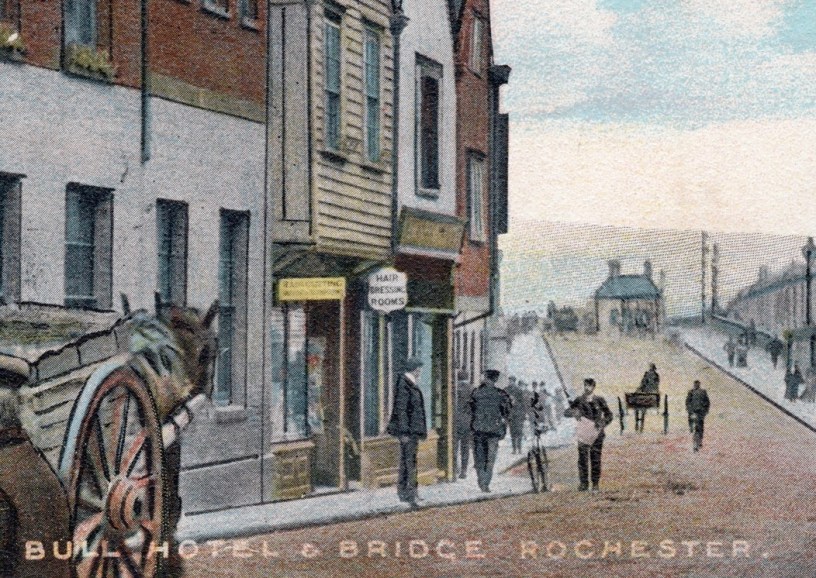
The first cafe, which opened within weeks, was at 14 High Street, Rochester. The premises had previously been a hairdresser and tobacconist ran by a William Burge who was also a bird fancier. Charles Dickens was apparently a custom of his, and who used to bring his canary “Dick” to have its claws clipped.[2] An image cropped form an old picture of the Bull Hotel shows that Burge’s premises was large enough to offer ‘rooms’.
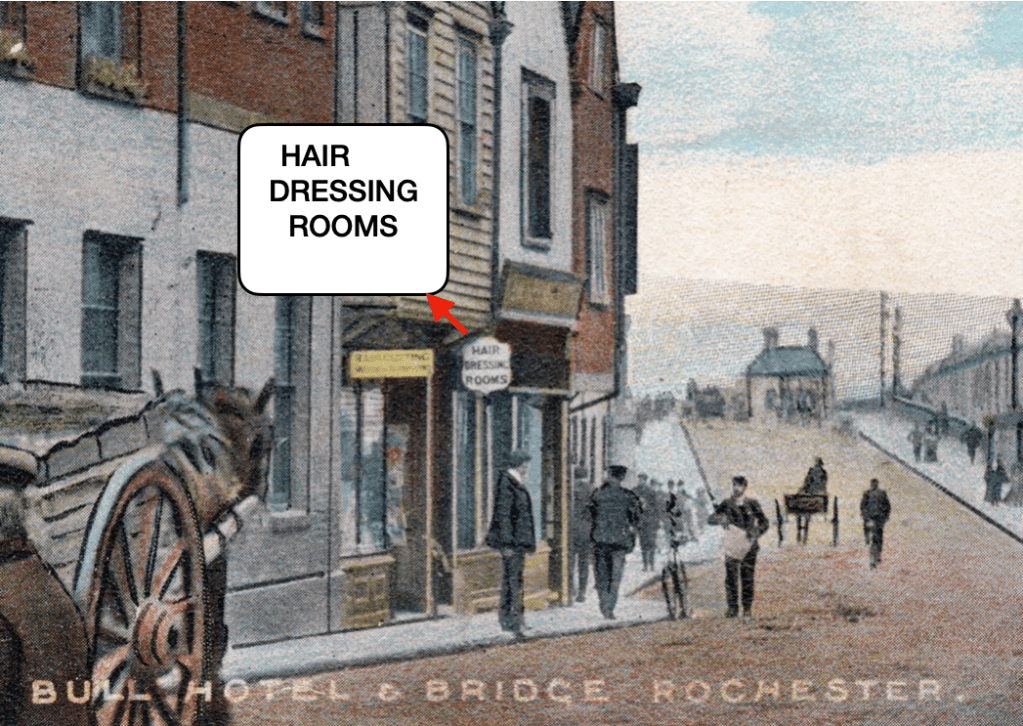
By August it was reported that the company had sold 2000 shares that were held by 200 shareholders, and that business was increasing week by week.[3]
Such was the early success a meeting was convened at Chatham in May 1877 to consider opening “similar [cafe] to the one that just opened at Rochester”. The meeting heard that the Rochester cafe was taking £2/day and trade was increasing. It was also anticipated that the cafe at Chatham would do better than the Rochester cafe.[4] In making the case for a People’s Cafe at Chatham a clergyman made the case for a ‘dry’ cafe by stating that nothing in the world tended more to keep the workingman down- socially, morally and politically – than the “horrid” drink.
The meeting agreed to open a People’s Cafe at Chatham but it took over a year to bring it to fruition – it was formally opened in September 1878;[5] the delay could have been due to local opposition – as suggested in a much later news report.[6] Within a year the Chatham Cafe was taking £20 / week.
By July 1880 there were three People’s Cafes in Medway – Rochester @ 14 High Street. Chatham @ 121 High Street, and Brompton @ 8 Garden Street / Temperance Hall. (The location of the Chatham cafe is difficult to fix.[7])

By 1895 a second Peoples’ Cafe had opened in Rochester[8]. By 1913 there was a People’s Cafe located at 8 High Street, Strood.[9]
The intention of the company’s directors was to have each cafe managed by a husband and wife team who had no “encumbrances”, and who were “total abstainers”. Initially experience in running such a business was not required but recruitment ads from around 1884 specified the need for applicants to have business experience[10] …. suggesting the role entailed more than just preparing / serving food & drink?
Rochester & Chatham People’s Cafe Company
Based on news reports of AGMs of the Company, and the dividends paid to the shareholders, the company was a commercial success – at least before the Great War (1914/18).
The cafes provided as one would expect, food and drink. A report based on a theft from the Rochester cafe stated that a bargeman stole four eggs and a quantity of cooked meat and a roll.[11] A report of a theft from the Chatham cafe stated the price of a cup of cocoa was 1d.[12]
Even allowing for the sale of high volumes, it is doubtful that this would have been sufficient to pay the dividends that were declared to the company’s shareholders. After two years of trading a dividend of 15% was paid;[13] the following year it was 8.5%. This increased to 10% in 1895, but in subsequent years was generally about 5%.
It is quite possible that the profitability of the Company came less from food & drink sold to working people, but more from providing lodgings and space for meetings and social events – as suggested by the adverts placed in the press.
I suspect that it was not a coincidence that the Directors opened a second cafe in Rochester High Street / Chatham Intra — “a few doors down below Chatham Central Station” in 1895. The Directors felt the new premises would be suited to the trade[14] – no mention of a ‘philanthropic need’.
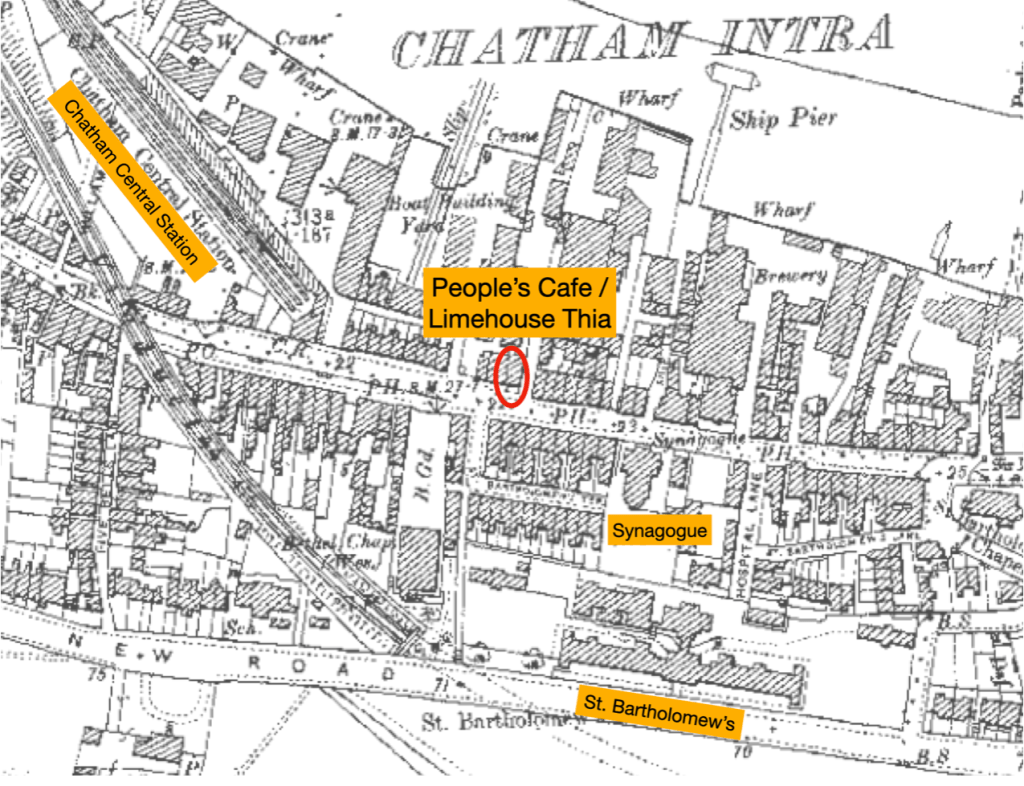
The (not-so) Central Chatham railway station opened in 1892. This would have brought travellers into the area – some of whom would require accommodation. Having rooms near the station would have been a commercial advantage.
The premise is now Limehouse Thai at 327 Rochester High Street.

Social Benefits of the People’s Cafe.
To understand the importance of the Peoples’ Cafe to the communities of Rochester and Chatham, I feel it helpful to be reminded of the tremendous hardships that working people – and particularly those who found themselves unemployed – faced. Rochester in 1871 was described as a dirty and disagreeable place,[15] and very short of places for people to bath – other than the river. (The Charity Commissioners in 1855, who investigated the running of the Richard Watt’s charity, required the charity to fund the setting up of public baths and washhouses.)
There was little in the form of job security. Much work was sessional or seasonal. Even the dockyard, a major employer in the area, laid-off workers in the winter. Charities would establish soup kitchens funded by donations.[16] The second annual meeting of the Company reported, “Both establishments [Rochester and Chatham] provided a soup kitchen during the winter months. “Thousands of tickets (were) sold and much distress was alleviated”. A dividend of 15% was declared[17] – perhaps possible because of the income from the soup kitchen?
It would be wrong to assume that the ‘ticket price’ was paid by the person who would consume the soup. It is possible that the tickets were purchased by an individual or perhaps an organisation, for distribution. I base this on the fact that those who helped fund the early St. Barts at Rochester had ‘nomination rights’ in respect of who would receive free treatment.[18] The ‘Customer’ may well have been expected to pay a nominal amount such as 1d. The Soup Kitchen set up in parish of St. Nicholas (1870) cost £2 2s per session – inclusive of the “people’s pence”.[19]
One news report makes reference to the Chatham Cafe having baths – they had “been fairly patronised and much appreciated”.[20] The People’s Cafe at Brompton, that was situated in the Temperance Hall, had a large room that could be hired for “clubs, lectures and entertainment” – presumably providing another income stream.
Although I’ve discovered little more about the local People’s Cafes, others elsewhere in the country, in addition to providing food & drink at “prices within the reach of everyone” also gained income from providing hot & cold baths for 3d, and the sale of provisions.[21]
A Tragic Story
It’s not for here to recount the tragic stories of women who found themselves with an unwanted pregnancy – for moral and financial reasons – but one report of an event that occurred in one of the local cafes was particularly troubling.
I suspect that the accommodation provided in a People’s Cafe would not have been ‘premier’; the above advert states “good accommodation for commercials”. They could therefore have been quite ‘anonymous’ with commercial travellers coming and going.
In 1889 a woman from London booked into the ‘cafe’ – probably in Chatham-Intra because of its proximity to the station. During the night she gave birth to a stillborn child. It seems possible she came to Medway in order to secretly give birth.
On the child being stillborn she endeavoured to dispose of its body. In the morning the landlord found her in a very poorly condition. With some reticence she advised him that she had given birth during the night and that her baby was dead. He called the police. The baby’s body was found and an inquest was held at the Medway Union. A surgeon confirmed the child had been stillborn and no charges were to be made in respect of the child’s death[22], however the coroner stated that when she was well enough she was to be charged with concealing a birth.[23] (Courts had discretion but she could have faced being imprisoned for up to two years – with or without hard labour. The outcome was not reported but if it went to trial there was ‘double evidence’ of trying to conceal the birth – firstly coming to Medway to give birth, and secondly trying to dispose of the body.)
Decline of the Rochester & Chatham People’s Cafe Company
Does this sound familiar? The annual report of the company in 1912 stated that the company’s profitability had been hit by the “unusually high prices of provisions and the local strike of transport workers”. Although the profits were somewhat better than the previous year, the Directors declared a dividend of 5%.[24]
It is unclear when the People’s Cafe at Chatham Intra closed. Its premises were being run as a private dinning room by 1920. If my supposition is right, that the cafe opened to capture business from the opening of the Chatham Central railway station, this cafe may have closed soon after the station closed in 1911.
Was the ‘Cash-Cow’ milked dry?
In 1924 despite making a loss of £32 the Directors still declared a dividend of 5%. This may well have been to quell dissent amongst the shareholders as the Directors qualified this low yield by pointing out that, since the formation of the Company, the shareholders had had their money returned in dividends more than five times over.[25]
The death knell for the Company was sounding during the lead up to Britain declaring war on Germany in 1939 (3 Sept 1939.) At the Company’s AGM in September the chairman reported that food businesses were facing “colossal difficulties” – that were only going to increase rather than decrease.[26] In the “60 second” annual report it was reported that the income of £1,110 13s 3d exceeding expenditure by £37 12s 4d. Despite the Company only hold a balance £76 9s 1d, and facing uncertain times the meeting approved the payment of a dividend of 7.5%.
There was as a news blackout during WW2 so as not to provide information that may benefit the enemy. It is through probable that the local Peoples’ Cafes made an important contribution to supporting the poor during food and fuel shortages. Financially though any cross-subsidy that could have come from providing accommodation would have been lost due to the Chief Constable in 1940, after Dunkirk, effectively placing an embargo on strangers coming into the City. (This led to the closure of the Six Poor Travellers House in July 1940.[27])
In 1948 the Rochester & Chatham People’s Cafe applied for voluntary liquidation; the notice was purely formal as the company’s liabilities had been or would be, paid in full.[28] Efforts were also made to track down shareholders who had been ‘lost’ in order to pay out what may have been a substantial dividend.[29]
Learning for the Future from the Past?
Unlike the situation in the 19th century there is today a welfare system. However regardless of the source of any come, the truth of Wilkins Micawber’s advice to David Copperfield remains:
“Annual income twenty pounds, annual expenditure [£19 19s 6d] result happiness. Annual income twenty pounds, annual expenditure [£20 0s 6d] result misery.”
Today we distinguish between the ‘Private and Voluntary’ sectors but those who set up People Cafes seem to have set up commercial ‘side-lines’ that made investment in a low/no profit philanthropic enterprise worthwhile.
It is also perhaps worthy to note that the shareholders in the Rochester & Chatham People’s Cafe Company were local, and shares were sold and purchased at local auctions.
Geoff Ettridge aka Geoff Rambler
28 Nov 2023
[1] 28 Mar 1877 – Rochester, Chatham & Gillingham Journal
[2] 24 Dec. 1937 – Kentish Express
[3] 3 Aug. 1877 – Dover Express
[4] 2 June 1877 – Rochester, Chatham & Gillingham Journal
[5] 27 Sept. 1878 – Dover Express
[6] 8 Sept 1884 – Rochester, Chatham & Gillingham Journal
[7] There was a Peoples’ Cafe listed in Kelly (1882) at 388 Chatham High Street, but a news report in 1884 located it in Holborn-lane; the company’s 7th AGM speaks of the new house in Holborn-lane being “now well established and should make a good show in the future.” A news report of 1891 lists the cafe at 121 Chatham High Street – where it is also listed in Kelly (1913).
[8] 24 Aug 1895 – Rochester, Chatham & Gillingham Journal
[9] Kelly’s Directory 1913
[10] e.g: 5 April 1884 – Hastings and St Leonards Observer
[11] 27 Nov 1880 – Kent Times
[12] 6 Mar. 1886 – Kent Times
[13] 9 Aug. 1879 – Hastings and St Leonards Observer
[14] 24 Aug. 1895 – Rochester, Chatham & Gillingham Journal
[15] 7 Jan. 1871- Maidstone Journal and Kentish Advertiser
[16] The Chatham Dockyard Story. Philip MacDonald, 1981. p125
[17] 9 Aug 1879. Hastings and St Leonards Observer
[18] geofframbler.blog/2018/06/30/modern-st-barts-its-first-50-years
[19] 19 Feb 1870 – Rochester, Chatham & Gillingham Journal
[20] 9 Aug 1879 – Hastings and St Leonards Observer
[21] 30 Sept 1881- Boston Spa News
[22] 12 Jun 1889 – Thanet Advertiser
[23] Offences Against the Person Act 1861
[24] 31 Aug 1912 – Kent Messenger
[25] 30 Aug 1924 – Kent Messenger & Gravesend Telegraph
[26] 29 Sept 1939 – Chatham News
[27] A History of the Richard Watts Charity. E J F Hinkley. 1979. p49
[28] 13 Feb 1948 – Chatham News
[29] 12 Mar 1948 – Chatham News
 Geoff Rambler's weird and wonderful Kent