
Compilation of Great War Reports
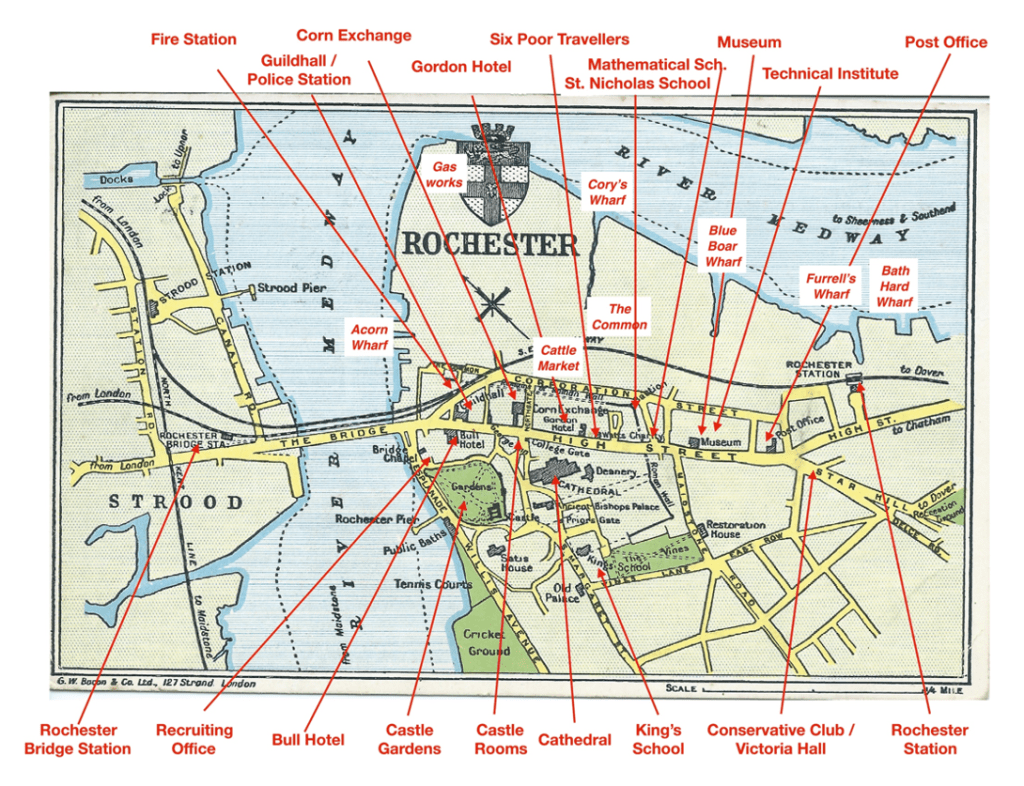
Between December 2014 and December 2018 I submitted quarterly ‘news reports’ for the City of Rochester Society’s newsletter on what was happening in Rochester 100 years previous. This is a compilation of those submitted reports. The other blogs related to particular years, is a compilation of the research that was undertaken to prepare these news reports. This material is perhaps more readable / accessible.
August to December 1914 – Readying for War.
In advance of the declaration of war Rochester Station has been converted into a military encampment. Soldiers are under orders to protect the bridge and tunnel because of the strategic importance of the main line to the continent.[1] The greatest danger at this time though seems to be from the trains with it being reported that Private Michael O’Neill, 19, of the Royal Dublin Fusiliers, was knocked down and killed by a boat express train whilst guarding the bridge.[2]
Within four days of the declaration of war Rochester began to see ‘action’ with the charging, at Rochester, of John Kaltenbach, a German master watchmaker for loitering near a railway arch with a supposed felonious intention of destroying or interfering with railway communication.[3] (5 Aug.) However, a few days later the magistrate discharged Mr. Kaltenbach with the advice to the police that they should not lose their heads even if others are losing theirs.[4]
On 10 August, the Coventry Evening Standard, under the headline “First War Prize in Medway”, reported the capture of the German bargue, Neptune. The ship carrying a cargo of bottles was captured in the North Sea and bought into Rochester. The Captain and crew claimed they were unaware that war had broken out[5]. Five days later another captured German ship, the Eriga, arrived in Rochester where the crew were taken as prisoners of war.[6]
This early wartime activity must have put soldiers responsible for local defence, on a high state of readiness local defences – but perhaps not the police! Failing to respond to the challenge from soldiers guarding Rochester Bridge, the soldiers opened fire on their boat – fortunately no one was hurt.[7]
As if the people of Rochester were not nervous enough a journalist reporting on the “tremendous advance in death-dealing machinery which has taken place within the last few years”, claimed that artillery was now available that could fire a shell from Trafalgar Square and hit Rochester[8] Perhaps to press home the fact that we were now at war an order was passed, under the provisions laid down for districts in which troops are billeted, that required licensed houses in Rochester to close at 9 o’clock[9]– an hour earlier than Maidstone.
The church and local employers quickly implemented contingency plans to respond to the call to arms. “Forty special constables for Rochester [were] sworn in, including Rev. A T Wallis, vicar of Strood, and several tradesmen of the town.”[10] With a view to keeping open the places of two musicians who had been called up, the Vicar of St. Peter’s, Rochester, (the Rev. H. A. Hicken) and his daughter, covered their places in the orchestra that played at the Empire Music Hall, Chatham.[11]
Short Bros, Seaplane works at Rochester, increased recruitment advertising for tinsmiths, sheet metal workers, draughtsman and mechanics. Each applicant had to provide details of their experience and expected wage, applications for Engine Mechanics were also required to state whether they were single or married[12]. (Situation vacant – 14 & 21 Aug. and 10 & 18 Nov.) [This may have been due to the Government’s desire to ensure, during this “emergency”, that priority was be given to employing men with dependents to support. (Hansard 26 August 1914 vol 66 c49.)]
Rev George Barrington Baker, curate of St John’s St Leonards-on-Sea was appointed a minor canon of Rochester Cathedral to cover the absence of the Rev. W E Morgan who had been deployed as Chaplin of the Forces on Active Service[13]. (8 December.) It was also gazetted that Mr. L. Gibbs, one of the teaching staff of Rochester Mathematical School had been commissioned as a Second-Lieutenant in the 8th Battalion of the West Kent Regiment[14].
Tragically there were also reports of lost lives. The Mayor and town clerk of Rochester joined other dignities on 30 November at the internment of 21 victims of the Bulwark disaster [Ship destroyed by an explosion while taking on coal from the airship base at Kingsnorth. 26 Nov.] The funeral procession, which left the Royal Naval Hospital at Chatham [now Medway Hospital] “was a touching spectacle. “Despite the unpropitious weather” large crowds turned out. Fourteen unidentified bodies were interned in one grave; the other seven were buried in separate graves in Gillingham.[15] Captain Herbert Claude Morton, Royal Marines, who also died in the explosion was buried in St. Nicholas Cemetery following a service in the Cathedral.[16]
Earlier it had been reported that Lieutenant Lionel Streatfield Woodgate, son of Mr Ernest Woodgate, former Mayor of Rochester, had been killed in action at the Battle of Mayne on 8th September.[17]
We end this news resume with a report that German aeroplanes have passed within sight of Rochester as they attacked Sheerness docks. The planes were fired upon by troops who were on look-out.[18]
January to February 1915. “Rochester is Rallying”.
I am needing to be careful what is reported as under the Defence of the Realm Act, (DORA) that was enacted four days after hostilities began, I must not communicate anything that may cause disaffection or alarm amongst those serving in the forces or civilians.
+++++
The people of Rochester are rallying to the cause!
The services at the cathedral are “unusually well attended” and a number of social gatherings are being held for the soldiers billeted in the area. Upwards or 120 soldiers were entertained last Sunday in the recreation room of the old post office.[19]
The Council of the Association of Men of Kent and Kentish (21 & 23 High Street, Rochester) have decided to publish a list of their members who are or have taken part in active service and to provide gifts to the crew of HMS Chatham. The ship’s captain, in response to an enquiry from the association[20], advised that the crew would appreciate gifts of pipes, socks and books whilst in warms climates, and scarves and glovers if deployed in home waters.
Voluntary efforts are growing apace in the City. Last Thursday (7 January) a very large meeting was held at the Guildhall to consider the formation of a volunteer training corp for the city to be formed on a democratic basis. When it was stated that every man was to be on equal footing there were loud cheers of hear, hear. It was subsequently resolved that officers would be appointed by a show of hands by the whole corps.[21] On the following Monday another meeting held and several hundred enrolled in the new Voluntary Training Corp.
Excellent progress has also been made in the organisation and training of the City of Rochester Ambulance Corp that was formed shortly after war was declared. Four stations have been established Guildhall, Conservative Club Star Hill, Borstal Cottage, Borstal Road and Strood Work House.[22]
The drive to increase enlistment is being driven in part by a number of cartoons that I suspect are being carried nationally. On 23 January the Chatham Rochester Gillingham News published a cartoon of and father accosting a young man who was courting his daughter with the line – “look here my lad, if you’re old enough to walk out with my daughter, you are old enough to fight for her and your country”.
One must recognise the patriotism of Mr. Fairey an employee of Shorts Brother was keen to join the Fly Corps but who was informed by the Admiralty that his “services as a destructor could not equal his well-known abilities as a constructor[23]. And when Mr Wallace, solicitor, apologised to his Honour Judge Shortt at Rochester County Court, for appearing before him in the uniform of a lieutenant commander of the Royal Naval Volunteer Reserve. The judge responded with “you could not be robed more honourably”.[24]
Less honourably – but perhaps understandable, if not excusable – was the conduct of Private Harry Kid, who was stationed at Rochester and had not returned for duty, who was discovered underneath the mattress of a bed – on his wedding day.[25]
Over Christmas our hospitals did their best to be festive. St Bartholomew’s Hospital, what with having a 30 wound British and Belgium soldiers as patients had decided against the usual Christmas decorations but at the request of the soldiers found some evergreens for the ward. Spirits were also lifted by the sisters and nurses who went between the wards with lighted tapers singing carols. With few adult patients but 50 children, spending Christmas Day in St Williams the staff did their best to celebrate Christmas as usual.[26]
St Bartholomew’s, although benefiting from gifts and cash, is struggling to meet the cost of the additional demand being placed on it. The Matron was pleased to list the gifts she had received for the wounded soldiers; these included cakes and cigarettes from Mrs. Francis and pillows and socks from Mrs Wilson – both ladies from Rochester[27]. As important as these gifts are to the patients, St Barts is in urgent need for funds to meet the increased expenditure necessitated by the war. Provisions have increased in price – as has medication – and due to scarcity of good surgeons higher salaries have needed to be offered.[28]
Rochester Cathedral has made two donations £17 2s 10d and £13 17s 2d following an urgent appeal for funds to support the Kent Voluntary Detachments.[29]
I cannot ignore in this dispatch the losses that Rochester families are experiencing. The papers are listing names, with pictures, if they have them, of men killed or lost in action, and carrying reports as to how the “river towns of Kent” (Gillingham, Chatham and Rochester) had suffered terribly through the war … but noting that the only effect seems to be a strengthening our determination to carry on the war to a successful conclusion.[30]
Col H D’Arch Beaton, Mayor of Rochester, praised the patriotic spirit of the people of Chatham, Rochester and Gillingham following loss of the ships Cressy, Aboukir, Hogue, Pathfinder and Formidable, along with hundreds of brave husbands, fathers and sons. Women and children in the towns are “overloaded with grief”. Col. Beaton reported that Gillingham was most severely affected with 43 women being widowed in one street and 28 in another.[31] (The painting “Live-Bait” commemorating the loss of the Cressy, Aboukir, Hogue, hangs in the Guildhall Museum, Rochester.)
One can’t image the grief that Mrs. Graves, of Gravel Walk, Rochester, experienced when she received a letter from the Admiralty, on what would have been her husband birthday, advising her that her husband, marine Alfred Graves, was presumed dead following the sinking of the Formidable (destroyed in a torpedo attack 1 Jan). She has since received a letter from him that he wrote the evening before the ship went down.[32]
Amongst the tragic stories of loss there have also been reports of great bravery. Particularly we have heard that Private H J Ranger of Rochester who joined the Royal Army Medical Corps, has been awarded the Distinguished Conduct Medal for his gallantry and prompt action on the battlefield. Faced with heavy fire Private Ranger brought in Prince Maurice of Battenberg who had been mortally wounded.[33]
Less serious but nevertheless alarming was the bomb dropped just outside of Rochester at Cliffe. Fortunately no one was hurt and no buildings damaged, but a hole 12 inches deep and several yards in circumference was created in a road.[34]
Sadly there are those who by temperament or circumstances are taking advantage of the current crisis. Elizabeth Whiffen, 15 John Street, was charged with impersonating a soldier’s wife and inducing various ladies to give her money; she pleaded guilty. The bench, not liking to send to prison a woman with a baby in her arms, put Whiffen on probation for a year.[35]
Also before the Court was Geo Davis from Rochester who was committed for trial for hoodwinking a sentry at the gate of Fort Pitt Military Hospital and then going on to steal from the nursing sister’s quarters.[36]
Life though goes on and the Council resolved to increase the size of the Bowling Green in castle grounds,[37] and the cattle market continues in the castle grounds.
Do remember that if you’re planning to travel anywhere by rail do check the train times first. Owing to the demands being placed on the rail network by the military authorities the South-Eastern & Chatham railway has published a revised timetable.[38]
March to May 1915. “The Price of War is Increasing”.
Life and commence in Rochester is radically changing. Large numbers of troops and munitions workers are now being billeted with families across the city – which is increasingly coming under the control of the military authorities. Notices have been published in the press preventing the use of the Medway, east of the bridge, by fishing and leisure craft;[39] this will have considerable implications for those earning a living from fishing the Medway so the Council will be making representations to the authorities see whether any allowances can be made.
Casualties of War
Disturbing news is reaching us about the appalling and distressing conditions in which our prisoners of war are being held. Lord Harris, Vice Lieutenant of Kent, has arranged with Mr. J. Spoor of Rede Court, to establish a fund to assist the men of the Buffs and West Kent Regiments, and men from Kent who are members of other regiments, who are being held as prisoners of war. Of particular concern is the fact that there is not a comprehensive list of who is being held prisoner and where. Anyone with information about prisoners is requested to write to Mr. Spoor. [A list of Kentish Prisoner of Wars published was subsequently published.[40]]
The Association of the Men of Kent and Kentish Men, has also opened a fund that will be administered as an auxiliary to that established by Lord Harris. Particulars can be obtained from, and cheques sent to the secretary, 21, High Street, Rochester.[41]
The mayors of Rochester, Chatham and Gillingham have all undertaken to send provisions and other necessities to men from their towns that are being held as prisoners of war. Amongst the men from Rochester known to be prisoners of war are Rifleman Bennett of the Rifle Brigade, Byson of the Rifle Brigade and Pte Farrer, Royal Scots Fusiliers.[42]
We have continued to receive casualty information. Perhaps the saddest coincidence is that of second lieutenant Nesbit, whose parents live in Rochester. The notice announcing that he had been promoted to a lieutenancy because of his gallantry and excellent service, appeared on the same day as the notice stating that he had been killed during fighting at Radingham, France.[43]
Two more bodies from the Bulwark were found this week in Rochester bringing the total to 100[44]. Another shipping disaster – the sinking of The Lusitania – has also touched Rochester. Although Mrs. Farrier, daughter of Mrs. Bingham of Fort Clarence House, was amongst those saved from the Lusitania disaster [7 May 1915]. her husband and their ten-month-old baby were lost.[45]
German Aliens
There seems to be a persistent and understandable concern about the possibility of German spies being in our midst. Mr. L A Goldie, Adjutant of the Rochester Volunteer Corp, deemed it advisable to meet with members of the Corp to explain that he was not German and that his name is not Goldstein or Goldberg, and that although his mother was German there was no German influence in his upbringing.[46]
Mr. James Bush of Bernard’s Farm Stoke, who runs a lodging house found himself before the Rochester Police Court, for failing to require guests to furnish information to determine if they were aliens. Although the maximum fine was £100 the bench imposed a fine of 9s and gave a week to pay.[47]
Air raids and Disasters
The Corners’ Court in Chatham had to hear the tragic circumstances of a fatal airship accident that occurred at Hoo. 150 bluejackets were involved in hauling an airship down by means of a long trailing rope, when it was suddenly snatched by the wind. All men let go of the rope except for James Standford (23) who was carried up 500 feet. On becoming exhausted he finally had to let go of the rope and fell to his death.[48]
The risk of air raids remains omnipresence with a Zeppelin spotted passing over Rochester heading for the Thames.[49] The Rochester Education Committee has instructed all headmasters to at once dismiss the children from school in case of an enemy air raid.[50]
The Rochester Town Council has attracted some criticism for not showing financial restraint in their decision to purchase land to build a new fire station[51] – the fire station no doubt being required to house the motor fire engine that is to be supplied by Messrs. Merryweather and Sons, for the sum of £1,048. The fire engine will be for the use of the City Volunteer Fire Brigade[52] – a purchase that people may not be so critical of should Rochester experience a fire as a consequence of a bombing raid.
New lighting regulations have been brought it to make it difficult for enemy pilots, who tend to raid under the cover of darkness, to identify landmarks that will help their navigation. The new regulations require the turning off of streetlights and for householders set up blackout arrangements to prevent the escape of light from their windows.
Daisy Holande, wife of a bargeman from Lower Upnor, and Elizabeth Bennet of 11 Dickens Terrace, Wainscott, where both early offenders under these new regulations and they were fined 23s and 20s, respectively, by Rochester Police Court for failing to obscure light.[53]
The absence of lights on Rochester Bridge has been blamed for a recent disastrous collision on the bridge early Monday morning between a motor mail coach running from London to Dover, and a single horse mail coach proceeding from Rochester to Strood railway station to fetch mail. “The two vehicles came together in a terrific crash at the Rochester end of the bridge.” Edward Hodge, driver of the horsed van, was thrown from his seat. “He alighted on his head in the road and fractured his skull”.[54] [Nothing said of the injuries of the horse.]
Courts and Tribunals
Our Courts and Tribunals continue to be very busy enforcing DoRA as well as punishing those taking advantage of the war or failing to support the war effort. The majority of appeals being made to the Local Exemption Tribunals, for exemption from conscription, are being rejected with the best that many men can expected is a deferment in their call-up to allow time to make alterative arrangements. One exception was that of Alfred William Jordon of Rose Street, Rochester, a milk carman. His duties involved moving milk up from the railway station to the creamery. An unsuccessful trial was undertaken involving two women in the moving of the milk. As they were not able to take on this duty the Tribunal gave an exemption to Jordon on the condition that he did not change his job – and should he change his job without notifying the tribunal, he would be fined £50.[55]
One role that women have been able to take over successfully has been that of conductors on the trams from Star Hill. “The appearance of the fair sex on the cars aroused some interest but it soon wore off.”[56]
Pub Opening Hours
Amongst the human sadness generally reported in the Court pages, it was pleasing to find a positive report: At Rochester Police Court the Justice’s Clerk reported that this was the fifth consecutive Court in which there had not been a single charge of drunkenness and remembering the large number of men in the district engaged in war work, that was very credible. The Mayor (Colonel H Breton) agreed and said it was plain that drunkenness was not caused by war. The Mayor thought that pubs closing earlier might be beneficial for the troops but he was not so sure that it benefited the civilian population who he speculated were now drinking at home.[57]
Wartime Profiteering
There is a growing suspicion that some people are profiteering from the war. Reuben Davies a dairyman from Chatham, and another dairyman, Alfred Reeves, were found guilty at the Rochester Police Court for selling milk adulated by the addition of 35% of water. They were fined £2 12s 6d – including costs[58]. The price of gas is also going up across the county. Gas companies supplying customers in Rochester, Chatham and Gillingham have all increased their prices by 3d / 1,000cu ft. They are attributing the increase to the higher price of coal. “The increased price might be due to the war but it is possible that some people are making huge profits at the expense of the consumer.”[59]
The Government, keen to crackdown on the black-market for military equipment, has given punitive powers to the Courts to discourage such a trade. The maximum sentence is now £20 + three times the value of the goods purchased. However, the Rochester Magistrates dealt leniently with Stephen Henry Muggeridge from Strood, who previously being of good character, and claiming ignorance of the law, was only fined 20s for purchasing a regimental mackintosh.
Supporting the War Effort
Our magistrates fortunately showed independence of thought when Rochester & District Laundry Company was brought before them charged under the Factory Act. The firm was accused of allowing two girls to work on Sundays in January, and also late at night on three days in the second week of January. The firm claimed that the girls were willing work the extra hours for which they were paid, in order that the company could comply with inflexible requirements of a contract it had with the Home Office. The magistrates appreciating the effort the firm was making to support the war effort only imposed a nominal fine of 1s and charged only half the usual court costs – £3 in all.[60]
Less patriotically it has been reported that married women are leaving the employment of the laundry because the separation allowance they now receive from their husbands render it unnecessary for them to work.[61]
The Mayor of Rochester presented the members of the (Wolunteer Training Corps) with their War Office Brassards – a red armlet bands embroidered with “G.R”.[62]
An urgent appeal has been made for butchers and bakers to join the Army Service Corp. Enlistment will be for the duration – with pay 8/6 per week and keep all found; a separation allowance will be paid to the families of married men. Apply the Recruiting Officer, Dock Road.[63]
Health Concerns
The city’s medical officer is being kept extremely busy. He has been particularly concerned to put arrangements in place is address the plagues of flies that can infest the city in the summer. The Town Council has appointed an ex-police inspector to supervise the removal of stable manure in the City and to ensure every manure pit in the city is inspected between 1 May and 30 September.[64]
The Health Committee has also received claims from two families for ‘loss of time’ because they had been placed in isolation as a consequence of soldiers being billeted with them developing cerebrospinal fever [meningitis]. The committee was most displeased with this request as the military authorities should have paid the compensation.[65]
St. Bartholomew’s Hospital continues to experience financial problems. It is currently £3,000 in debt and fund-raising initiatives have commenced with house-to-house collects in Queensborough[66]. The situation is expected to worsen with it being estimated that the hospital will need £9,000 next year.[67]
On a lighter note
“A pretty war wedding was held at St Peters”[68] between Miss Elizabeth Haddon, daughter of Mr. and Mrs. Haddon of Roebuck Road, and Captain W. Eric Bingham Gadd, lifted sprits in Rochester. The couple met whilst the groom was stationed in the district. The marriage was expedited as the groom expected an imminent deployment. The groom wore khaki. Mrs. Gadd wore the uniform of the Commandant of the V.A.D hospital at Rosherville, Gravesend. The bride was gowned in Ivory satin with a court train. As the couple left the church they passed under an archway of swords.
Any finally – A parishioner of St Nicholas (Rochester) suggested at a Vestry Meeting that those present should beat the bounds of the parish. Rev. A. Briggs, Vicar, observed, “I think we must beat the Kaiser first.”[69]
1 June to 31 August, 1915.
Anti-German Feelings Continue to Grow
The sinking of the Lusitania and reports of the ill treatment of British prisoners of war, has led to a growing resentment towards Germans who are thought, as previously reported,[70] to still be in Kent. The military were needed to quell a riot that started in Chatham when some drunken soldiers took it into their minds that there were still businesses being run in the town by Germans.[71]
The impact of the Princess Irene explosion[72] continues to be felt across Medway. Members of the Cadet Corp of the Mathematical School have been enlisted to search outlying areas for debris [remains and personal items] from the explosion, and the public have been requested to help with the identification of laundry and other marks on the recovered fragments of clothing.[73]
Of particular concern are the reports of the appalling treatment of 600 Kentish men who are being held as prisoners of war by the Germans. The matter has been raised in Parliament and an appeal for goods and money to alleviate the suffering of the Kentish POWs is being coordinated by Mr. J. L. Spoor of Rede Court, Rochester.[74]
Women of Rochester
An outstanding contribution continues to be made to the war effort by the women of Rochester. An enthusiastic meeting of the Rochester Branch of the National Union of Women’s Suffrage Societies was held at the Victoria Hall. The meeting, chaired by Lady Darnley, heard a talk by Mrs. Henry Fawcett, branch president, on “What women can do during the war”. [Millicent Garrett Fawcett was probably the president of the NUWSS at this time.] A collection at the end raised £4 for the Kent Prisoner of War Fund.[75]
The Executive committee of the Rochester & Strood Women’s Unionist Association also recently met. The committee was pleased to hear that since the association set up working parties in October “for the purpose of making garments for little children who have lost their fathers in the war”, 250 items have been made.[76]
Slackers, Renegades and Profiteers
Sadly though there are some who are not doing as much as they might to support the war effort. The Bishop of Rochester, speaking at Penge, gave a stirring call to national service stating that the burden of war must fall on all – not just our sailors and sailors; during his address he referred to slacking as renegades.[77] There are also some amongst us whose actions maybe undermining the war effort. Amongst many is Frederick Buley (18) from North Street, Strood who was ordered by Magistrates to pay £5 compensation and 6s 6d costs, for absenting himself from work at the Medway Steel Works that is undertaking essential work for Admiralty.[78]
Another instance of adulterated milk was brought before Rochester Magistrates. Alfred Reeves, a milk vendor of 314 Luton Road, who had two previous convictions for a similar offence, was fined £15 for selling milk that contained 25.9% added water. It was stated that Reeves had supplied six quarts daily to the Fort Pitt military hospital. The magistrates reported that they were going to do all that was within their power to prevent the adulteration of milk.[79]
Threat of Zeppelins
The threat from Zeppelin raids continues to grow and in turn undermine the morale of the public. The Secretary of the Admiralty recently reported that a Zeppelin raid took place on the Northeast coast of Kent in which 15 were killed, 15 were wounded and several fires were started.[80] To reduce the chances of an area being targeted regulations have been issued under the Defence of the Realm Act requiring communities to extinguish or obscure all light at night.
John Ford, 14 Roebuck Road, was the first to appear before Rochester Magistrates for failing to prevent the escape of light from his house. He may well have just received a cautionary warning from the police constable had he not sworn at the officer. Ford apologised for his language and because he was the first to be bought before the court, it decided not to convict him – but the magistrates did endorse the actions of the constable.[81] Samuel Osborne of 33 Roebuck Road was not so lucky – he was fined £1 for allowing light to escape from the Rochester Seamen’s Institute[82], but he could have been fined up to £100.[83]
Should there be a Zeppelin raid it is possible that our fire service will not be able to cope with the outbreak of numerous fires. Local businesses should therefore develop their own arrangements. These should include all staff – male and female – undertaking regular fire drills and ensuring that fire buckets are kept full at all times.[84]
Local Impact of the War
Councils across Kent are having trouble in obtaining the tar and stone required to maintain the roads. This is due to the scarcity of craft capable of bringing materials into Rochester.[85]
In order to reduce costs the Council has decided to dispose of the peacocks that live in the castle grounds, and to have their house pulled down.[86]
The Gravesend and Rochester Agricultural Association decided at its general meeting at the Bull Hotel Rochester, not to hold the ploughing match and horse, sheep and root show this year. This was in part due to the lateness of the harvest but also because there are insufficient men and horses, due to the war, being available for the ploughing competition.[87]
The tighter Licensing laws led to Joseph Giles of the Ordnance Arms, High Street Rochester [now the Britannia, 376 High Street] being fined £10 for selling liquor from unlicensed premises – his residence on the opposite side of the road to his pub. Those found drinking were fined 10s each.[88]
Role of Honour
Latent William Edmondson (28), a Rochester Solicitor, was injured whilst fighting alongside two fellow schoolmates at the Dardanelles.[89]
The death toll continues to grow. We have heard that Lieutenant Meyrick Bingham Whistler Smith-Rewse, grandson of the late General G.W. Powlett Bingham,[90] of the Vines, Rochester, was killed in action on 22 May 1915.[91]
Reports have also been received that Sgt. George Kill (21) has been killed in action by shrapnel. Born in Rochester he occasionally assisted Rochester in Kent football League matches and won a number of prizes in Rochester Swimming Club races.[92]
On a Lighter Note
The delayed marriage between John Acheson of Rochester and Miss Florence Phyllis Darling, daughter of Mr. & Mrs. Darling of the Rising Sun Inn [6 Delce Rd] finally took place at St. Peters. The marriage had been postponed as QMS Acheson was unable to get leave. After a short honeymoon in London the bridegroom returned to France.[93]
Mammoth remains have been discovered on Upnor Hills. Dr. Andrew of the British Museum, who is excavating the find, believes it to be the “completest” set of mammoths remains unearthed in England. The tusks measure 9ft in length and it’s believed the animal was 13ft tall.[94]
Rochester also recently hosted what is believed to have been the largest muster of Kentish Freemasons ever known. The meeting of the Provincial Grand Lodge of the Kent Freemasons was held at the Mathematical School in the High Street, and was followed by a banquet in the Corn Exchange.[95]
++++
Further to the report of George Kill being killed in action, we have received additional information from Angela Watson, his Great Niece.
George Frederick Kill, was killed in action on the 1 June 1915. He was one of five brothers from an Army family all of whom were serving soldiers in the First World War; their father, Samuel James Kill re-enlisted into the Royal West Kent Regiment and was based in Maidstone. George’s four brothers returned safely home – his youngest brother, Albert Jubilee, enlisting on the day that George was killed.
“George’s fiancee, Nellie L Upton*, was nursery maid to Dr White’s three children, John, Emily Monica and Mary, where George’s sister Daisy also worked, at 22 Star Hill Rochester – the big white house with double stone steps leading up to the front door. Many years later I remember Monica White, who taught for many years at Rochester Grammar School which I attended, telling me that as a child she remembers Nellie standing at the nursery window reading a letter with tears running down her face.”
Nellie’s subsequent life was also linked with tragedy. Nellie married John William George Sampson at Medway Register Office in November 1915 ; John was the driver of the bus that, on the evening of 4 December 1951, drove into a troop of 52 Royal Marine Cadets Corp, killing 24 of them, in Dock Road. Nellie would then have had to endure the trauma of this event and the subsequent inquest and trial of her husband.
George features in the 1915 display at MALSA.
* Nellie’s registered name was Helen Upton.
1 September to 30 November 1915.
The strain is beginning to show
News reports over the past three months have been distressing and depressing both for those serving at the Fronts and for those at home.
Role of Honour
With a great sense of pride the Executive Committees of the Rochester Conservative and Liberal Associations, sent off Captain Robert N Sebage-Montefiore, prospective Unionist candidate for the city, with their sincere wishes for his safe and speedy return[96]; sadly those wishes did not save him. Whilst commanding the Rochester troop of the Kent Yeomanry at the Dardanelles / Gallipoli he sustained serious bullet wounds to his shoulder and legs,[97] injuries that he died of in Alexandria.[98],[99]
We have also heard that Sgt. Major J. H. Carter (42), who was foreman in the Corporation’s sanitary department, before the war, has been reported as drowned. He and his company were involved in landing at Gallipoli when their ship – the minesweeper Hythe – was struck by another boat; 155 are reported missing.[100]
Great Recruiting Rally
Despite the hardships being experienced on the Front Lines recruitment rallies continue to attract enthusiastic support. Thousands of people lined the streets in Rochester and Strood to witness the start of a great recruitment parade. The procession, led by the band of the Royal Marines, set off from Rochester High Street and made its way to Military Road, Chatham via various streets. A great sense of pride was felt as the streets were filled with the sound of marshal music and the tread of men who had already enlisted.[101]
Rochester can be proud of the numbers who have enlisted. Our schools have supplied a large number of ‘old boys’; 7 masters from Kings and 10 from the Maths school have enlisted, and over 300 men have left Aveling & Porter to fight. The numbers could have been more but for the essential war work being undertaken by this engineering firm, which brought it within the munition workers’ rules which prevents staff from leaving.[102]
The large number of men enlisting is, though, having an impact on services at home. Delegates attending the general meeting of the Chatham, Rochester and District of National Union of Teachers, held at the Gordon Hotel, heard that Kent schools were struggling to cope with the loss of 8,000 teachers who have enlisted. The union did not want special treatment but felt the Government should give Appeal Tribunals instructions to take evidence from Education Committees on the impact of a teacher leaving from particular schools.[103]
In spite of the war the school children had some cause to be cheerful what with the Rochester Education Committee deciding to extend the school holiday by a week, owing to the lateness of the hop harvest,[104] and deciding, because of the lighting restrictions, that schools should close 30 minutes earlier.[105]
The Green-Tented City of Medway
The population of the towns – centred on Chatham – has quadrupled in size as a consequence of the war – the Special Correspondent of the Birmingham Gazette goes as far as to describe Chatham as “a throbbing pulse of the war”.[106] A green-tented village that accommodates an ever-changing population, now stretches miles beyond Strood, Rochester and Gillingham.
To help meet the needs of the troops billeted and encamped in the district Princess Marie Louise of Schleswig-Holstien visited Strood to open the commodious premises known as ‘Ye Olde Bridge Tavern’, located in the high street, as a centre for the YMCA’s work in the area.[107]
Fundraising efforts continue for those serving and who have been wounded
The mayors of Rochester, Chatham and Gillingham are making a joint appeal for money to purchase extra warm underclothing for the Non-Commissioned Officers of the Medway Squadron of the East Kent Rifles. The Medway Squadron under the command of Major Granville Winch, a member of Rochester Town Council, will be part of the Mediterranean Expeditionary Force.[108]
Serious concern continues to be felt for the welfare of the Kent Prisoners of War. A conference was held in Chatham, attended by the Mayor of Rochester, to discuss the arrangements for sustaining regular supplies to the Prisoner of War camps. Mr. Spoor, who is coordinating the Kent effort, stressed the importance of regular supplies that will help prevent starvation and that the men can come expect. Mr. Sills, on behalf of the Rochester Relief Committee, stated that it dispatches between 15 and 20 lbs. to half their 32 men in one week and to the other half the following week.[109]
In addition to flag days a large number of fundraising events continue to be held to raise much needed funds to support the war effort. St Bartholomew’s, for instance, is £3,000 in debt and a house-to-house collection was undertaken between 18 and 25 October during which it is estimated that volunteers called at 40,000 houses.[110]
Miss Gladys Wright, diplomatist, and other lady members of the Medway Swimming Club, put on a demonstration of natation at the Watt’s Swimming Baths to raise funds in aid of wounded soldiers. The demonstration, given by Mrs. Gerald Newcombe and Miss Wright, included plunging and turning somersaults in the water.[111]
A collection at Gillingham Football ground raised over £30 of which £21 12s 10d was given to the West Kent Comfort Fund, £5 5s to St Bartholomew’s and £4 6s to the Maidstone Eye Hospital.[112]
Local auctioneers held an auction in the castle grounds to raise money for the purchase the Star & Garter Hotel, Richmond as a home for disabled soldiers and Sailors – the outcome was though disappointing. Although there was some spirited bidding no sensational prices were fetched. A grand piano was sold for two guineas,[113] and an envelope containing a postal order realised £2 10s – the postal order it contained was for 2s 6d.[114] [In total £135 was raised compared to £702 from an auction of livestock in the Cattle Market.[115]]
Although funds are critical to helping hospitals cope with the increased demand for their services they are also in need of specialist equipment. At a meeting held at the Guildhall it was agreed to use of the workshops of the technical institutes of Rochester, Chatham and Gillingham to make ‘hospital munitions’. These include muffs, mittens, jackets etc., as well as bed-rests, cradles, lockers and special fracture and surgical appliances. Rochester City Council donated £10 for materials to make equipment for the Rochester Hospital. People who would like to be involved in the manufacture of this equipment are invited to visit the workrooms on Saturday afternoons between 2:30 and 4:30pm.[116]
Women feeling the Pressure?
There are an increasing number of reports of drunkenness amongst women as well as street arguments and the use of obscene language. The licensee of the Burnt Oak, Gillingham, was fined £10 at the Rochester Magistrates for permitting drunkenness on his premises. On hearing the evidence the court and police expressed concern about the increase in drunkenness amongst women.[117] This could be symptom of the pressure that women may be under. Amongst the many other court reports, Annie Thompson, wife of a naval warrant officer, of Horsley Road,[118] Rochester, was bought before the court for neglecting her children. She was well provided for financially but was spending too much on whisky and was therefore failing to provide adequately for children. She was sentenced to three months imprisonment. To help alleviate her distress on receiving a prison sentence, the magistrate assured her that her sentence would not entail hard labour.[119] [The reports are silent on what happened to her children.]
Other cases before the Court have involved what could be best described as ‘community disagreements’ resulting in women engaging in heated arguments. At a recent sitting of the Rochester Court, at which the case against two married women from Parr’s Head Lane was dismissed, the Mayor observed that an increasing number of “Rochester ladies are indulging in fisticuffs” and concluded that “it’s a very bad thing and the sooner it is put a stop to the better”.[120]
War Time Austerity
The price of coal is escalating and having failed to come to an agreement with the local coal merchants to limit the profit on the sale of coal for domestic purposes, the Rochester and Chatham Corporations have made arrangements to buy and retail coal.[121]
In pursuance of austerity the Strood Guardians have decided to reduce the size of the Christmas plum puddings for inmates this year from 1lb to 3/4 lbs.; the other Christmas fare will remain much the same.[122]
Public Notices: The Rochester, Chatham and Gillingham Gas Company have asked their customers to advise them if they experience a significant drop in gas pressure. This could occur as the company has been required by the Ministry of Munitions to alter the way it manufactures gas in order that more chemicals essential for the production of munitions, are produced.[123]
Remember to obscure light for your safety and that of Rochester. The Rochester City Police Court continue to hear cases brought for infringement of the Lighting Order brought in under the DoRA.[124] – and no one is immune, Cllr. R. Wilfred Dale, grocer in the High Street, as fined 20s for failing to obscure light despite complaining that others in the High Street are infringing this regulation.[125]
1 December 1915 to 29 February, 1916.
Solidarity and Self-Sacrifice through Necessity.
The Bishop of Rochester in his New Year message referred to the growing strain of war which shows no sign of abatement, and the loss of heroic lives laid down for King and Country. “The war” the bishop said “has been forced upon us by stern necessity; it is our pride that we know how to fight as Christians and as gentleman without cruelty or vindictiveness.”[126]
A Rush of Men
There was tremendous activity around the Guildhall on Saturday (11 December) as over 2,000 men presented themselves, before the deadline [that was extended], to attest their willingness to enlist immediately or at a future date, under what is known as the Derby Scheme[127]. The administrative arrangements put in place proved to be wholly inadequate for the numbers presenting and staff needed to relocate from the offices across the courtyard into the Guildhall, and despite working until midnight they needed to open the office again on Sunday.[128]
Sir Ernest Lamb, our Radical MP, was the first to be seen in the House of Commons wearing an armlet that signified he had attested under the Derby Scheme[129]. Although nationally thousands attested the number was insufficient to meet the country’s military needs so the Government brought forward proposals for conscription in the Military Services Bill; Sir Ernest was one of 36 MPs who voted against this legislation which was passed with a huge majority.[130]
Conscription started on 2 March 1916. Those who believed that they should not or could not be called-up had the right to appeal to local Tribunals.
Our Courts and Tribunals continue to be very busy enforcing DORA as well as punishing those taking advantage of the war or failing to support the war effort. The majority of appeals being made to the Local Exemption Tribunals, for exemption from conscription, are being rejected with the best that many men can expected is a deferment in their call-up to allow time to make alterative arrangements. One exception was that of Alfred William Jordon of Rose Street, Rochester, a milk carman. His duties involved moving milk up from the railway station to the creamery. An unsuccessful trial was undertaken involving two women in the moving of the milk. As they were not able to take on this duty the Tribunal gave an exemption to Jordon on the condition that he did not change his job – and should he change his job without notifying the tribunal, he would be fined £50.[131]
Women Continue to Share the Burden
The two daughters of the Dean of Rochester, Misses M. & P. Storrs, along with Miss M. Hickin, Miss K. Graham and Miss Clare Latham[132] are travelling to Erith from this
district, to engage in shell-making in order that the regular munition workers can have Sundays off.[133]
To deal with the shortage of teachers caused by illness and enlistment, the Rochester Education Committee has appointed a number of married ladies who had formally been teachers [before they married] as ‘supply’ teachers[134]. [The Dundee Evening Telegraph reported on 4 Oct 1910, that the Rochester Education Committee had decided to request all married women teachers in their service to send in their resignations forthwith, and in future no married women were to be appointed on the teaching staff.] In Rochester and Chatham women have been taken on as postmen and teachers as temporary sorters to help with the Christmas post.
Christmas – Nave used for Communion for the first time since the Reformation!
There are proving to be more soldiers in Rochester and Strood wishing to attend Sunday services at the cathedral than can be accommodated; the Queen’s Regiment has therefore been asked to attend St. Peter’s.[135] However, recognizing the significance of worshiping in the cathedral at Christmas extra services were laid on for Christmas Day.
All seven Christmas Day services at the cathedral were well attended and a special 9am parade service was also arranged for the troops. To cope with the large numbers wishing to take Communion a table was specially prepared for the Holly Sacraments which were administered in the nave for the first time since the Reformation.[136]
Prisoners of War
It has been previously reported how badly the Germans are treating our soldiers who have been taken prisoner. This contrasts starkly with the way in which we are looking after German prisoners held in the Rochester PoW Camp. Based on an investigation by an American journalist who visited the camp and had free access to all the prisoners, there are 3,400 prisoners held at Rochester in large barracks which were used by the cavalry before the war. Among the prisoners are 1,000 captured at Loos. The German PoWs said they were satisfied with their treatment, with their accommodation and the quality of food; every prisoner receives daily, half a pound of meat with vegetables, and bread that is “as good as cake”. The German’s manage the internal affairs of the camp themselves under the oversight of one commandant, a couple of officers, some sergeants and about 20 soldiers. (The report includes much more ‘favourable’ information.)[137]
Temperance – A Symbol of Solidarity?
The Bishop of Rochester addressed an inaugurating meeting of the Kent County War Time Temperance Crusade in Tunbridge Wells. The call he said was not anti-alcohol but followed the example of the King in using abstinence as a demonstration of solidarity and sacrifice with those fighting to save our country from invasion.[138]
Although there are continuing concerns about the impact of excessive drinking the Chief Constable reported to the City’s annual licensing committee that in the past year there had been a decrease in drunkenness (29 down from 32 in 1914) even though
there has been a very large increase in the population bought about by the number of soldiers stationed in the district[139]. The Committee also received a report from the Chief Constable advising that there were now 91 ‘on’ licenses in the city including 70 ale houses and 21 beer houses, making one ‘on’ license for every 344 residents of Rochester.[140]
Austerity and Public Services
A number of measures were considered by a special committee of the Rochester Corporation to economise on expenditure. One measure was to require households to burn their rubbish thereby reducing the need for collecting and carting it. The committee also thought that a better system for the collection of rates was needed.[141]
Additional savings will be made by stopping the allowances paid to workmen serving in the forces as their pay now exceeds the wages they received whilst working for the Rochester Corporation[142], and the Education Committee has resolved not to provide desks, pianos, library books or special requisitions for schools in the ensuing year.[143]
There are growing concerns about the state of the county’s roads. W. Banks (Surveyor, Rochester) along with representatives from other councils, met to discuss the problems brought about by the high cost of materials and shortage of manpower to maintain the roads that have suffered extra wear and tear due to military traffic.[144]
Because of the number of difficulties encountered the Rochester Town Council have decided to take no further action in the matter of supplying coal to the poor[145]. It may be of help to readers to know that Wm. Day & Co., 230 High Street, Rochester, is selling a device that reduces the grate size thereby enabling a banked fire to be had with less coal.[146]
There is such a serious shortage of housing in the dockyard towns of Chatham, Rochester and Gillingham that people are offering rewards for the first intimation of empty houses, and a local paper [unnamed] is offering a reward of £5 for such information.
Our hospitals are also facing significant financial shortfalls. The Strood & Frindsbury VAD hospital[147] that is to reopen under its new and reorganised staff, had a budget shortfall of £150. This was, in part, due to the cost of the new operating theatre and equipment costing over £100, and the authorities only allowing 2s / day / man; however I am now pleased to report that the special appeal to the public at Christmas raised the required funds.[148]
As generous as the public has been more money is still required. The Recognised Association of Voluntary Workers at Rochester is appealing for funds as a very large order sent by the War Office for supplying the needs of four hospitals, has used up all the money that it had in hand.[149]
The Disreputable Few
Although few in number there have been a more than one would expect of billeted soldiers stealing from their host families.[150]
Others who are acting disreputable are the men employed in essential industries who fail to report for work or turn up unfit to work; for instance, Fred Couchman and Fred Ellmer, gasmen employed at the Medway Steel Company, were brought before the magistrates, and fined £5 + costs, for ‘neglect of work’ as they presented for work drunk. As a consequence, gas required for the works to operate was not produced[151] and essential production was lost.
Roll of Honour
It is with considerable sadness that we continue to receive information relating to the loss of lives of the inhabitants of Rochester and the surrounding towns – where widows and fatherless children abound. The loss of HMS Natal joins the list of Hogue, Cressy, Aboukir, Hermione, Amphion, Triumph, Laertes and Princess Irene – to name the most prominent – all ships with a Chatham connection.[152] A. Scriver, A.B., of 24 Gravel Walk, was amongst the 343 lost in the sinking of the P&O liner SS Persia. [30 Dec. 1915.] We are currently waiting on news of HMS Arethusa that hit a mine – 12 crew are listed as missing[153]. [Six may have died, http://www.marabese.com/arethusa.%5D
At home, whilst preparing for deployment, Thomas William Cowley was tragically killed after being hit by a bullet whilst undertaking machine gun training in North Street, Strood; Lieut. Dennington who was demonstrating the use of the gun was exonerated from blame.[154]
Notices
- Pte. W Rowe from Cuxton, serving in the 6th Royal West Kent Regiment, is reported as missing. If any comrades in France have any information can they please write to Mr. & Mrs. Rowe, Dean Farm, Cuxton.[155]
- The Rochester Volunteer Training Corp decided at a general meeting to cease to exist as a battalion and to amalgamate with the Gillingham, Chatham and Gravesend contingent. Together they will form the 4th Battalion of the Mid-Kent Regiment of the Kent Volunteer Fencibles. Rochester members will become B Company of the battalion with Mr. L A Goldie in command.[156]
- The South Eastern and Chatham Railway Company have decided to close the Station Road entrance to Strood station so better control can be exercised over passengers going to and from the platforms.[157]
- The posts in Two Post Alley are to be removed as they are seen as a source of danger.[158]
March to May 1916.
War is becoming far from Appealing; Tribunals Busy – Hardship Intensifying.
There are many reports in the papers on appeals against compulsory military service. These news reports form an important historical record as after the war the Government instructed the Local Government Boards to destroy all tribunal material. The appeals reported below were selected to illustrate the anguish that call-up brought to many Rochester people, and the rather harsh decisions and words delivered by the Rochester Tribunal – chaired by the Mayor, Colonel Breton, a retired military man.
Time to Honour the Pledge!
Men who attested are now being asked to honour their pledges but many married men are aggrieved about being called-up whilst there are still eligible single men available to be enlisted. The Medway Branch of the ‘National Union of Attested Men’ held a meeting, in Chatham Town Hall, for married men to discuss their concerns and options. All the men present affirmed their willingness to serve but felt the Government had reneged on its pledge not to call them up until all available single men had been enlisted.[159]
At one sitting of the Rochester Tribunal the Mayor read out an anonymous letter that he believed had been written by the wife of a married man who had taken exception to the exemption that had been given by the Tribunal to several single men who “had told fairy tales”. The Mayor stated that he felt the Tribunal had been chary in all such cases and had only allowed exemptions of six months.[160]
A number of employers applied to the Tribunal for exemption for men they regarded as being essential to their businesses. In most cases an exemption of six months was allowed in order to give them time to find someone who was exempt from military service to fill the role; sole-traders were generally allowed a similar time to sell or make other arrangements to manage their business whilst they served. Mr. F. L. Woolfe, grocer and provisions merchant of North Street, Strood, applied for exemption as he had been running his business singlehandedly since the outbreak of war. Despite claiming that the business provided the sole income for his wife and two young children, and his called-up would result in the break up of his home, closure of his business and financial ruin, he was still only allowed six months to put alternative arrangements in place – or to sell his business.[161]
Conditional exemption[162] was however given to Harry V. Beale and Fred Archer Webb at the request of Mr. William Hillier, dairyman of Eastgate. The Tribunal accepted Mr. Hillier’s evidence that it took three men to lift a churn onto the cart ready for delivery and therefore it was not a job that could done by children or women.[163]
Mr. F. L. Naylor’s was also granted Conditional Exemption on the basis that he was the only undertaker in Rochester. Despite a dentist producing models of jawbones etc., to demonstrate the work he was doing with wounded soldiers, the Tribunal only granted him exemption of six months[164]. The Tribunal, though, was not so sympathetic to the appeal by Mark Miller, an RSPCA inspector, who was not given any deferment as the Mayor did not think an inspector was necessary for Rochester.[165]
Particularly harsh words were delivered by the Mayor to James Charles Henry Little of 141 Cecil Road, a member of the Rochester Baptist Church and assistant master at St Peter’s School. Mr. Little had attested but when called-up he lodged an appeal as a Conscientious Objector stating that he would not even undertake non-combative service. The Mayor, Col. Breton, said, “I have had a pretty well enough of you Conscientious Objectors. It is extraordinary to me how unscrupulous the conscientious objectors can be. He takes a solemn oath to defend the King and abide by orders, and he takes the oath with the distinct intention of breaking it – I have no sympathy with you whatsoever. You will be fined £5 and handed over to the authorities.”[166]
In addition to granting or refusing exemptions, the Tribunal could also remove exemptions and reverse decisions. Frederick Ashby, a postman, was summoned to appear before the Tribunal to show cause why his Exemption Certificate should not be cancelled. He had been exempted for special domestic circumstances but it had now come to the attention of the Mayor that if he joined the Army the Post Office would make his army pay up to his ordinary pay so his mother would be no worse off. The Mayor informed Mr. Ashby that the Tribunal did not think housework was a thing to keep a man out of the Army at this crisis and his certificate was therefore cancelled.[167]
Hardship & Austerity
Prices are escalating and shortages increasing. The poor, particularly, are finding it extremely difficult to keep warm because of the high cost of the little coal that is available. It is reported that some hawkers are selling coal for 2s 6d [12.5p] per hundredweight [50.8kg] and people are eking out what coal they have by means of logs.[168]. In March the Guardians of the Medway Union were extremely concerned for the wellbeing of 600 aged and infirm patients accommodated in the Union, as all the coal had been used and there was none available for them to purchase.[169] [Industries supporting the war effort had priority for the coal that was available.]
Those with the means to purchase coal are experiencing great inconvenience in obtaining it. One merchant in Rochester reported a situation where a woman came from a village some two miles away, and begged for a hundredweight of coal that she then took away in a pram.[170]
Fortuitously the Rochester Education Committee has been able to request a reduced budget of £9,147 for 1916/17, against £9,384 last year, as “there had been no deaf, dumb or blind, and no mental deficiency cases”. To deliver more savings the committee placed an embargo on the purchase of desks, pianos and library books for the year ending 31 March 1917[171] but decided against reintroducing slates, as they can pose a threat to hygiene, and to try harder to make more economical use of the paper that’s still available.[172] [Slates were shared and wiped clean with fingers and spit.]
Public Health Concerns
The appearance of Spotted Fever [meningitis] in the City and the surrounding area, is causing considerable concern. A number of steps have been taken to try and prevent the spread of the disease through the troops and into the civil population. These include moving soldiers from their billets and accommodating them under canvas,[173] cancelling all weekend leave, banning soldiers from places of entertainment, and stopping troops from using public transport.[174]
In order to try to control another nuisance and the spread of disease, the Town Council has declared war of the plague of flies that infest the City in the summer. A scheme has been instituted which requires the regular inspection of the manure pits of the City between 1 May and 30 September. To enable the Sanitary Inspector to undertake all the inspections required of him the Council has granted him an allowance of £10 / annum towards the upkeep of a motorcycle, and one gallon of petrol / week; Five hundred posters are also to be displayed around the City warning people of the danger of flies.[175]
More encouragingly, on the health front, the Trustees of St. Bartholomew’s have reported that £2,028 has been wiped off its deficit. The hospital has managed to increase its income from its ordinary sources, and other fund-raising activities have been particularly successful – including £855 being raised through a house-to-house collection.[176]
Church Services
The Cathedral and local churches continue to respond well to meeting the spiritual needs of the young soldiers who are billeted in the area, and the increased number of people wishing to attend a service. The high attendance experienced at Christmas was repeated this Easter. It is estimated that the service held in the Nave of the cathedral on the evening of Easter Sunday, was attended by over 2,000 worshipers. Fifteen minutes before the service started the cathedral was packed and hundreds were unable to gain admission.[177]
The Bishop of Rochester continues to make special visits to Rochester Cathedral and recently confirmed a number of wounded soldiers and sailors;[178] “it was a touching sight to see men in their blue uniforms and red neckerchiefs (hospital garb) attending a solemn service of the laying on of hands.”[179]
A most unusual Rogation Service was also held in Rochester Corn Market by the vicar of St Nicholas (Rev. W. J. Gray) for the blessing on the crops. It was the first time for centuries that a such a service had been held in Rochester[180] and perhaps recognises the challenges associated with producing the food we need.
Roll of Honour
Sadly it appears that Second Lieutenant Bernard Pitt, a former master at Rochester Mathematical School, who had been officially reported as missing, may have been killed in a mine explosion; he was 34 and leaves a widow and four children.[181]
Sergeant A. E. Whattler who was the assistant master at Troy Town Council School before the war, was wounded in the chest on the Tigris. In a letter home to his wife he wrote, “They are only boys but they die like Englishmen and heroes”.[182]
The steamer City of Rochester, owned by the Rochester City Steamship Company, was sunk off Southwold, along with its cargo of around 1,700 tons of much needed coal. It is not known whether it was torpedoed or hit a mine, but fortunately the captain and all but one of the crew survived.[183]
Notices
- The Women’s War Agricultural Committee[184] is to hold demonstration of women’s work at Coombe Farm, Tovil in order to demonstrate that women can take on the tasks previously undertaken by men. The demonstration will include milking, hedge-cutting harnessing & driving horses, use of cultivators, ploughing, preparing seed beds, and planting cabbages,[185] any women wishing to be involved should contact the organisers.
- The Dean & Chapter have announced that they will not allow anymore brasses to be placed in the Cathedral as there is already a great number and there will probably be many more before the war is over.[186]
- The Nore Command has advised that from 1 May 1916 the cruising of yachts and pleasure boats will be permitted (amongst other places) in the Medway east of Rochester Bridge.[187]
- The Rochester fire brigade require firemen who must be capable of driving a Petrol Motor Fire Engine. Wages 35s / week plus uniform.[188]
Happy Times!
In amongst the doom, gloom and austerity of war, it is pleasing to see that the people of Rochester find time to enjoy themselves. Our spirits received a real patriotic lift on Empire Day [24 May] when for the first time since the day was inaugurated, the Union Jack was flown – by order of the Government – from all public buildings. The day made for many bright celebrations in the schools around Rochester[189]. The event, held at Rochester Parish Church and attended by 300 children, aimed to ensure the “children realised the vastness of our world empire and the responsibilities which will devolve to them inviolate.” The infants received a rousing cheer for their song ‘Our Flag’, whilst the girls very devoutly sang a war hymn and the boys gave a very hearty rendering of “Rule Britannia”. In the addresses old St. Nicholas boys were remembered who were serving in the trenches and special reference was made to William Lawrence, bomb-thrower, who had been awarded the DCM.[190]
And there have been weddings. The Rochester firemen attended the marriage of Thomas Alfred Fowle, one of their comrades, to Faith Louisa Hayes, at the Rochester Baptist Church. As the couple left the church they passed under an archway of crossed axes. It was apparently the first wedding of a fireman for 20 years in Rochester.[191]
A military wedding took place at St. Peter’s between Capt. W. E. Bingham Gadd of Rosherville and Miss E. V. Hadden, eldest daughter of Mr. & Mrs. T. Haddon of 41 Roebuck Road. The bride wore a dress of white satin with a court train, and carried a bouquet of lilies and heather. The couple passed under an archway of crossed swords as they left church, and were then towed in a car, by a team of NCO’s, back to the bride’s parents house for the reception.[192]
June to August 1916.
The City Mourns but the Support of Women and Children Remains Steadfast.
A Nation Mourns
Along with the rest of the Nation, Rochester was shocked to hear the news that Lord Kitchener, Secretary of War, had died on 5 June, in the sinking of HMS Hampshire. A service to commemorate his life and all who had perished at sea, packed the Cathedral to overflowing.[193] By coincidence, this service was the first ceremonial occasion for the new Thames and Medway Battalion of the Kent Voluntary Fencibles battalion, that had been formed from the merging the Gillingham, Chatham, Rochester and Gravesend battalions. About 300 officers and men attended the service. The battalion, including drums, signals and cyclists, first paraded on the high ground by Fort Pitt hospital before marching behind the Battalion’s band to the Cathedral. A Gravesend member of the Fencible wrote: –
“R-r-r-oll – crash; r-r-r-oll – crash, went the drums and then the haunting strains of Handel’s Death March floated through the nave and aisles of the ancient Cathedral of Rochester. We, the members of the Thames and Medway Battalion. K.V.F., rose in silent respect to the memory of the late, great chief, Lord Kitchener.”[194]
The Mayor (Col. H. D’Arch Breton, late R.E) at a meeting of the Council, reminisced that Lord Kitchener was his senior by a year and that they were together both at Woolwich and at Brompton Barracks. “In those days there were no outward signs of the potentialities of character that produced such splendid fruit. The Mayor went on to say that he had the superstition that every man had a chance given to him and if he could not profit from it, it was through his own faults or defect. Herbert Kitchener had his chance in being posted to the Palestine Survey, which bought him into contact Charles Gordon, another great general of Engineers, and from that small beginning he developed into the giant that we had known and lost”.[195]
Military Service Tribunals
The Rochester Tribunal continues to be busy hearing applications for exemption from conscription into military service. However, dissatisfaction is increasingly being expressed about the differences in some of the decisions made by the Tribunals of Rochester, Chatham and Gillingham. It has therefore been decided to review all previous decisions with a view to securing equality of treatment of those exempted from military service;[196] this could result in exemptions being withdrawn.
When Mr. Edward Percy Leonard [of the Leonard’s department store] applied for exemption he asked if his application could be heard in private. The Mayor stated he saw no reason for this and had particular reasons for hearing the application in public. Mr. Leonard, proceeding, said he was one of two partners and had control of 14 out of 27 departments. The firm now had 101 assistants and only 14 were male. Six of their staff were serving in the army and receiving their full salary. The Mayor here remarked this was one of the reasons he wanted the hearing in public as he wanted to congratulate Messrs. Leonard for the example they set in the matter of employing women. Mr. Leonard was given six months’ exemption and was advised that he could apply again in six months, but Mr. Craske, (military representative) said “I hope you won’t have to.”[197]
[Simon Shreeve of the Old Roffensian Society, advised that following Edward Percy Leonard’s application to the Tribunal for exemption from military service, he went on to serve in the Royal Engineers in the Great War. There is also a photo, held by MALSC, of a Leonards of Rochester motor van complete with lady driver. Edward Percy Leonard attended King’s School, Rochester between 1893-94, and went on to become the Chairman of Leonards (Rochester) Ltd in 1945. He died in 1954.]
Some rivalry was evident at the Rochester Tribunal between the Guardians the Strood and Medway Poor Law unions. Guardians of the Strood Union applied again for exemption for Albert John Croomer, labour-master and general assistant, in the Union. The Guardians stated they only have three male officers to manage 100 casuals who pass through the workhouse each week. Mr. Craske (the military representative and member of the Medway Union board) said “you must treat them very much better than we do as we only have half that number.” Mr. Povey, for the Strood Union, replied “You don’t give then gruel, perhaps; we do”; the Mayor, another member of the Medway Board, stated they do give gruel in the winter. The Tribunal allowed an exemption of two months.[198]
Patients of St. Bartholomew’s will undoubtedly be pleased to hear that Alfred Edward Onslow, 40, hairdresser of Rochester High Street, was given conditional exemption on the grounds that he attends the hospital daily to cut their hair.[199]
Austerity and Economy
The increasing cost of food is not just troubling the poor. Since the start of the war the purchasing power of the sovereign has reduced by between 33% and 35%, and the situation is bound to get worse as the war continues.[200] The Medway Guardians have passed a resolution in support of an appeal made by the Newcastle Board, to the Government to regulate the price of food;[201] the Medway Guardians also successfully applied to the Local Government Board for permission to buy coal other than by contract [202],[203], but their local efforts still failed to secure the amount required.[204]
The Frindsbury/Strood VAD hospital is also facing financial difficulties as a consequence of the increased cost of food and the inadequate funding they receive from the Government when patient numbers are significantly reduced. Although patient numbers might be down the staff costs remain the same, and in the winter the cost of heating a ward of five men is the same as if there were 50. Although the expense of running the hospital is £83 more than the Government grant the managers are determined to retain capacity as it will be vitally important in dealing with emergencies.[205]
There is some good news, though. The Rochester, Chatham and Gillingham Gas Company will be reducing the price of gas by 2d from the quarter ending 30 September [206] – perhaps because of a reduced salary bill as 66 of their men have enlisted.[207] Rochester police officers are also to receive a pay rise on account of the increased cost of living.[208]
The Corporation is hoping to support the war effort and realise extra income, with the Hobb’s Paper Baler that they have purchased for £32. Once it has been delivered the Corporation will start waste paper collections.[209]
Community Effort
There has been a generous response to the appeal for “eggs for our wounded Tommies”. The parish of Snodland heads the list of contributors, having donated about 500 eggs; Mrs. Rowe, the Chief Organiser at Rochester, has written to Miss Lamb, the local organiser, thanking the parishioners for their generosity. Luton is currently the second highest donator of eggs.[210]
The directors of local voluntary organisations continue to make “heavy demands for comforts on the patriotic ladies in Rochester”, so in order to raise funds to purchase the materials necessary to make the required garments, a concert was given at the Gordon Hotel. The event was to be held in the beautiful gardens of the hotel but due to heavy thunder showers[211] the concert was held in the hotel’s Japanese Tearoom. The concert was notable for two reasons; the introduction to the public of little known local performers, and the plenitude of food – that included strawberries and cream -prepared by the ladies and served in the interval. Three hundred attended the concert – but many more purchased tickets. After the storm it was possible to stroll on the lawn in the cool of the evening.[212]
The children are also making an enthusiastic contribution to supporting the war effort. Many pupils from the local elementary schools supported the fundraising day organised for the Strood VAD hospital. One party from the Infant’s Council School in Gordon Road, Strood, delivered their contribution in costume, “there being a sailor, a soldier, a Boy Scout and two charming little nurses; there were loud cheers as they handed in their gifts”.[213] The girls of Troy Town Council School held a sale of their work which raised £4 2s 1d for the relief of Belgium children, and a collection held in the boy’s department raised upwards of £2.[214]
Roll of Honour of those who serve, and those who have given their lives.
Amongst a distressingly long list of Kent men lost in the North Sea battle [Jutland], was Acting Sub-Lieutenant T. H. Cobb (19) of HMS Invincible; he was the ninth surviving son of Mr. Herbert M. Cobb, of Mockbeggar, Higham, Rochester, and who had only became a midshipman on August 2, 1914.[215] [All but six of the crew of 1,032 officers and men were lost in the sinking of HMS Invincible.]
Amongst this loss we can, though, all share in the pride of Mr. & Mrs. J. D. Beany, 38 Station Road, Strood who have four sons serving, two of whom have won distinctions for gallant conduct and good service in the field. Cpl. Frederick Beany of the Army Cyclist’s Corp., was awarded the Distinguished Conduct Medal for carrying messages under heavy gun and rifle fire, and Cpl. Ernest Beany, Royal Garrison Artillery, was awarded the Military Medal for taking charge of his detachment after the officer was killed and three men were seriously wounded. When he was relieved he had been without sleep for three days and three nights. The other men of the battalion received a large box of cigarettes from the General.[216]
The Dean & Chapter of Rochester Cathedral have decided to reserve the one window in the Lady Chapel, that is still to be filled with stained glass, to be a memorial to old boys of the King’s School who have fallen in the war.[217] The window will cost 200 guineas and £40 has already been raised.[218]
And it not just those in the military who are paying with their health and life. An inquest held in Rochester, into the death of a young woman aged 20, who worked in the munitions factory, found that her death was due to acute atrophy of the liver caused by TNT poisoning contracted during her employment.[219]
The ‘Disreputable’
Surely, John Bates, a milk seller of Rochester, deserves a disreputable mention. He was only fined £10 for supplying milk with 15.8% added water – despite having been convicted of a similar offence the week before. It was also mentioned in Court that he had also supplied milk to St. Bartholomew’s hospital containing boric acid which Dr. Pritchard, medial officer, stated presented a great danger to those who may have drunk the milk.[220] It is clear that the selling of adulterated milk, either by adding water or the abstraction of cream, is extremely lucrative and a growing problem that impacts on the health of the Nation – so why are the magistrates treating these offenders so leniently?[221] [Boric acid was used to remove the sour taste and smell from milk that had gone off.]
Notices:
New Alcohol Regulations: An order has been made under the Defence of the Realm Regulations, 1915, to bring Rochester and Canterbury under the regulations that control the sale of liquor.[222] These regulations enable the local authorities to close premises that serve alcohol, limit opening times and require the alcohol content of beer sold in their areas to be reduced. A ‘no treating order’ was also passed which makes it an offence in Rochester to buy drinks for others or to loan them money to buy a drink.
Life Goes On:
There was considerable excitement when the City took possession of the latest Merryweather petrol fire engine that is capable of 30-40mph on the level, and can cope with gradients as steep as 1 in 5. It is fitted with 1,000 feet of hose as well as a lifesaving ‘Sliding Carriage” that is capable of reaching a height of 50ft. [223] Unfortunately no one applied for the position of Fire Engine driver so it was decided to appoint Mr. Herbert W. Woods, secretary of the volunteer Fire Brigade, and pay him an honorarium of £10 / annum.[224]
A pretty wedding was solemnised at Rochester Baptist Church, at which Mr. Walter James Lewington of Napier Road, Gillingham, married Miss Evelyn Clara Hughes the only daughter of Mr. & Mrs. H. Hughes of the Black-moor’s Head, [5] King Street, Rochester. “The bride looked charming in her dress of crepe-de-chine, trimmed with shadow lace and lined with Ninon. She wore a tulle veil and orange blossom and carried a bouquet of white roses and lilies-of-the-valley. After the ceremony a reception for 70 to 80 persons was held at the Tea Table Cafe in Rochester High Street”.[225] [79 High Street. Subsequently Carlton Oriental Café, later Patrica’s Pantry.[226]]
September to November 1916.
A sense of desperation is developing for farmers and the military alike.
A stalemate seems to have set in at the Front but the number of casualties continuing to increase. In an attempt to break the deadlock, and no doubt to replace ‘lost’ men, the military is pressing for less men to be granted exemption from military service. The Strood Tribunal has received a letter from Brig. General Campbell-Geddes, Director of Recruiting, stating that all men whose call up has been deferred until 1 January 1917 are to be called up immediately, and that no further applications for the renewal of exemptions should be accepted; the letter though also emphasised the need to ensure farms are not denuded of labour.[227] Lieut. Pickard, Recruiting Officer for the Rochester District, attended a meeting of the District’s Farmers’ Union at the Kings Head to explain that the Government intended to have all men under 30 years of age for the Army, but so far as is possible they would be substituted with men, under the substitution scheme, “who would be fairly decent men, not discharged invalids, but men who, although able-bodied, were, through some physical defect, not fit for the trenches”.[228]
As if to ensure we are left in no doubt as to the efforts being made at the Front, the National Electric Theatre (205 High Street, Chatham) showed four times a day, for a week, the film “Battle of the Somme”. Those who saw the film readily recognised that the written word only conveys a limited picture of the war compared to “kinematography” that brings before our eyes the “terrible, saddening yet glorious realities of war.[229] (This film can be found on YouTube.)
To provide some comfort to those serving on the Front Line families may wish to send parcels to their loved ones. If you need advice as to what to include you can consult G. A. Morris, 24 High Street, Rochester, who stocks useful products such as flasks that are guaranteed to keep liquids hot for 24 hours, lamps and hot water bottles.[230]
Threat from the Skies
Bombing raids continue to trouble us in Rochester and although it’s possible to insure against personal injury caused by Zeppelin attacks, Rochester magistrates believe prevention is better than cure and are determined to ensure the City is kept in darkness. John Byrob, 91 John Street, may therefore feel he was fortunate in only being fined £5 for failing to prevent the escape of light, on 25 September, from the Rochester Cooperative Bakery in George Lane – while an air-raid was in progress![231] Despite the Bench’s intention to enforce the ‘blackout’ they dealt sympathetically with Walter Poynter, 32 Five-bells Lane, who was also before them for failing to obscure light and for being abusive to the Special Constable who asked him to put the light out. Mr. Poynter explained that on the morning of the offence he had received news that he had lost a second son at the Front. In the circumstances the Bench dismissed the case against him on the condition he paid the 4s Court costs.[232]
It is comforting to know that the City of Rochester Division of St. John Ambulance Brigade maintain a constant state of readiness to deal with casualties that may be caused by an air-raid. The Brigade has four stations across Rochester – Guildhall, Conservative Club, and the Borstal and Strood Unions. Each is equipped with stretchers, bandages and dressings, and members regularly attend lectures on first aid and undertake weekly drills in stretcher and bandaging work.[233]
With the threat from the sky being so great, it was tragic to hear of a seaplane accident that resulted in the death of William Hodgson (24) a Petty Officer mechanic of the Royal Flying Corp, who drowned off Grain when his machine nosedived 100ft into the Medway near Cockleshell Hard. The pilot, Flight Sub-Lieut. Mostyn Lewis, survived the accident, as he was thrown clear, but he’s so shocked he has not yet returned to flying.[234]
Price of Food
The scarcity of food is pushing up prices. Mr. W. Cobbet Barker of Bryant House, Rochester, and a member of the Kent Agricultural Committee, believes the most significant reason for our food shortage is the shortage of labour due to not being able to recruit sufficient women to help with the harvests. He put this down to the separation allowance paid to women whose husbands are serving, and thereby removing the need for them to work outside of the home. Another reason offered is that the yields are poor due to not having sufficient access to manure and machinery.[235]
This may well be borne out by the case of Felix Bourne, a dairy farmer from Borstal and Chatham, who was charged before the Rochester County Police Court with selling milk 16.6% deficient in fat. In his defence he claimed that the milk was sold exactly as it came from the cows. He explained he kept 92 cows on marshy ground and, owing to a shortage of labour, they had been left out during the wet and chilly nights, and they had not been milked as they should; these circumstances he explained, affected the quality of the milk – the magistrates accepted this explanation and dismissed the case.[236]
Despite concern being raised by some Guardians of the Strood Union, it was agreed that the Relieving Officer had acted appropriately in increasing the payment by 1s / week to meet the higher cost of food and fuel.[237]
Roll of Honour
Families across Rochester are receiving tragic news. These include, amongst many:
Mr. & Mrs. Fancett, 53 Rochester Avenue – their son Pte. Robert Fancett (23) died of wounds received in the Battle of Loos, France. He joined up at the commencement of the war and has two brothers fighting on the front line.[238]
Mr. and Mrs. George Randall of the “Forstall”, Patterns Lane, who lost their only son, Gunner Gordon Randall (20). He was educated at the Maths School and was a fitter apprentice at Aveling & Porter. Gordon was called up shortly after the start of the war and had been on the Front Line since last Boxing Day.[239]
Dr. and Mrs. A. Packmans of Grove House, Maidstone Road, Rochester, heard their eldest son, Lieut. Tom Packman, who had been on the Front Line for two years, had been killed in action.[240]
Mr. & Mrs. George Weeks, 55 Gordon Road, Strood, have been notified that their eldest son, Corp. Fred Weeks, died of wounds in a Clearing Station in France. He enlisted in 1911 and was part of the original British Expeditionary Force that landed in France on 8 Sept. 1914. He served without a scratch until he received the fatal wound.[241]
Mr. & Mrs. W. Weaire, Bryant Road, learnt that their son died in hospital back in May whilst being held as a Prisoner of War in Bagdad.[242]
Mr. & Mrs. J. Brand, 78 High Street, Rochester, are anxiously waiting for further news of their son, Rifleman Harrod Brand (23), who was reported as being wounded in action. He had been a cathedral chorister for eight years and became the organist at Newington at the age of 16. [243]
And in memory of Cecil Fearnley, a son of one of the lay clerks, who was killed in action in May 1915, a stained glass window has been placed in the south isle of Rochester Cathedral. The window contains a figure of a young David playing a harp.[244]
It is becoming evident that lasting injuries are not always physical. Amongst a recent list of the wounded was Pte. G. Bishop, of Rochester, who was listed as suffering from “Shell-Shock”;[245] and a Rochester inquest found that Pte. Whitmore, who had been severely wounded, was suffering from temporary insanity when he shot himself whilst on sentry duty.[246] [Interesting to note the term shell-shock was used in the press in 1916. Sources, such as the BBC, state it was not until 1917 that the term was coined by Dr. Charles Myers.]
Honoured for Bravery
Company Sgt. Major A. F. Smith who is currently home on sick leave at 65 Cecil Road, has the rare distinction, for a warrant officer, of being awarded the Military Cross. Before the war he was a most popular Sergeant Instructor at the Math School. Although the army had no claim on him he was one of the first to volunteer his services when Lord Kitchener called for old NCOs to enlist. The action that led to this award involved Sgt. Major Smith advancing with his company in an assault and killing three of the enemy found in a captured trench. He then, after his officers had become casualties, and despite himself being injured in three places, took command.
Although details are yet to be published we have heard that Capt. Cecil Cloake from New Road, Rochester, has been awarded the Military Cross for conspicuous bravery at the Front Line.[247] [This may be Cecil Stedman Cloake who was educated at the Maths School, and who was awarded the MC for reorganising two companies who had lost their officers, and “by his cool pluck restored the confidence among the men at a critical time”.]
With an Eye to the Future?
The Kent Education Committee has agreed, subject to funding being found, to establish a Craft School in Rochester to provide short courses of training in certain kinds of work, for sailors and soldiers who have been disabled in the war.[248]
As a consequence of the low birth rate the Government is concerned to tackle the high level of infant mortality. The Rochester Health Committee after considering a report on their child welfare services, concluded that in the present circumstances they could only approve two additional visits being made by a nurse to infants, at the end of the 5th and 8th months.[249]
Notices:
The Rochester Recruiting Office has moved from the Old Post Office into the Conservative Club on Star Hill. In turn, the Conservative Club has moved into the Bull Hotel; these changes “were made possible by the patriotic spirit and courtesy of the Committee of the club”.[250]
The Council, having now purchased a horse & cart from the Rochester Laundry Company for £50, are ready to commence the collection of waste paper.[251]
The Rochester Town Council have passed closing orders in respect of drapers and milliners, furniture dealers, pawnbrokers, tailors and outfitters requiring them to close at 8pm., except on Fridays when they need to close by 1pm; on Saturdays they must close by 10pm.[252]
Amongst the Gloom:
The postponed bank holidays were, in Rochester, taken on the 9th and 10th October. To celebrate the holiday, Leonards Department store held a “Great ‘before the holiday’ shopping week”, during which there was a special display of new fashions – in the new shades of Russian Green and Bordeaux.[253] Leonards are also to hold a special sale to entice early Christmas shoppers – in the ladies underwear department they will have on offer 80 dozen fine quality Marino combinations.[254]
Weddings continue to lift our spirts. A pretty wedding between Miss Elizabeth Alice Arnold of Richard Street, and George Grieveson of Cecil Road, took place at St. Peters. The bride was charmingly attired in white crepe de chine and Ninon bodice, and wore a wreath of orange blossom and a veil.[255] And at St. Nicholas, Strood, the marriage took place between Bombardier William King from Berkshire and Miss Alice Wilmore Hancock, the eldest daughter of Mr. Charles Hancock of 90 Gordon Road. The groom, who had just recovered from a war wound, wore khaki, and the bride wore a smart costume of saxe-blue with a silk hat to match, and carried a beautiful bouquet of white lilies and azaleas.[256]
And Finally:
A Rochester Brewer’s Drayman named Farrer was fined £2 for stealing beer from a barrel by sucking the liquor through an India-rubber tube – an operation known as “sucking the monkey”.[257]
December 1916 to February 1917
The drastic measures to maintain the Front Line are causing problems at home.
The drive to send every able-bodied man to war is creating serious difficulties for maintaining services at home. Employers are finding it increasingly difficult to fill positions and there are pages of small ads for positions to be filled by women, men ineligible for service or discharged service men.
All men under 31 who are medically fit and have been exempted on the basis of the work they were doing was of national importance will now be called-up. All lads on attaining the age of 18 will now be called up immediately and not at 18 years 7 months as at present – but they will still not be sent to the Front Line until they are 19.[258] The Mayor advises all employers to get their men medically examined to determine whether there are medical grounds for exemption as any man coming before the Tribunal who has not been medically examined is likely to be regarded as ‘fit for service’. This suggestion was not well received by 130 men at the works of Messrs. Aveling & Porter who refused to be examined by the Military Medical Board on the grounds that they were exempted by their Trades Union under the trade card scheme[259] which allowed certain ‘craft unions’ to grant their members exemption from conscription.
Mr. Corbett Barker, from Rochester and member of the Kent War Agricultural Committee, is highly critical of the decisions being taken by the Appeal Tribunals which he says are blindly following the edict that the military’s needs are paramount. He believes at a time when every ton of food is vital it makes no sense to remove more skilled men from the land.[260]
Roll of Honour
A most distressing, closely printed, page has appeared in the Kent Messenger under the heading of “Kent and the War”. The page lists the names of hundreds of Kent men who are lost, wounded or missing.
News has been received that Sgt. A. Little (24) of the Royal Fusiliers, whose home was 197 High Street, Rochester, has died of his wounds in France. He had gained a Kent County scholarship to the Maths School, and enlisted in November 1914. He married Miss Hillier from Rochester in July 1915 and proceeded to the Front in November 1915.[261]
Mr. E. B. Wood of Rochester has heard that his only son, Second Lieut. E. P. Wood, is laying in Havre dangerously wounded – but who is perhaps still alive because of the assistance provided by German soldiers. Although wounded in both thighs and having a compound fracture of the right thigh, Lieut. Wood managed to crawl into a shell hole where he laid for a day in the rain. He was later rescued by the Germans who took him to their lines, dressed his wounds and left him in a dug out. Following a further battle, the British took the German trenches and found Lieut. Wood in a dug-out.[262]
Although not yet officially confirmed it is understood that PC. Eve, a member of the Rochester City Police Force, and who was called up from the Reserve early in the war, has been killed by a German shell which burst just as he was leaving the trenches to return home to England on Christmas leave.[263]
Such is the demand to publish memorials and with space being limited, the Kent Messenger has decided to place a charge of 2s 6d for the insertion of a picture of a man killed in action or missing[264]. Those mourning the loss of loved ones may, though, like to know that a new war shine has opened in the Jesus Chapel at Rochester Cathedral.[265] [This chapel was located in the North Transept, near the fresco.]
Reception of the Wounded
The services at home for caring for the wounded are fully stretched. Dr. Ind (District Medical Officer) provided a very satisfactory report of the ambulance work of the brigades in the past year – specifically mentioning the unloading and transportation of the wounded at Folkestone, Tonbridge, Chatham, Gillingham and Rochester. Around 2,600 wounded soldiers had been received at Chatham during the year and moved to hospital by motor transport. This was in addition to those moved by the VAD detachments who moved between 6,000 and 7,000 men from the ambulance trains and Fort Pitt hospital.[266]
Fortunately, the Strood VAD has returned to full capacity following the closure for renovation of the Darnley Ward. The ward is now looking resplendent – the new coverlets give a bright clean and charming effect, whilst the new mattresses form a most helpful and comfortable addition. Thanks are offered to a very long list of friends and donors.[267]
Christmas
The third Christmas of the war has come and gone. As in previous years the chief delight of the children of the Gordon Road, Infant School, Strood, has been making plum pudding for wounded soldiers. This year ten huge puddings were made on the school premises. The ingredients were provided by the parents of the children. The puddings went on display at the annual Parents’ Day after which five were sent to the Strood VAD and five to St. Bartholomew’s Hospital.[268]
The inmates of the Medway Union had a better Christmas than they would have had had members of the Gillingham Free Church had their way. Fortunately for the inmates the Guardians regarded the letter from the Free Church, that expressed deep regret that the inmates of the Union were to receive beer at Christmas, as ‘piffle’ that should be ignored’.[269]
Christmas at St. William’s Hospital was spent quietly but none the less very happily. The wards were most prettily and tastefully decorated and all the usual fare was provided. The stockings that were hung up overnight were found to be overflowing with toys and gifts on Christmas Morning – Santa Claus having visited everyone with his usual generosity! On all wards the nurses strove and succeeded in providing the amusement for patients of all conditions.
At St. Bartholomew’s the nurses at 5am heralded Christmas Day by going from ward to ward singing carols. Despite the war the dinner did include turkey and Christmas Pudding. All the wards were tastefully decorated but the two military wards, that accommodated 58 soldiers, were particularly well done out in this respect.
The staff and friends of Fort Pitt and Drill Hall hospitals also did everything possible to enable the 500 or more, patients enjoy the spirit of Christmas, and the men staying in the Travellers’ Rest [Six Poor Travellers] enjoyed the usual roast beef, plum pudding and coffee, and went on their way with 1s 10d. The men also received gifts of a pipe, tobacco and matches donated by friends.[270]
There was perhaps no brighter or happier spot this Christmas than the Soldier’s and Sailor’s Institute at 119 High Street, Strood. It was, though, not so festive for the 190 inmates in the Strood Union. It appears that due to the shortage of labour it was not possible to decorate it to the same standard as in previous years and the food although wholesome, was not up to the usual standard due to higher prices.
What will the New Year bring?
In response to the Germans petitioning for a cessation of hostilities the Bishop of Rochester in his New Year message, encourages the Nation not to enter into peace discussions as offered by Germany and her allies. He recognised that instinctively we want an immediate end to the miseries of war but felt a more substantive peace is required than would be offered by a mere suspension of hostilities as that would not deliver a guarantee of a continued peace – to achieve anything less he believed would be a betrayal of our heroic dead.[271]
Amongst those thinking of the future, once the war has been won, is the Salvation Army. They are aware that the number of widows is increasing daily and that after the war when the munition factories close, thousands of women will be left without employment. To help women consider their options a presentation was given at the Salvation Army Hall, Chatham, on General Booth’s widow’s migration scheme. Before the war there was an excess of 1.25 million women in England and one of the great ideas of General Booth was to find an outlet for some of the surplus women in our Colonies – particularly Canada. The Salvation Army now believes that this scheme could be usefully extended to help women who after the war will find themselves without support, to start a new life in the dominions.[272] [The Salvation Army Archivist advised that 1,769 women and 1,019 children UK-wide sailed under the Women’s Migration Scheme which ran from 1916-1923 – but all records were lost when the building housing them was bombed in 1940.]
Recreation
Concerns about the availability of alcohol and disorderly behaviour seem to be unfounded in Rochester. The Chief Constable reported to the Licensing Session that there were 69 ale houses and 21 beer houses in the City making one ‘on’ license per 348 of population. Despite the opportunity to drink there has been a 50% reduction of people charged with drunkenness compared with 1915. During 1916 only 46 persons had been charged with drunkenness and only 16 were resident, and only one was a solider. Perhaps one can wonder whether this improvement can be attributed to the increased number of licensed premises now being managed by women, whose husbands are at war, as there was not a single complaint about the houses managed by women.[273]
The leasee of the Corn Exchange cinema requested permission to open from 8pm to 10pm on Sundays to provide entertainment for the many hundreds of soldiers who are billeted in Rochester and have little to do on Sunday evenings other than to wander the streets. By a vote of 9 to 6 the Rochester Town Council decided, for the sake of the soldiers, to allow the cinema to open on Sundays between 8pm and 9:30pm for a trial of one month[274]. This decision greatly troubled the vicar of St Peter’s who in the Parish magazine stated he believed that this was another example of “commercialism being adopted under the cloak of philanthropy”[275]. However, when the Council looked at the attendance figures, at the end of the month, they found that although the cinema was full there were insufficient soldiers and sailors attending to justify the continuance of a license for Sunday opening[276].
Life Goes On – Heroically
Joy at last for Lieut. J. Durling of 119 Maidstone Road, Rochester, who lost his left arm and has undergone ten operations – he has recently become engaged to Jessie, daughter of the late Rev. Hamilton Cobb, Minor Canon and Precentor of Rochester Cathedral. Lieut. Durling, was educated at Kings Rochester and threw in his studies at Cambridge to enlist when the war broke out.[277]
Simon Shreeve, of the Old Roffensian Society Ltd., has provided some additional information concerning this engagement. The couple married in 1917 and went on to have four children. Durling was at St Augustine’s College, Canterbury, from 1912. He gave up his studies to enlist in 1914, but resumed them in 1918 after resigning his commission. Durling, who was a Choral Exhibitioner at Emmanuel College, Cambridge graduated in 1919 – the year in which he was ordained in Rochester Cathedral. He had a long career in the Church in the south and was Prebendary of Exeter Cathedral from 1951. He died in 1963 aged 68.
And Finally – A strange discovery has been made in Rochester Cathedral where the supposed fine example of old time wood-carvers art in the decorative work of the famous Chapter House door has been found to be counterfeit – it being a casting in solid lead, cleverly inserted in the panels.[278] [I have visually examined the door and believe it is almost entirely wood. However, I spotted one small rosette that looks to be painted metal. Could the press have overstated the find?]
March to May 1917
Life is becoming desperate – labour and food are in short supply.
The Call to the Colours
The drive to send more men to the Front is having a detrimental effect on families, businesses, and agriculture, as well as the distribution of food which is already in very short supply.
The Tribunals have received instructions to review the exemptions from military service that they have allowed. To ensure this is robustly undertaken military representatives have been instructed to appeal against any exemption given to a man under 31 who was not engaged in work associated with national security.[279]
Despite the desperate need for food, men involved in food production, distribution, and agricultural work, such as dairymen and tractor drivers, are having their exemptions from military service withdrawn. Amongst many are Harry Valentine Beal (30) a married carman employed by Mr. W. Hillier, and Thomas Browning (30) a married carman in the employ of Mr. Felix Bourne.[280] It is not just the agricultural businesses that are being affected. Mr. A. H. Apps, the undertaker, has placed a notice in the papers announcing that although he has enlisted, he has made arrangements for his business to continue[281]. Mr. George Bridges, 33, landlord of the Star Hotel, Rochester, found himself in a more difficult situation. He had invested all his savings into his hotel on the basis that he had been twice rejected for military service but has now been reclassified as being suitable for service in a garrison at home.[282]
As can be expected many men are unhappy with the tightening of the regulations under which they can seek exemption from military service. Mr. Owen Brown a married man and manager of Messrs. Harper and Co. Wine Merchants and Naval contractors, complained at his appeal, about the number of single men who had still not been enlisted.[283] Members of the Amalgamated Society of Engineers employed at Chatham Dockyard, Short Brothers, Curtiss & Harvey, and at other munition works, have come out on strike in protest about the withdrawal of the Trade Card Scheme. Under this scheme the Union could grant exemption from military service to men undertaking work of national importance. The Union was also concerned about the introduction of ‘Dilution Orders’[284] which broke complex tasks down into simpler ones that non-skilled workers could carry out.
Older men aged between 41 and 50 – single or married – are also now to be considered for call-up. Before ‘attesting’ (committing to serve) they will be required to undertake a medical and if found ‘unfit’ they will not be required to attest. Those who do attest will have the right of appeal to the Tribunal but it is expected that they will be ready and willing to serve as soon as they are called upon.[285]
Serious Threat to Food Supplies
There is a clear tension between needing to release men for military service and having sufficient men to cultivate the land. Large notices have been placed in newspapers calling for men who know how to plough – be they currently policemen, carters, dustmen, porters and so on – to come forward to help the country confront the grave menace to our food supplies. Employers who are unable to permanently give up a worker are encouraged to consider temporary releases as a skilled ploughman can plough sufficient land in a week to yield £75 of food, and 4,000 skilled ploughmen could plough sufficient land in three weeks to yield almost £1m of food. The need is so urgent, as the ploughing season has started, that all employers are asked to call their employees together within 24 hours to ascertain if any are capable of ploughing.[286] However, there are real dangers with deploying inexperienced men on the farm. Tragically, Lance Corporal John Cosgrove, (44) of 14 Cavendish Road, Rochester, who was serving with an agricultural labour company of the Royal West Kent Regiment, died when he was pitched from a tractor whilst working on a farm at Meopham.[287]
In addition to seeking ways to bring more land into production – which includes grubbing-up hop plantations and planting potatoes – the Board of Agriculture is keen to tackle losses caused by pests – notably rats and sparrows. The local Farmers’ Union is highly critical of the proposals put forward by the Board of Agriculture to set up “Rat & Sparrow Clubs” as there are insufficient men to join the clubs and the War Department is unlikely to make bird-scaring cartridges available. The Rochester Branch of the NFU is also very concerned about the hop-growers being required to plant potatoes as much of the land cleared of hops is unsuited for the growing of potatoes, parsnips, carrots etc. – but it would be suitable for growing large swedes.[288] On a more positive note, Mr. W. Corbett Barker of Bryant House, Rochester, [Strood] reported on his success in keeping pigs on open poor hilly grassland, that he owns, which is studded with thorns and scrub. He reports that the sows have had large litters and the pigs are improving the poor land. He believes that this way of keeping pigs has considerable merit at a time when the cost of feeding stuffs, which are in short supply, continues to increase.[289]
Increased production though needs to be matched with reduced consumption – particularly of bread and flour – if food rationing is to be avoided.[290] The local effort commenced with a Royal Proclamation, pertaining to the economy in foodstuffs, being read out by the Mayor on Empire Day [24 May], from a small platform that had been erected outside of the Guildhall. As the Mayor mounted the stage the Royal Ensign was raised on a flagstaff that had been positioned at the end of the platform. At the close his Worship said that the Royal Proclamation would never have been issued unless there was a dire necessity, and he hoped the citizens of Rochester would economise in the strictest way possible. Pledge cards were then distributed that asked people to give an undertaking to follow the Food Controllers Orders and to display them in their window for others to see.[291]
As a ‘contribution’ to reducing the need for grain the Town Council has decided to dispose of all but 50 pigeons from the Castle Gardens. There are currently between 400 and 500 pigeons in the gardens and although they provide a great attraction for children and visitors, they do consume a considerable amount of grain. Those killed will be sold.[292]
The Food Controller who is responsible for overseeing food production is also responsible for its distribution and for setting maximum prices. From April 30th – with probably less than six weeks of wheat in store – the Food Controller takes control of all the flour mills in the UK that produce five or more sacks of wheat flour per hour.
Soon many suppliers and traders in Rochester and district, found themselves in Court for selling foods above the maximum price set by the Food Controller. These included George Batchelor, a farmer from Cooling and a Wesleyan Methodist local preacher, who was found guilty of selling potatoes above the price fixed price by charging 1s / bag which was the equivalent of 20s / ton. He received what the Court called a lenient fine of £2 10s for each of the four offences.[293]
Those hoping to eat more heartily by eating-out will find that the restaurants in the City are restricted in the amount of food they can buy, that they cannot serve meat on Wednesday and that potatoes can only be served on Wednesdays and Fridays.[294]
Quite understandably a special allowance seems to have been made for the fifty “hungry war-worn” soldiers from Fort Pitt Hospital who were entertained by the staff and scholars of the Council schools in Station Road, Strood. Following a programme of songs, dances and recitals, tea was served – and what a tea it was with the soldiers being offered far more than the allowance recommended by the Food Controller![295]
Beer Wars!
In order to preserve grain the Government has decided to limited beer production to 10,000,000 barrels which will reduce the need to import grain and, in turn, save 100 voyages / year.[296] This order has led to price rises and a shortage of beer. Some brewers have taken advantage of the situation and started to set a higher price for their beer. Locally the price of mild beer has been increased to 7d and bitter to 1s / pint – but has remained at 5d and 8d respectively, in other parts of Kent.[297] This led to licensees in Chatham and Rochester deciding not to accept further supplies from brewers until they reduced their rates to the old prices for Kent – an action that the press termed the ‘Beer War’.[298] Soon many public houses had to close before the regulation time as they had run out of beer – some even closed for days.[299] Following heated negotiations, it was agreed that for as long as the Government’s restriction order lasts, beer will be sold in the Rochester and Chatham district at 6d / pint for mild and 8d for bitter.[300]
Austerity
Strood and Frindsbury VAD Hospital is facing considerable financial difficulties. The recent cost of care is coming out at 4s/man/day whereas the allowance paid is only 3s/man/day – the difference would have been far greater had it not been for the generous donations from the public. Savings could be made on the food budget but the management desires to maintain a generous diet for the men to whom the Nation owes so much. It is hoped that savings will be made on the expenditure on heating and lighting with the arrival of the summer.[301]
Roll of Honour
Private George Hubble (20), who before enlisting was employed by Messrs. S J Bryce & Sons of Rochester, has died of his wounds in a French Casualty Clearing station. He had previously been blown up and wounded by a shell in the Battle of the Somme after which he lost his voice for seven weeks. Some months after his recovery he was sent back to the Front where he sustained the wounds in both thighs and his right arm, which proved fatal.[302]
Notices
- The Red Cross Depot and Hospital Munitions Centre at the Technical Institute, Rochester, is still in urgent need of workers who can spare a few hours a week to assist in the manufacture of surgical swabs, socks, mitten-boots for treating trench foot, cushions and pillows etc., as well as hard goods such as splints, crutches and bed cradles. In addition, donations of money and material would be gratefully received as over the past six months the demand for products and the cost of flannel, wool, timber and other materials have increased considerably.[303]
- British Summer Time was instituted in May 1916 to maximise working hours in the day, particularly in agriculture. Day light saving is to be reintroduced[304] this year between 8 April and 17 September.
And Finally
The death occurred at Rochester of Mrs. Mary Paige, 7 Albany Road, who was in her 102nd year. She had been born at a village near Launceston, Cornwall, in November 1815.[305]
June to August 1917
Could the making of post-war plans suggest the end is in sight?
The Future of the Nation and the Empire is in the hands of women
Women are carrying responsibility for their families and filling jobs previously undertaken by men – indeed the cathedral has even taken on women to fill the roles of organist and verger.[306] They are also directly supporting the war effort by working in the new munition industries, caring for the wounded and through many fundraising activities. Perhaps with some thinking the war may be reaching a conclusion, women are being reminded of their post-war responsibility for re-populating the Country.
Rochester appears to be lagging behind Chatham in making provision for mothers and babies. Mrs. E. Packman, Grove House, Maidstone Road, Rochester, in her letter to the editor of the Chatham News, said that Rochester mothers envied those living in Chatham and hope they will soon also have a Maternity Centre. In a very detailed letter Mrs. Packman stressed the need for saving babies across all classes. This, she said, will ensure vacancies caused by the slaughter of war can be filled, help keep our “mighty empire” populated – partly by reducing the need for younger women to emigrate – and will reduce the unnecessary suffering of innocent children.[307]
Baby week
Although the registration of births was introduced in 1907 it was not made compulsory until 1915. The data collected has highlighted the urgent need to tackle infant mortality by improving parenting skills. As part of the national strategy the three Towns held a Baby Week between the 1st & 7th July.[308] A number of shops put on special promotions including H&F Towner, 326 High Street, the Baby Linen Shop, on the Banks, that stocked dainty underwear and outside wear, and Armitage, 3 East Row, which stocks Phat-Pheet baby shoes that safeguard the growth of young feet.[309] A mothercraft exhibition was also held in the Castle Hall.[310]
Baby Week commenced with a conference opened by the Mayoress of Rochester, Miss Jackson, who in her address noted that the future wealth of the nation was being wasted by infant mortality.
Mrs. Packman in her address to an open meeting held on the Esplanade, said she had worked for 15 years in the area to improve child care and was disappointed to report that for 50 years infant mortality in Rochester had not gone down. She partly put this down to women not fully accepting their responsibilities, as it was only womanhood who could save the nation, but Mrs. Packman saved her severest criticism for the Corporation who she felt were insufficient to deal with the matter.[311] At the end of the conference a motion was carried that called for the immediate provision of a Maternity Centre in Rochester.[312]
On a lighter note, 350 babies were entered into the Baby Competition – but sadly no baby from Rochester was thought bonny enough – in the eyes of the judges – to win a prize.[313]
Public Health concerns
The war has exacerbated many health problems in the area to a level which now requires the attention of the authorities.
An important conference, chaired by the Mayor of Rochester, was held in the Town Hall Chatham to discuss the fight against venereal disease [VD] which is regarded as the main cause of the high pre and post-natal infantile mortality rates in the district. A number of social and morality issues were discussed and one suggestion put forward to help prevent the spread of the disease – perhaps tongue in cheek – was that boys should dance with boys at dances.[314] Dr. Greenwood who had proposed setting up VD clinics across Kent to ensure expert treatment was readily available, was disappointment that the clinic at St. Bartholomew’s had still not been set up and he hoped that the Mayor may be able to expedite matters.
There are also concerns about the spread of diseases as a consequence of our overcrowded trams. It is however hoped that the Town Council’s insistence that all trams be fitted with louver windows at the front and rear – that cannot be closed by passengers – will increase the flow of air through the tram and thereby decrease the spread of disease.[315]
As part of the post-war planning it was also recognised that the shortage of good housing is detrimental to good public health. However, the Strood Rural Council decided that until the Government is clearer about its plans for the munition works in the district it could not estimate the number of houses that will be required for the working classes after the war.[316]
If there was not enough to worry about a Sapper [private soldier in the Royal Engineers]
has recently died in Rochester of anthrax. It seems that a consignment of shaving brushes issued at Chatham, were infected with anthrax. Since the outbreak of war, the deaths of 18 soldiers at home, and 28 in France have been attributed to infected shaving brushes.[317]
The Threat from Air-raids
During May & June there have been a number of Gotha air-raids taking place during the day. Although the precise locations cannot be reported some did take place in the Medway area. The danger during these raids does not just come from the dropped bombs. An inquest into the death of an unnamed solider at Fort Pitt Hospital concluded that his death was due to inflammation of the brain following shrapnel wounds received during the Medway air-raid on 5 June. In reaching their verdict the jury could not be sure whether the shrapnel came from a German bomb or antiaircraft shells that were falling all over the place.[318] Despite this danger and no matter how many warnings are given, crowds still gather outside to watch a raid. The Mayor on receiving a donation of litters [cloth stretchers] expressed the hope they would never need to be used. However, probably being aware of the large number of casualties arising from the bomb landing on a crowd in Tontine Street, Folkestone, on 25 May 1917, the Mayor envisaged there could be 30 to 40 casualties should a bomb land on a crowded street.[319]
In order to try and reduce the risk of casualties during an air-raid the Watch Committee has instructed the police to display placards in various parts of the city to act as air-raid warnings.[320]
The Rochester Education Committee has also issued guidance to be followed in the event of a daytime air-raid. Scholars are to remain in school until normal conditions are resumed; gas and electric light should immediately be shut off and candles are to be made available. Teachers and children are also advised to keep as far away as possible from windows.[321] In the event of an air-raid warning being given before school time or during the lunch hour, only the headmaster should proceed to their schools to give attention to the children who might arrive.[322]
In recognition of the risks that firemen would face during an air-raid the Town Council has decided to insure members of its Fire Brigade against aircraft risks at a premium of 10s per man.[323]
Although the people of Medway felt unable show respect for the cortege of two German airmen who had lost their lives in an air-raid on an unspecified town on the Medway, the military ensured they were respectfully buried. Six flight lieutenants acted as pall-bearers to the pilot and a similar number of mechanics carried the coffin of the mechanic. The coffins were covered with the German Ensign and an aerial escort followed the cortege and circled around during the service. The last post was sounded by a navel bugler.[324]
Food – Quality and Quantity
Cases continue to come before the magistrates concerning adulterated food. Cases concerning the selling of diluted milk continues, but other foods are now being reported as being adulterated. Alfred Friend a grocer from New Brompton was found guilty at Rochester Police Court for selling nut lard and butter containing an excess of water. Butter should contain no more than 16% water but what was sold contained 19.04% water.[325] In an attempt to tackle the problem of adulterated dairy products a conference was held of local authorities, milk producers and distributors from the Rochester and Chatham districts. No firm decisions were reached but it was agreed that milk suppliers should cooperate in finding means to safeguard the purity of the milk and to improve the existing methods of distribution.[326]
At a time of food shortages it comes as some relief that some of the restrictions on fishing in the River Medway have been lifted. Certain non-motorised pleasure craft can use the river east of Rochester Bridge on the understanding they do their utmost to increase the local supply of food. Amateurs wishing to catch fish as food, outside of the designated areas, can now apply for a fishing-permit.[327]
The provision of land for people to cultivate their own food has been popular. To date 41 allotment sites have been provided by the Town Council. However, the locations are not well served with water and the Council says it’s unable to lay on a supply to all the allotments as it’s impossible to obtain the required materials. Nevertheless, the war-time food production competition for Gardeners from Chatham, Rochester & Gillingham and district, is to go ahead. Prizes of £3, £2 and £1 are offered for the best collection of vegetables from 1cwt of RITO No. 2.[328]
Beer Shortage – welcomed by some, lamented by others?
A United Temperance demonstration was held on the Rochester Recreation Ground [Jackson’s field] under the auspices of the Medway Towns United Temperance committee which was formed about four months ago. Its principle aim is to promote personal abstinence and general sobriety.[329]
Although members of the Temperance committee may be pleased with the news that beer in the Towns remains in short supply, there will be others who will be disappointed that many licensed houses continue to remain closed for half the week as they cannot secure a supply of beer.[330]
Roll of Honour
St. Peter’s school has recently received distressing news concerning two of its masters and two old boys.
Lieut. Frederick Youens, a master at the school, died whilst acting with tremendous heroism. While in a dug-out with his tunic and shirt off and having a wound dressed, he received information that the Germans were attacking his company. Twice he picked up bombs and threw them away, but the last exploded near him. His brave action saved the lives of those around, but ended his own.[331] For his outstanding courage he has been awarded the Victoria Cross.[332] Another master from St. Peter’s school, Captain Andrews, fell at Messines.
St. Peter’s School, along with many others across Medway, was shocked to hear of the explosion on HMS Vanguard [9 July 1917] that killed almost everyone on board [843 out of a crew of 845]. As the Vanguard was a Chatham ship its crew was largely drawn from the Medway Towns. Amongst those lost were two old scholars from St Peter’s – Robert Woodrow and William Bennett.[333] Others from Rochester, who were lost, included – Lance Cpl. Robert Woodrow (21), 12 Mordon Street; Painter 1st Class, John Taylor (32), 32 Cross Street, Strood, he leaves a widow and four children; Able Seaman [AB] George Chapman (20), 64 John Street; Chief Stoker, John Coe of 33 Cecil Ave, Strood, who leaves a widow and family; AB. Alan Deacon Weaire (20) of Bryant Road, Strood, and AB Thomas McGowan (30) who leaves a widow and child living in Rochester.[334]
Notices
Following the merging of the recruitment subareas of Gravesend and Rochester the military’s recruitment HQ moved, on 9 July, to Moat House, Castle Hill, Rochester.[335]
Happier News
A pretty wedding, that attracted a good deal of interest, was solemnised at St. Peter’s Church. The bride, Miss Winifred Trice Reaks, only child of Mr. & Mrs. Reaks, Victoria Street, married Mr. Charles Alfred Crossland of Maidstone Road. The bride was becomingly gowned in ivory crepe de chine embroidered and trimmed with silver lace, wore a tulle veil with orange blossom and carried a bouquet of lilies and roses. The reception was held at the home of the bride’s parents and the couple honeymooned in Eastbourne.[336]
And Finally
Rochester museum and library have received gifts including Walton’s Great Polyglot Bible, 1657, the Venerable Bede’s Ecclesiastical History, 1563, and a unique parchment scroll of the Book of Esther in Hebrew.[337]
September to November 1917
A Victory on the Front – Tragedy at Home
Devastating loss of life in an air-raid
Between 11pm and midnight on the 4th September, we experienced our first air-raid; on previous occasions bombs had only been dropped in the neighbouring rural areas.[338] Taking advantage of bright moonlight four Gotha Bombers made their way along the Medway and dropped two 50kg bombs on the drill-hall at Chatham Dockyard where 900 naval ratings were sleeping in hammocks.[339] Upwards of 107 were killed and 86 injured in this raid.[340]
For hours and hours, the wide space outside the dockyard gates thronged with anxious-eyed young wives, many with babies in perambulators, seeking news about their husbands. They were most kindly met by the specially augmented staff – not an inquiry was spurned or neglected, and the women were comforted while inquiries were made concerning their menfolk. At tea-time a long line of men streamed out. Now and again a young woman, having spotted her boy in the press, would dash from her babe and fling her arms about him with the cry “Thank God, you’re safe” – and so the vigil went on until the light faded and the gates closed for the night. Some stayed on and now again a warrant officer would beckon a young woman – pale but resolute, she would go to him with almost motherly solicitude.[341]
Luckily, the bomb that fell on Rochester landed on some marshland near the gasworks – it frightened some cattle but achieved nothing else.[342]
This air-raid has shown that we are not immune from attacks from the air, and highlighted our lack of readiness. The City’s ambulance VAD is comprised of 60 men but their equipment is limited. It has four stretchers – two donated by the Corporation and two by the Mayor. Small weekly donations made by the men themselves have enabled the purchase of four more stretchers as well as their uniforms and kit. Messrs. Featherstones of Chatham Intra, and Messrs Cob & Sons of Strood, have placed a motor vehicle at the detachments’ disposal. These can be quickly converted to carry stretchers but in the event of a daytime raid it is likely these vehicles will be out on deliveries. Commandant Spencer Sills says £200 needs to be raised to enable the purchase of a light vehicle.[343] Donations can be sent to Mr. W. Sawyer, 75 High Street, Strood, or to Mr. Nicholls, Capital & Counties Bank, Rochester.[344] [Now Lloyds Bank.]
Residents of Rochester are also concerned to know why an air-raid siren has not been installed in the City as when the wind is contrary they cannot hear the sirens that have been installed in the adjoining towns.[345] The Mayor though is of the opinion that false alarms, which have been numerous elsewhere, would unnecessarily bring out the police and the fire brigade, and seriously interrupted the work of the City.[346]
In the event of an air-raid the Dean & Chapter have given permission for the crypt to be used as a shelter[347] however men who are making use of the crypt have drawn a rebuke from the Mayor. On hearing that men from the district are taking rooms in Rochester, on the nights of a full moon, so they may make use of the crypt, have been told by the Mayor that their proper place is with their families and he doubted that young men at the Front would be impressed by men who did otherwise![348]
Saddest yet most impressive funeral
The Mayor of Rochester, along with those of neighbouring districts, attended one of the saddest yet most impressive funerals ever witnessed in the South-Eastern District when the Naval victims of the Gotha bombing raid were buried [in Woodlands Cemetery, Gillingham]. In all 98 bodies were buried of whom six remained unidentified. The coffins were conveyed in 18 motor lorries in a funeral procession that was two miles in length. The private mourners of whom there were a considerable number, were conveyed in motor ambulances. Thousands lined the three-mile route. The whole of the graves had been dug by bluejackets. One memorial carried the message “Rest in Peace, England will Avenge’. During the service aeroplanes flew over, and an airship hovered over the cemetery.[349]
Welcome News
The bells of Rochester Cathedral joined in the joyous chorus of bells that rang out across the country, on 23 November, as we celebrated a victory at Flanders.[350]
A young [unnamed] Rochester lad was included in a batch of exchanged wounded Prisoners of War. He related that for three days the Germans left him, together with some other wounded soldiers, in a trench. He was rescued by a Belgian woman who sheltered him for 12 months. But one day he was invited to a garden party to which a German princess had been invited. When she spoke to him in English he replied in English and his cover was blown. He was arrested and sent to a Prisoner of War camp and his kind friend was fined 5,000 francs.[351]
Nurses Recognised
Miss M. Breeze and Miss G. Farquhar both nursing sisters at St Bartholomew’s hospital, Mrs. A. Marsh of Knights Place, a private hospital, Miss E. Kerman, Staff Nurse, Queen Alexandra’s Imperial Military Nursing Service (QAIMNS) and Miss W. Batt, AP.,[352] Military Massage Corp at Fort Pitt, and Miss M Tyrie, staff nurse, QAIMNS, also from Fort Pitt, were included in a list of Kent Nurses brought to the notice of the Secretary of State for War for the valuable services rendered in connection with the war.[353]
Court Proceedings
The Rochester Courts have been busy enforcing wartime regulations.
Frederick Fancett, van driver for Mr. C Hubbard of Rochester was fined 5s for delivering bread that had only been out of the oven 10 hours as opposed to the required 12 hours.[354] [Food economy required the use of less bread and is difficult to cut fresh bread thinly.]
Anthony James Smith, landlord of the Leather Bottle, Cobham, was fined £5 for failing to keep certain vouchers of meals supplied under the food control regulations.[355]
Alexander Shreider, said to be a Russian and a private in the Army Pay Corp, was charged with taking photographs of Rochester’s castle and bridge, and Gillingham’s gas works. In bringing the prosecution it was stated that there is no suggestion that his motives were evil but he was still Court Marshalled.[356]
Emma Collier, 38 Rochester Avenue, was summoned for selling to the Chief Constable lard that was not lard. Analysis found that it contained 40% cotton seed oil. Ms. Collier was only fined 1s for the offence as the Magistrates felt the Chief Constable should have realised that it was impossible to get lard and the defendant had made an honest mistake in not making sure he realised she was selling a lard substitute.[357]
Life goes on – despite tragedy
The death of Canon Thorndike’s son in a flying accident, meant that the Canon was unable to officiate at the wedding of Miss Winifred Wagon, daughter of Mr. S. Wagon (jnr.) of St. Ives, Strood, and Rev. E. Denby Gilbert at St. Nicholas Church, Rochester, but the marriage ceremony still went ahead. The service was choral with the bride being met at the door by the choir and clergy. The bride wore a charming gown of soft ivory satin and a bodice of georgette tried with silver. The train was of antique lace over satin, with a ruching of chiffon, and on it was placed sprays of orange blossom. The bride also wore a veil of embroidered tulle and carried a sheath of Madonna lilies, a gift of the bridegroom. The reception was held at the Masonic Hall.[358]
Notices
- A caretaker is required for the Tuberculous Dispensary which is to be opened at 16 High Street, Rochester. Apply in writing to Dr. Francis Clark, 13 New Road, Rochester.[359]
- Tradesmen of Rochester, Chatham and Gillingham have decided to close during the winter months at 6pm on the first three evenings of the week.[360]
- Miss Woodward, 62 High Street, Rochester, is offering special electrical treatment massages and Radiant Heat Baths – all at very moderate terms.[361]
And Finally
Mr. W. Edmonds of Rede Court, has written to the Council saying he can no longer take the Corporation’s manure – those wishing to purchase the Corporation’s manure should send their tenders to the City Surveyor.[362]
December 1917 to March 1918
Queuing, Queuing, Queuing – a scourge that must be resolved.
There is a sense that the war may be moving towards a conclusion. The Bishop of Rochester has again warned of the risk of rushing to reach an unsustainable peace. Thoughts are being given to creating post war employment for demobilised soldiers and, at a meeting of Licensed Victuallers’ & Beer Sellers, Mr. E. Garner from Rochester, stressed the importance of license holders getting organised to prepare for the fight that was bound to come after the war concern the sale of alcohol.
Despite this developing optimism all is not progressing so well at the Front. Due to the secession of Russia, Germany has been able to greatly strengthen the Front against the allies. In order to meet this increased threat, the army needs up to 450,000 extra men from the civilian population.[363]
Rochester prepares for air raids.
Rochester is still reeling from the shock of the bombing of the towns and of the Drill Hall in September. It has therefore established a committee, to be chaired by the Mayor, that will be responsible for organising relief in the event of an enemy air-raid.[364] The Corporation has also purchased ten cases of 1lb tins of Nestlé’s milk that’s to be held in reserve should local tradesmen be unable to serve their customers.
The urgent need to tackle food shortages.
A public meeting was held in the Guildhall in response to Sir Arthur Yapp’s, [Director of Food Economy] call for greater food economy. The Mayor, who presided over the meeting, stated that the threat of famine was real – as experienced by those living in occupied countries – and we had to voluntarily eat less or have economies forced on us by the Government. He pointed out that our food shortage was in part being created by ships, that were being used to import food, being taken over by the military.[365]
The public are now having the extraordinary experience of finding meat shops closed as butchers have not been able to secure sufficient supplies. In Rochester, instead of the usual 60 to 70 beasts only eleven were available, for which there were 60 buyers. This is leading to the suspicion that farmers are delaying the bringing of stock to market to allow it to put on more weight and thereby increase the price they will receive.[366]
A rationing scheme is being introduced by the Government to ensure an equitable distribution of butter, margarine, and tea. Although meat is not covered, Rochester Butchers have decided to establish a registration and rationing scheme of their own to stop customers going from butcher to butcher. This was welcomed by Food Control Committee so long as priority is given to the working classes and those engaged in hard manual work.[367]
Despite their best efforts Rochester’s traders are having difficulty in meeting the needs of the inhabitants of Rochester with the food that is allocated to the district. The problem is that the district’s allocation does not take into account the number of migrant workers in the area. For instance, there are 50 navvies excavating a [unspecified] hill that weren’t here in October when the meat allocation was set, and the other day a gang constructing the gas main went to the food office to complain about there not being any meat and only being able to get bread & jam – they rightly complained that bread & jam was insufficient for a man wielding a heavy hammer all day.[368]
The local Food Inspector is taking steps to reduce the time people are having to spend in queues and thereby decrease the amount of time they are away from work, school or running the home. One of his first actions was to seize part of the supplies of the Maypole [Dairy] Company [171 High Street] and sell it on to other shop-keepers in the City [369] – and thereby spread the queues across more outlets. The police are assisting this arrangement by advising people, when they see a queue forming, where else in the City they may find the product for which they are queuing.[370]
The Guardians of the Strood Union continue to seek ways to economise on food. With the approval of the Medical Officer, inmates now only have bread on certain days of the week, and will be giving 4oz of potato in lieu of 2oz of bread. The bread allowance for breakfast and supper has been reduced to one ounce. It has also been decided to purchase Scotch herrings and corned beef to make up for the deficiency of meat in the house. Owing to the shortage of milk it has also been decided to give half-an-ounce of margarine and a pint of tea for supper in lieu of the amount of milk prescribed in the dietary. [371],[372]
In support of the initiative to increase farm productivity a very successful rally was held in Rochester as part of the national campaign to recruit an additional 12,000 women for the Woman’s Land Army. Preceding the meeting, that was held in the Castle Rooms, a procession formed in Frindsbury and paraded through the main thoroughfares to Rochester. Large crowds assembled along the route as 50 land-army girls who were dressed in their smart land-service uniforms, many of them carrying hoes and rakes, and some driving tractors, made their way to Rochester.[373]
Before the Courts
Despite the heroic efforts being made by those at the Front and at home, there are some amongst us intent on acting dishonourably. For instance, Fraser Bloxham (23), stoker, and Ernest Barwick (15), from London, were before the Quarter Sessions at Rochester accused of stealing coats from the Cathedral Choir whilst a concert was in progress. When Bloxham was arrested he was found to be wearing three gold wound stripes but had nothing to show he was entitled to them. Bloxham was sentenced to nine months’ hard labour and Barwick to a reformatory until the age of 19.[374] [A Gold wound stripe could only be worn by discharged soldiers who had been wounded whilst serving; those entitled to wear them were recorded in Army Book 64.[375]]
There can be no inhabitant of Rochester who is unaware of the severe food crisis that we face. Although systems are being put in place to ensure an equitable distribution of the food, there are those who will try to circumvent them for their own benefit. Harriet Lane, alias Philips of Kelly’s Cottages, Frindsbury, was one such person. She was fined 60s and 21s costs for contravening the sugar rationing order. By using the cards of five neighbours she obtained the supply for five people when she was only entitled to two.[376] In another case the Medway Dairy Company was fined 40s at the Rochester Police Court for using a dipping measure which had a hole in the bottom; using this measure a gill was lost on every two quarts sold.[377] [There are four gills in a pint, and two pints to a quart.]
Bishop of Rochester stresses the need for a lasting peace to be won.
The Bishop of Rochester’s New Year message encouraged resolve to persevering at all costs in order to win a lasting peace. Although an ‘old message’ it has a new interpretation for thousands of homes who last year had not been visited by bereavement, but the voices of the heroic dead are appealing to us to ensure that their sacrifice was not made in vain. The Bishop ended his message with the reminder that the future of the British Empire is in all our hands.[378]
In response to the King’s call for a day of pray and intercession, special services were held in the Cathedral, churches, and chapels in Rochester. As expected the Mayor and representatives from the police, fire, and ambulance services, attended but it was a pity it was held in the quire rather than the nave, as it was not possible to accommodate all those who wished to attend. Miss Malvain, the recently appointed lady organist was at the organ as Mr. Hylton-Stewart has now been called up. The hymns included the Battle Hymn by Martin Shaw.[379] [“Mine eyes have seen the glory of the coming of the Lord.”]
An evening of entertainment was held at the Chatham Hut. The programme included the singing of patriotic songs and a lecture given by Miss Pullen Barry from the YMCA headquarters. She spoke on “Life in our Overseas Dominions”. Very sensitively the lady hinted there would be a boom in emigration after the war and that there may be advantages for women in emigrating to Canada, New Zealand, Australia and South Africa.[380]
Consideration is also now being given to creating employment for demobilised men. A number of road schemes were considered including improvements to the old Watling Street that runs between Dartford and Rochester. However, the Road Board of KCC concluded that it would be unnecessary to initiate works of this character to provide employment.[381]
Notices
- The Corporation has about forty 10-rod plots on Strood Recreation ground for use as war-time allotments. Applications should be made to the City Surveyor at the Guildhall.[382] [A rod was a measurement of length of 5.5 yards.]
- During 1917, 30,000 persons visited the Museum at Rochester. The numbers fluctuate according to the number of troops passing in and out of the district.[383]
- Farmers wishing to hire agricultural implements can approach Messrs. Robin & Day, The Motor House. The daily rates are fixed – Cambridge rollers and tip-trucks 1s; Lorries 2s 6d, and Corn Drills 3s 6d.[384]
- Canada House [Gillingham] has opened to provide maternity care for the wives of naval ratings.[385]
And life goes on
The Rochester Special Constables were out in force at the marriage of their chief Mr. J. Smith to Nurse Oman, daughter of Mr. F. Oman, Sergeant-at-Mace to the Rochester Corporation. Nurse Oman is well known in the City and at St Nicholas’ Church. The Rev. W. J. Gray officiated, and as the newly wedded couple left the church the ‘Specials’ made a guard of honour with an arch of their crossed of staves.[386]
And Finally
Jennie Appleyard, a married woman living at 17 Foord Street, was fined 40s at the Police Court for telling fortunes by palmistry. The chief constable told the Bench a queue had been noticed outside the defendant’s house and that the stories she told to some of the young women who went to see her, concerning the welfare of a loved one, caused them great anxiety. Mrs. Appleyard in her defence said she has a diploma in palmistry and that she did not charge for her service leaving people to give what they liked.[387]
April to July 1918
More men and money required for the Front Line
More men needed for the Frontline
The large number of men being called up is having serious implications for the continuation of businesses critical to life at home. Businesses are losing their owners or have insufficient men to continue to operate effectively. In order to try and address this problem in Rochester a meeting of local traders was held in the Guildhall. The aim was to explore ways traders could collaborate in supporting the businesses of men called to the Colours.
The meeting was addressed by Mr. V. Gower, Mayor of Tunbridge Wells. His message however was not received well and an atmosphere of such levity developed that Mr. Gower accused Rochester’s traders of not taking the matter seriously enough. In response, they said they believed they could do no more than they were currently doing. Mrs. Passmore of “The Tea Table”, Rochester High Street, said that when her husband joined the Colours, two years ago, two tradesmen immediately came to her and offered assistance.[388] Col. Breton, Rochester’s Mayor, further added that he was aware from his work with the Tribunals and the Food Control Committee, that the traders were already doing all they could and he did not believe they had the capacity to do any more.[389]
More money needed to buy weapons
Many national initiatives are being undertaken to encourage people to buy war-bonds or to invest their savings with the Government in order to help fund the war. The money raised in Rochester during the Business Men’s Week, that was held in March, fell well short of its target. Rochester had aimed to raise £100,000 to buy 40 aeroplanes – ‘eyes in the sky’ – but only raised £15,190.[390],[391] Such a poor showing made it all the more important that Rochester did better during Tank Week (April 15th). To energise the local effort “Nelson” the original tank that had been on display in Trafalgar Square, was brought to Medway to promote the event under the slogan of “Go to the Tank and do it”. Many firms supported the local campaign by donating equipment and by giving publicity space to promote Tank Week; Leonard’s, for instance, encouraged people to ‘invest in the tank’ by including information about tank-events in their regular promotional adverts.[392]
“Nelson” was one of the earliest tanks and had seen action on the Western Front. It arrived in Rochester, rather appropriately, on a day of wretched weather. Crowds gathered around the main entrance to the Rochester Goods Yard to witness its arrival but somewhat surprisingly “Nelson” crept in via the backdoor – coming out of a rear entrance of the station yard.
“Nelson” scrambled off its huge double railway carriage at the Blue Boar end of the railway station and then taking advantage of fewer corners made its way to Corporation Street. Having a mind to the awkwardness of the turnings and its own 27 tons, the decision was made that the tank should make its entrance into the City via Free School Lane. This afforded the children at St. Nicholas School a splendid view of the tank from the upper windows. People passing along the High Street at the end of Eastgate were not a little surprised to see the monster swing itself gaily along by the Mathematical School to meet the representatives from the three towns at the bottom of Star Hill. It then proceeded along the High Street into Chatham Intra and onto the Town Hall at Chatham. On its journey “Nelson” was accompanied by a bodyguard of men from the Middlesex Regiment and the pipes and drums from the Royal Navel Barracks.
“Nelson” was used as a ‘tank-bank’ for people wanting to make investments below £50, whilst representatives from the Bank of England, who were accommodated in the Council Committee room, received the larger investments.[393]
At the end of the week thousands of people assembled near Chatham Town Hall to witness the departure of ‘Nelson the tank’. The ‘tank-bank’ closed at 8pm and quarter of an hour later the lifeless looking object began to move. Amidst an outburst of cheering “Nelson” was soon on its way travelling between the crowd under the guard of a few military men with fixed bayonets.[394]
A total of £250,048 was raised during “Nelson’s” visit to the towns, of this amount Rochester contributed £131,085.[395] Although this was a respectable amount it was still short of the amount the City had hoped to raise.
Following on from ‘Tank-Week’ came ‘Weapons Week’ in June. The City was set a target of raising £75,000 but owing to an under achievement of £25,000 in ‘Tank Week’ it set itself a higher target of £100,000. To encourage investments the City organised a Ward competition. For every pound subscribed or every 15s 6d of War Savings Certificates purchased, a resident was permitted to submit an entry into the competition that involved completing the following verse:
The Kaiser was shook by our Tanks,
And now he’s upset by the Yanks;
Buy Rochester guns
To help smash the Huns
A number of prizes were offered. One was a parcel of cigarettes that was presented to the head teacher of the elementary school that raised the largest sum / pupil, for the scholars to present to the ‘Old Boys’ of their school, and to the wounded in the local hospitals.[396]
The Old Post Office in Northgate [70 High Street], was renamed the “The Central Bank of Rochester Guns” for the duration of Weapons Week. The bank was open for 10 hours /day to receive subscriptions. The exterior was transformed with the adornment of flowers, flags and bunting – as was the Guildhall facade that assumed a gay appearance. An Information Bureau was opened in Leonard and Sons’, where there was also a window dressed to promote the week’s events.
Two mass meetings were held in the Castle Gardens – the first was in the afternoon and was preceded by a grand procession of school children. A gun captured from the Germans by the Royal West Kent Regiment, was put on display in the Castle Gardens, next to which there was a table that could receive subscriptions. Women had the opportunity to view the gun in the afternoon and men in the evening.[397]
Realising that people were tiring of so many appeals for money, Mrs. Hudson Lyall made an earnest appeal to women to support Weapons Week. She acknowledged that everyone was tiring of the war, but she said that if the men were not too tired to fight, those at home should not be too tired to save in order to get the weapons on which the lives of their brave men so depended.[398]
Despite everyone’s best efforts only £60,142 16s was raised in Rochester during War Weapons Week; the Mayor though was not disappointed by this amount as he said his own estimate was that only £30,000 would be raised.[399]
More wounded men are arriving from the Front.
There was such a high influx of wounded men arriving from the Western Front that the Stood VAD needed to erect a marquee on the lawn of Claremont House in order to provide extra beds. The loss of the lawn meant that the annual gift day had to be a smaller affair than previously, but gifts were still graciously received by the Countess of Darnley accompanied by the Dean of Rochester. For nearly an hour there was a stream of well-wishers bringing their gifts of largely cash; one gift from a pupil from Station Road school, Strood, was labelled – “The contents of my money box with love to all the soldiers. Hope they may soon all get better”.[400]
King’s School remembers scholars who served with Honour
At the Commemoration Day of the King’s School, the headmaster remembered the ‘Old Boys’ who had fallen on the Field of Honour. Forty-Six Old Roffensians had sacrificed their lives for England since the war had begun – 14 in the past 12 months. Some of these were in the school only four years ago, and then little recked [with little concern] that they too would make the last and greatest sacrifice for God and Country. Since the last speech day, the headmaster reported, one Old Roffensian [Gordon Harry Gill[401]] has won the DSO, four the military cross, and one who had been head of school three years ago, Capt. Wilfred Wyatt, had been decorated with the Chevalier of the Legion of Honour.[402] [Gordon Harry Gill (1882-1962) was at King’s from 1893 to 1898. He later rose to the rank of Brigadier RASC and was ADC to HM the King in 1936.]
Wilfred Adlington Wyatt (1895-1989) was a King’s Scholar at King’s from 1909 to 1915
New food rationing books issued
Rochester’s Elementary Schools closed for a week to enable teachers to attend the Corn Exchange to assist in the issuing of the new ration books. The teachers worked extremely well and were praised for their willingness to help the City out of a difficulty. As a consequence of the sterling effort made by the teachers it was pointed out that any resident who was entitled to a ration book, but who had not received one, had probably failed to provide the necessary information on their application form. Folk finding themselves without a ration book were advised to apply to the Food Controller for a supplementary book.[403]
Preparing for the future
A Baby Week, organised by the Medway Child Welfare Association, was held between 7th and 14th July. The aim of the event was to try to significantly reduce infant mortality. The motive was not entirely humanitarian as it was recognised that there was an urgent need to ‘replace’ the men who had been lost as a consequence of the war.
The week started with a meeting in the Rochester Castle Hall presided over by Mrs. Harmer, the Bishop’s wife. Sadly, it was not well attended as the organisers had failed to recognise that Monday is a very busy day in the home.[404] The week included a number of informative as well as fun events with Mrs. King, from Strood, winning the handsome perambulator that had been displayed in the window of Franklin Homan’s, 180-184 High Street, Rochester, for having the Champion Baby in the Pram Parade.[405]
Women prepare to vote
The inaugural meeting of the local Women’s Citizens’ Association, that aimed to stimulate women’s interest in social and political issues in order to prepare them for active citizenship, was held in the Guildhall. The meeting was addressed by Mrs. Storrs the President of the local group. Mrs Storrs advised the women of their responsibilities as Parliamentary Voters and urged them to look at questions of the day from non-party and non-sectarian viewpoints, and not to be afraid to ask questions and to give opinions.[406]
And finally
A ‘passionate goodbye’ resulted in an unnamed young couple being bought before the Court for causing damage to growing barley. However, the complainant, Mr. Henry Baker of Kennel Farm, Maidstone-Road, Rochester, asked for the Court’s permission to withdraw the complaint as he had since leant the defendant was about to go abroad on service and had undertaken to donate £2 to St. Bartholomew’s hospital. The Bench agreed the request but pointed out that the offence carried a maximum fine of £100 or six months imprisonment.[407]
August to October 1918.
Peace is Anticipated but Hardship Increase with the Arrival of the Flu.
Remembering
This Remembrance Day, that marked the anniversary of the declaration of war, was a memorable one in the annals of Rochester Cathedral. The services were marked with great solemnity and seldom have the congregations been so large. The nave service in the evening beat all records, a half-hour before the service was to commence every available seat was occupied. The organ steps provided additional accommodation, the choir was opened and filled, and many had to be content standing in the transcript. Outside there was a dense crowd of people unable to gain admission – many of who stayed close by the Cathedral during the service. At its conclusion, the Dean said it was not only a day of remembrance but rededication to the great cause that England had undertaken. An inconclusive peace would be treachery to the dead and disaster to the living.[408]
Hundreds of people also flocked to Rochester Esplanade where the local clergy and ministers had arranged a joint and combined open-air service. During the day peals were rung on the bells of the Cathedral and St. Margaret’s Church.[409]
Roll of Honour
Mrs. Gulvin of 36 Gordon Rd, Strood, received a letter from an Army Chaplin advising her that her husband Charles Galvin (23) died of an abdominal wound sustained in action. Despite the best efforts of the surgeons he died in the 57 Casualty Clearing Station and was interned near buy. The Chaplin, who was with him shortly before he died, was able to tell his widow that he did not suffer much and that he had specifically been asked to write to her. Charles was called to the Colours in March and had been in France for three months. He leaves a widow with an infant son.[410]
We have also heard of other Rochester men who have made the supreme sacrifice:
Gunner Henry Gowers, 22 Hooper’s Place, killed in action in France. He enlisted at the start of the war on August 1914. Under the command of Capt. T. Aveling he went France in 1915 and took part in the battles of Ypres and Albert.
Mr & Mrs Millstead of the Coach & Horses Inn, Strood, have heard that their son, Pte. Arthur Millstead, serving with the American Expeditionary Force in France was poisoned by gas and succumbed in American Base 24. Miss Ethel Holmes, Chief Nurse at the hospital wrote to his parents saying their son was transferred to the hospital with a severe gas burn to his left leg. Nurse Holmes said he had absorbed so much of the gas there was little they could do for him. He was laid to rest in a small new American cemetery and as the bugle sounded he was lowered into the grave under an American flag. A Church of England clergyman officiated at the funeral which was attended by the soldiers and nurses of the command.
Mr & Mrs Bennett, 2 Cecil Rd., have received the sad news from Egypt of the death of their oldest son Frank (21). He joined Kitchener’s army in the first year of the war and after six months training he was sent to Egypt. He then passed into the RAF school at Cairo to train as a Flight Lieutenant, however he died in an accident before he could take his commission. He was an old boy of the Gordon Road school and a member of the Vines Church choir.[411]
Wounded in Action
The Allies advance continues with many being killed and injured. At the beginning of September every bed at the Strood VAD was full as it took in 55 Canadians.[412] We have also received information about Rochester men who have recently been wounded in action:
Second Lieut. R. Morris, old boy and Assistant Master of the Maths School, was wounded in the recent fighting on Marne, and is currently in the War Hospital, Reading.[413]
Capt. Thomas Aveling, son of Mr T L Aveling, JP, of Rochester, has for the second time been wounded while in France. He was home in the early summer when he was presented with the MC at Buckingham Palace. He returned to France in time for the great Allied advance in July.[414]
Fuel Shortages
As a consequence of reduced supply and the new for coal at the Front Line there is little available at home. The Coal Controller has therefore decided that the village squire, vicar, doctor or other responsible person may accumulate a reserve stock of coal for emergency distribution to villagers should the ordinary coal supply fail at any time during the winter.[415]
To future conserve fuel the street lights of Rochester are not lit six days before and five days after a full moon. When lamps are lit, they are put out by corporation workman between 9:30pm and 10pm. The Rochester churches are also rearranging their services to save fuel following the excellent example set by the Cathedral in reducing the use of electric power for the organ.[416] The Water companies are also asking everyone to save water as they need reduce pumping in order to conserve fuel.[417]
Food Shortages
As previously reported firms are finding increasingly difficult to manage with the loss of men to the Colours. Two appeals heard by the Rochester Appeals Tribunal gives a sense of the problem were supported by the Food Control Committee.
Exemption was sought and given to Bernard Humphrey assistant to Mr. Glover at Delce Mill who at present is engaged in jam making. The food control committee requested the continued exemption of Mr. Humphrey who has made the majority of the six tons of jam manufactured in the past few weeks, and which supplies 54 shops in the City with jam.[418],[419].
William Cavill, butcher, employed by Messrs. Payne of Strood, was also given exemption. It was explained that Mr. Payne is to ill to undertake the work and should Mr. Cavill be called up there would be some1,600 registered customers who would have no one to supply them. Mr Payne said he had done all he could to obtain a substitute. There were no other men to do the work and heavy lifting was such that no women could be expected to do it.[420]
The Blackberries Order that prohibits the use of blackberries except for the purpose of food or for the manufacture of food in now in force.[421] [In September 1918, in view of the general failure of the fruit crop, the Ministry of Food issued a special appeal for blackberries for jam making as 5,000 tons was required for the Navy and Army alone. School children participated in the National Blackberry Collection.]
Influenza
One could be forgiven for thinking that things can now only get better when the Towns were hit by influenza. In the last two weeks of October there were upwards of 50 deaths in the Strood district – this number being equal to the number of deaths registered in the whole of the last quarter. Ninety percent of the deaths were caused by influenza, bronchitis, or pneumonia. The death rate is such that undertakers with their depleted staff are experiencing great difficulty in coping with the extra demands being placed on them.[422]
To try and control the spread, theatres, music halls and cinemas have been placed ‘out of bounds’ to service men until further notice, and troops parade each morning when all ranks are issued with a handful of solution which they inhale. This has become known as the ‘Sniffing Parade”. Schools in Rochester are closed, and special constables have been called upon to do regular police work, as so many teachers and police officers are down with the flu.[423]
Fundraising
A Ladies swimming gala, organised by Miss Gladys Wright, the local lady expert, delightfully exemplified natatory art in the Mathematical School’s swimming bath. The gala took place in the company of a large number of onlookers including a party of wounded soldiers. The ladies were attired in appropriate costumes representing the Allies. Amongst other events was a nightdress competition[424] – the details of which were not reported but no doubt gladdened the hearts of the wound soldiers!
Is Peace Near?
Sensing Peace may be near, the Rochester Bellringers have petitioned the Dean & Chapter to sanction the addition of two new bells to the existing peal to commemorate the declaration of peace when it takes place.[425] Lieut. John During of the Buffs, and former chorister at Rochester Cathedral, is planning to return to his studies at Cambridge and has been awarded a Kitchener Scholarship.[426]
At a crowded meeting of the ‘Rochester and Strood Women Citizen’s Association’, held at the Guildhall, a vote of confidence was enthusiastically endorsed in the Prime Minister, President Wilson and Marshal Foch in their decision for an unconditional surrender of Germany as the preliminary to any discussion of peace. Mrs. Storrs in addressing the meeting said that after four years of awful anxiety and sorrow they meet together as happy people full of joy and gratitude to God for the near vision of victory and peace. They looked forward to the ringing of the church bells and the singing of the Te Deums – but they also had a duty to make the future as bright and full as possible. “If the men could do such mighty deeds abroad, then with their new rights and their hearts full of love and pride the women of England could surely do great things for their beloved country.”[427]
And finally
A party of REs while laying a drain in an encampment being formed in a meadow at Woodstock Road, Strood, discovered a human skeleton in a remarkably good state of preservation. It lay about 2ft. below the surface and beside the head was a formidable knife or dirk, with two-edged blade about 10 inches in length. There were no signs of the skeleton having been enclosed in a coffin, and the circumstances are suggestive of a crime committed many years ago – an inquest is to be held.[428]
November 1918.
Cathedral Bells Ring-in News of the Peace and Rejoicing in Port and Garrison and Street.
The peace had been expected for a few days. On Sunday [10th] A announcement was made from the pulpit that should the expected news of the armistice being signed, come through on Monday the Cathedral bells would ring and that at the end of half an hour, a service would be held.
Monday’s Magnificent News
News of the Armistice reached the Kent Messenger at 10:45 in the morning, 25 mins after the Prime Minister had announced the news to a few press representatives in Downing Street. It reported “The great relief for which the world was waiting came on Monday morning, when the Allies’ terms of armistice were signed by Germany and fighting ceased, the Kaiser having abdicated on Saturday and fled to Poland for refuge from his revolutionary subjects demonstrating under the Red Flag. The armistice was signed at 5 o’clock on Monday morning and the last shots were fired at 11 o’clock, and although technically the armistice is only a preliminary peace, and does not necessarily lead to peace, yet in this case we know that Germany has consented, by force of circumstances, to a disarmament which coupled with her internal chaos, renders her impotent to resume the fight.”
The first indication of the signing of the armistice in Rochester and Strood was the sounding of hooters and sirens in Government establishments and on the river. Immediately there was a hum of excitement and when the news became known through official circles later considerable enthusiasm prevailed. Constant cheering rent the air, flags were hoisted and shop fronts decorated, and the remainder of the day given over to holiday-keeping.
Great News tempered by Tragic News for the Dean & Mrs. Storrs.
The news of the signing of the Armistice reached Rochester at about 9:30am on Monday 11 November. Dean Storrs was one of the first to be made known of the Armistice and almost at the same time the Dean of Rochester and Mrs Storrs received information of the death from flu of their second son, Lieut. Frances Storrs (35) RNVR.[429] The Dean knew though he had a duty to perform and soon met with the Mayor and at 12 noon there was a great but simple service.
Unbridled Celebration
Immediately the news reached Rochester the steam vessels on the river sounded their sirens and hooters with great vigour. These demonstrations were renewed from time to time and, for once, seemed to sound quite musical. Engines whistled from the railway and factories added to the merry din. School boys cheered to their hearts’ content, and it is said by those who ought to know that at the “Maths” School such cheers have never been known before. Mr. Headmaster Lucy made the announcement and when he at last could stopped the boys from cheering he announced a half-day holiday.
The citizens of Rochester take things more stoically than is the custom in many towns, and although their joy is none the less sincere they do not indulge in the boisterous scenes witnessed in other parts or attempt to rival the gaiety of the neighbouring Boroughs.
Flags were displayed on the high street and in the side streets. The loftiest one to be seen was the national flag affixed to a sweep of Messrs Glover & Son’s windmill, on high ground in Delce. A good deal of bunting was in evidence on the river and as the morning advanced flags appeared on the Guildhall and Castle, and the bells of the Cathedral sent out a merry peal.
At the seaplane works of Messrs Short and Bros., excitement knew no bounds. Heads of departments at once conveyed the news to their various workshops – and work was forgotten about until the next day. The din of the beaten metal, the shouts of the men and women workers will never be forgotten – it was as if Bedlam had been let loose. In the clerical department lists were scanned for the names of men who had been drawn from private business and sent by the Tribunal to undertake work of National Importance. Some of them were told that if they chose they could pack up. Those who decided to leave and lived away, made their way to the labour exchange to arrange for a ticket home. Similar events occurred at the works of Aveling & Porter and the Medway Steel Works.
There was intense excitement Chatham Dockyard when the Armistice that was announced by the placing of spars, that had been painted white in preparation for the announcement, and the flying of flags from the cranes. Soon after the sirens were proclaiming the glad tidings. At noon, the men were called to the muster station and were addressed and given a half-day holiday – returning at 7am the next morning.
There were wild scenes of joy in the street during the afternoon and evening. Immense crowds were out, and the singing and shouting, the explosion of fireworks and the duties of excited men in uniform made matters exceedingly lively. Soldiers were seen climbing the transports, and a party of the military also commandeered a motor bus for joy rides. All trams stopped running at noon. The streets of Gillingham, Chatham and Rochester were extensively beflagged, and the bells of the Cathedral and churches were rung for the greater part of the day.
Even before the Armistice was signed the boys of the King’s School had had their half-term break lengthened by the addition of Friday & Monday, to honour Captain Montague Smith’s decoration with the Portuguese Order of the Aviz, and the Military Crosses recently won by Captain Roy Winder, Lieut. E French, and Second-Lieut W. Furminger.[430]
Thanksgiving
As announced on the Sunday the Cathedral Bells commenced ringing at 11:30am summoning thankful citizens to the sacred edifice for a service at noon. An estimated two thousand people attended the cathedral although the simple but inspiring service that was held in the choir. “O God, our help in ages past”, sung to the never dying “St. Anne’s” tune, went up from hearts that were overflowing with joy and thankfulness.
Despite the great blow that had befallen them both the Dean and Mrs Storrs were present. Understandably there was no address from the Dean but in a deeply emotional voice he said: “Brethren, at this hour of every day during the past four years a small company have gathered in the Lady Chapel of this Cathedral to make intercessions to Almighty God, to pray for our sailors and soldiers for the cause for which they were fighting, and for final victory.
Packed services of thanksgiving were held at every place of worship to sing the praises of peace. Principal amongst the great gatherings were the Cathedral, Chatham Parish Church, and the Royal Naval Barracks.
A great sense of wellbeing was experienced in the Cathedral for the Evensong service the following Sunday – it being a joy to sit and wait and listen to the pealing bells. Special seats had been reserved for Australian officers from Cobham Hall, but people accustomed to services being packed for the 6:30 evensong, thronged to the doors of the Cathedral from around 5:30pm. The service was attended by admirals, generals, officers and men, WAAC’s and WRNS’s soldiers, sailors, nurses, wounded, munition and civilian workers all came together to give thanks for peace – and how they sang – people singing as they’ve never done before!
The service was supported by a 60 strong RE band dressed in their scarlet tunics. The roll of drums, the sound of martial music, the great organ and the praises of overflowing hearts made a mighty impact. By the start of the service there was not a vacant seat in the choir, nave or transepts.
After the 6:30pm service the Dean delivered a combined service for thanksgiving and praise in which Non-conformists ministers and their congregation from Rochester, Chatham and Strood had been invited – but only those from Rochester attended as a united service had already taken place in Chatham Town Hall.
The bells of St Margaret’s also rung out merrily and inside the choir and congregation at each service joined in heartedly in praise and prayers. In memory of the fallen the hymns “Forever with the Lord” and “For all the Saints” were included. Services were also held in the Rochester Baptist Church and the Vine Congregational Church where services offering thanksgiving for the cessation of hostilities and prayers for a permanent peace were held.
The Evening of Peace Day – Looking to the Future
A public meeting under the auspices of the Rochester & Strood Women’s Citizens’ Association was held in the Guildhall on the evening of Peace Day. Mrs Storrs, the President of the association was to take the chair but was not able to do so as she was mourning the loss of her son. Miss Cleghorn, MA., said she was pleased to visit Rochester it was her birthplace and is well known in the ranks of the ranks and file of the National Union of Teachers. Miss Cleghorn said that there can be nothing more prominent or important than the education of the young as we start reconstruction. She was inclined to think that young people were getting out of hand and that she hoped for their sake and for the sake of the Country, they will soon be bought back under discipline. To applause she said that in the matter of reconstruction and all the great problems which now we’re to face as a country, she hoped that women were not going to act in a way to antagonise the men. The meeting ended with the signing of God Save the King.[431]
An informal gathering took place in the Mayor’s Parlour to celebrate the good news, when the members of the Corporation partook of the hospitality of the Mayor. A few toasts honoured – first to the King and then the British Navy – ‘the Silent Service’. The Town Clerk Mr. E Lec, recalled his army experience. He said “when he first set foot in France he had a wonderful vision of what he was going to perform, but unfortunately the Huns never gave him the chance as he was shot down while engaged in preparing a new jumping off ground for the regiment”.[432]
November 1918 to January 1919
Time for Recognition and Reconstruction
Following the signing of the Armistice a period of reconstruction starts. Col. W D’Arch Breton on being elected for the fifth year in succession as the Mayor, remarked that the duty was more insistent upon him to accept because he was the only member who was not hampered by business ties. In accepting the honour he said to his mind it was far greater than “a tail of stray letters of the alphabet trailing after one’s name”. In referring to the great after-war problems facing the country, the Mayor expressed the opinion that the difficulties of the last 4 years would be as peace compared with what would come after the war. The enormous difficulty of the redistribution of labour would take the effort of every man to try to arrange in a way which did not result in serious trouble.[433]
Influenza
The influenza epidemic in Rochester, Chatham and Gillingham during October and November placed inordinate pressures on doctors are worked to death and chemists who had never been so busy. Death notices in the ‘News’ are unusually heavy. A number of deaths occurred at Fort Pitt and the staff of the Strood Workhouse were seriously depleted. A business in Strood and another in Rochester had to temporarily closed. At its peak 70 members of the locomotive department of local railway staff in the district, were laid-up by the malady. Over 50 of the Rochester-Chatham Postal staff were also down with the flu. In some instances clerical staff have been delivering telegrams. Over 50 deaths have been registered in the district in the last fortnight – this number being the same as those registered in the previous quarter. The Education Committee had to close the Elementary Schools as there were no fewer than 1,472 children and 28 teachers absent. While the schools were closed all the windows were opened and the floors scrubbed. There was though concern that the children who were not in school were going to the cinema so little good will come from closing the schools. It has however been heard that cinemas are excluding children under 15. The Mayor also wrote to the managers of the tram company suggesting that no standing should be allowed in the middle of the tram while influenza was prevalent, and also the door near the driver should be kept open.[434]
The list of those who had died showed that the flu posed a serious threat to the young – but there were also tragic circumstances of mothers dying leaving a large number of children, and returning wounded soldiers finding their wives had succumbed to the flu. The Medway Union reported that in the last week of October / first week in November, 30 people from Chatham, three from Rochester and six from Gillingham had been admitted to the infirmary with pneumonia as a consequence of the flu. Thirteen of the patients had succumbed. Six nurses and seven doctors were down with the flu.[435]
Christmas
Peace and Victory were the keynotes of the Christmas celebrations in the Medway Towns. At Rochester Christmas Day was heralded with a peal of the Cathedral Bells at 6:15 and for three quarters of an hour until the commencement of the 7 o’clock service Messrs. Osbourne and Haig and their comrades of the belfry, made the welkin ring right and merrily This was the earliest for some years that the Cathedral Belfry had been so occupied. There were not large attendances at the Cathedral services but the music was hearty and appropriate. On the Saturday, Monday, and Tuesday before Christmas Day [Wednesday] Rev. Hicken of St Peters, together with 30 members of the choir perambulated the parish singing. As in former years the he and a few members of the choir attended St Bartholomew’s on Christmas afternoon and sang two carols in each ward.
With the depressing shadow of war gone Christmas assumed its old-time brightness at the Strood Poor Law Institution. Although there were problems with the supply of Christmas fare that was nothing compared with the joy of knowing that peace again reigned on earth.[436]
Strood VAD
As the epidemic abated – towards the end of November – grateful thanks was given by the Strood VAD to the City Ambulance Corp who offered valuable help during the illness of the Commandant, Quartermaster, and other staff. A number of the ambulance men worked all night doing the needed.[437]
The cessation of hostilities foretold the closing of the Strood. First the Darnley ward was closed but the management continued to run two other wards until it was finally closed at the end of December.[438] Despite it being decided the VAD would close at the end of the year, the staff and workers spared themselves in no way to give the soldiers under their charge a real good Christmas.[439]
Steps towards returning to ‘Normality’
The Old Corn Exchange that was once the ‘Home of the Movies’, now vacated by the military, has now returned to being a spacious and well-ventilated hall. The entire hall has been redecorated and there is a large silver screen, every seat is now cushioned and many of them entirely new. Topping the bill of the opening evening, that was hosted by Mr. H. Burrells, a returned wounded warrior (of the Chatham Cinema de Lux), was a great boxing match.[440]
Following representations from the Corporation the General Officer commanding the district has consented to more light in the public streets at night.[441]
At an enthusiastic meeting at the Guildhall it was agreed to restart the Rochester Choral Society and already there is promise of a great future. Despite the wretched weather, there was a good attendance, particularly of ladies. The option of starting a new society was discounted in preference to restarting the old society which had been in existence – on and off – for over hundred years. It would therefore be a thousand pities if after the war it could not start again. It was also agreed as was the tradition started many years ago for the conductor to be the organist of the Cathedral. It was hoped that as this was a ‘revival’ old members would consider themselves members. The first practice was fixed for Tuesday 21st January.[442]
Austerity has to Continue
The Mayor took steps to draw the public’s attention to the advice of the Coal Controller on a subject that he regarded as being of pressing importance, on ways to make savings in fuel and light. He pointed out that if we fail to bring consumption below the authorised ration it may need to be reduced[443]. The general advice being offered to economise on fuel was to ‘Hide the Poker’. It was pointed out that every time you poke the fire you poke away heat. Need evidence? Watch the next person who pokes the fire – they invariably add more fuel. “Hundreds of thousands of tons of coal per year would be saved if all the pokers in the country were put away”.[444]
New Order Forming
The Bishop of Rochester in his New Year Message made an important appeal to women. Although he saw the coming year as one of hope and promise, he points out that it will also be a time of significant political and social reconstruction. It will also be a time of many of transitions in their occupations as multitudes are released from duties taken up at home for the common good. Rhetorically he asks about the thousands of VAD nurses who noblely devoted themselves to the alleviation of human pain – and will they be content to return to the life of five years back? The Bishop hoped that they will be able to offer their experiences in fields that have opened up in the past five years – such as child welfare, district nursing, sanitary inspectorships, and the combating of disease with new methods – he also saw roles for women in the church.[445]
Mr Dan Hubbard, London Organiser, Amalgamated Society of Engineers, and the National Labour Party’s candidate for Chatham Division, held a well-attended public meeting at the Corn Exchange. Mr. L. Goldie, a former mayor of Rochester said in his address, that if there was one thing he had learnt from the war it was there was no inherent antagonism between any class that speaks the English Language. Every class had stood shoulder to shoulder in fulfilling their duty and had withstood the enemy – and it was a mystery to him that before the war class was against class, and that things had not been as its now been proved it could have been.[446]
A large number of women have written to the Local Government Board concerning the urgent need for a maternity and child welfare centre in the City. The matter has been referred to the Council along with an enquiry as to the progress they are making in establishing a Child Welfare Committee.[447]
The City Council has resolved to join the scheme to establish a Joint Board for the purpose of co-ordinating all forms of education in Rochester, Chatham and Gillingham.[448]
Now the war is over the future of the Dockyard is under consideration. Delegates from Rochester Council are to join those from Chatham and Rochester to wait of the First Lord of the Admiralty.[449]
Demobilisation Trouble
Locally unrest amongst service men hasn’t been as prominent as elsewhere but there has been a great many expressions of opinion and collective action taken with the Army Service Corps as well as the infantry regiments; about 500 Army Pay Corps men gathered outside the central mess in Chatham to petition the Corp in respect of demobilisation[450]. In Chatham, temporary and reserve men are being discharged as rapidly as possible in order to accommodate the men coming in from the ships.[451]
Welcome Home
There was an exceedingly happy party in the New Corn Exchange when the Dean of Rochester gave a dinner party for 50 to 60 repatriated PoWs whose homes were in the city. Notwithstanding their treatment and in some cases the wounds they had received, the men on the whole were exceedingly well. The menu was an elaborate one prepared by the Deanery staff on the premises, and the VAD ambulance men and the ladies who had helped pack the parcels sent to the PoWs, assisted in serving the dinner.[452] [Names of PoWs attending were listed in the news report.]
And finally
Although the Treaty of Versailles is still to be signed this is as good a point as any to ‘sign-off’. Hostilities have ended, the old order has been washed away – and England stands at the threshold of a new era of great optimism but radical change with the Government having far more sway over how people could live their lives.
Many thanks to all who have followed my War Reports. I hope, like me, they have given you, through the serialisation over the years, some insights into what it might have been like to have live in Rochester during the war and living in a place that had effectively been taken over by the military – in actuality and in proxy under the mayoral-ship of the Mayor, Col. H. D’Arch Breton, late of the Royal Engineers.
All dates relate to the date of publication
[1] Daily Mirror, 1 August 1914. Includes pictures.
[2] Dover Express, August 1914.
[3] Sunderland Daily Echo and Shipping Gazette, August 1914.
[4] Sunderland Daily Echo and Shipping Gazette, August 1914.
[5] Birmingham Daily Mail, 10 August 1914.
[6] Manchester Evening News, 15 August 1914.
[7] Manchester Evening News, 15 August 1914.
[8] Evening Telegraph, 21 August 1914.
[9] Kent & Sussex Courier, 25 August 1914.
[10] Evening Telegraph, 21 August 1914.
[11] Essex Newsman, 15 August 1914.
[12] Birmingham Daily Mail 14 & 20 August, & Coventry Evening Telegraph 18 November 1914.
[13] Newcastle Journal, 8 August 1914.
[14] Kent & Sussex Courier. 11 August 1914.
[15] Grantham Journal, 5 August 1914.
[16] Evening Telegraph. 1 December 1914.
[17] Kent & Sussex Courier. 11 December 1914.
[18] Derby Daily Telegraph. 26 December 1914.
[19] Chatham Rochester Gillingham News, 2 January 1915.
[20] Dover Express, 8 January 1915
[21] Chatham Rochester Gillingham News, 16 January 1915.
[22] Chatham Rochester Gillingham News, 27 February 1915.
[23] Chatham Rochester Gillingham News, 6 February 1915.
[24] Edinburgh Evening News, 20 Jan 1915.
[25] Hull Daily Mail, 25 Jan 1915.
[26] Chatham Rochester and Gillingham Observer, 2 January 1915.
[27] Chatham Rochester Gillingham News, 16 January 1915.
[28] Chatham Rochester Gillingham Observer, 20 February 1915.
[29] Folkestone, Hythe, Sandgate and Cheriton Herald, 6 February 1915.
[30] Dundee Courier, 2 January 1915.
[31] Birmingham Gazette, 4 January 1915.
[32] Cambridge Independent Press, 8 January 1915.
[33] Newcastle Journal, 12 January 1915.
[34] Western Gazette, 1 January 1915.
[35] Chatham Rochester and Gillingham Observer, 2 Jan 1915.
[36] Surrey Mirror, 19 January 1915.
[37] Chatham Rochester Gillingham News, 9 January 1915.
[38] Chatham Rochester Gillingham News, 6 February 1915.
[39] Chatham, Rochester & Gillingham News, 29 April 1915.
[40] South Eastern Gazette, 4 May 1915.
[41] Sussex Agricultural Express, 21 May 1915.
[42] Kent Messenger, 29 April 1915.
[43] Folkestone, Hythe, Sandgate & Cheriton Herald, 3 April 1915.
[44] Kent Messenger, 15 May 1915.
[45] Kent Messenger, 15 May 1915.
[46] South Eastern Gazette, 27 April 1915.
[47] Chatham, Rochester & Gillingham News, 6 May 1915.
[48] Western Daily Press, 27 April 1915.
[49] Edinburgh News, 17 May 1915.
[50] Herne Bay Press, 8 May 1915
[51] Chatham, Rochester & Gillingham News, 11 March 1915
[52] South Eastern Gazette, 18 May 1915.
[53] Chatham, Rochester & Gillingham News, 13 May 1915.
[54] Kent Messenger, 10 April 1915.
[55] Chatham, Rochester & Gillingham News, 4 March 1915.
[56] Chatham, Rochester & Gillingham News, 1 May 1915.
[57] Birmingham Daily Mail, 26 April 1915.
[58] The South Eastern Gazette, 2 March 1915.
[59] Folkestone, Hythe, Sandgate & Cheriton Herald, 20 March 1915.
[60] Chatham Rochester and Gillingham Observer, 6 March 1915.
[61] Northampton Mercury, Friday 05 March 1915.
[62] Dover Express, 7 May 1915.
[63] Chatham Rochester and Gillingham Observer, 17 April 1915.
[64] Chatham, Rochester & Gillingham News, 13 May, and Kent Messenger, 17 April 1915
[65] Chatham, Rochester & Gillingham News, 13 May 1915.
[66] South Eastern Gazette, 25 May 1915.
[67] Chatham, Rochester & Gillingham News, 22 April 1915.
[68] Now demolished. Was in King Street – Huxley Court now on the site?
[69] Kent Messenger, 10 April 1915.
[70] War Report, CRS Newsletter, March to May 1915.
[71] 5 June, Chatham, Rochester & Gillingham Observer.
[72] 27 May, War Report, CRS Newsletter, March to May 1915.
[73] 5 & 19 June Chatham, Rochester & Gillingham Observer.
[74] 4 June, Kent & Sussex Courier.
[75] 8 June, South Eastern Gazette; 12 June, Chatham, Rochester & Gillingham Observer.
[76] 10 July, Chatham, Rochester & Gillingham Observer.
[77] 17 June, Manchester Courier and Lancashire General Advertiser.
[78] 29 June, South Eastern Gazette.
[79] 31 July, Kent Messenger.
[80] 19 June, Chatham, Rochester & Gillingham Observer.
[81] 15 June, South Eastern Gazette.
[82] Was located on the corner of High Street and Furrels Rd., now site of Peugeot dealership. (www.chathamhistoricalsoc.btck.co.uk.)
[83] 10 July, Chatham, Rochester & Gillingham Observer.
[84] 19 June, Chatham, Rochester & Gillingham Observer.
[85] 5 June, Kent Messenger.
[86] 30 July, Chatham, Rochester & Gillingham Observer.
[87] 28 August, Kent Messenger.
[88] 28 August, Kent Messenger.
[89] 18 August, Liverpool Daily Post.
[90] General G W Powlett Bingham, born 2 May 1818 and died 3 December 1881.
[91] 7 June, Western Times.
[92] 26 June, Kent Messenger.
[93] 21 August, Kent Messenger.
[94] 22 June, Liverpool Echo; 26 June, Chatham, Rochester & Gillingham Observer.
[95] 5 June, The Kent Messenger and Gravesend Telegraph; 19 June, The Whitstable Times and Herne Bay Herald.
[96] Kent Messenger, 25 September 1915.
[97] Kent Messenger, 6 November 1915.
[98] Kent Messenger, 27 November 1915.
[99] There is a memorial to Capt. Montefiore in the Ramsgate Jewish Synagogue.
[100] Kent Messenger, 6 November 1915. [There is a picture of Sgt.-Major Carter in the Chatham, Rochester and Gillingham Observer. 13/11/1915.]
[101] Chatham, Rochester & Gillingham Observer, 9 October 1915.
[102] Kent Messenger, 13 November 1915.
[103] Chatham, Rochester and Gillingham Observer, 27 November 1915
[104] Kent Messenger, 2 October 1915.
[105] Herne Bay Press, 6 November 1915.
[106] Birmingham Gazette, 9 October 1915.
[107] Kent Messenger, 16 October 1915.
[108] Kent Messenger, 11 September 1915
[109] Chatham, Rochester & Gillingham Observer, 25 September 1915.
[110] Chatham, Rochester and Gillingham Observer, 16 October 1915.
[111] Chatham, Rochester and Gillingham Observer, 2 October 1915.
[112] Kent Messenger, 2 October 1915
[113] Kent Messenger, 20 November 1915
[114] Chatham, Rochester and Gillingham Observer, 2 November 1915.
[115] Kent Messenger, 5 December 1915.
[116] Chatham, Rochester and Gillingham Observer, 13 November 1915
[117] Chatham, Rochester and Gillingham Observer, 4 September 1915.
[118] For more info of this area see – www.medwaymemories.co.uk/?page_id=72. The site includes a reminisce sent to City of Rochester Society by Betty Finn as well as memories of other people.
[119] Chatham, Rochester and Gillingham Observer, 27 November 1915.
[120] Chatham, Rochester and Gillingham Observer, 18 September 1915.
[121] Kent Messenger, 6 November 1915.
[122] Chatham, Rochester and Gillingham Observer, 13 November 1915.
[123] Chatham, Rochester and Gillingham Observer 27 November 1915.
[124] Kent Messenger, 4 September 1915.
[125] Kent Messenger, 25 September 1915.
[126] 4 January 1916, Kent Messenger
[127] The Derby Scheme was a means to try and avoid the need to introduce conscription.
[128] 18 December 1915, Chatham, Rochester and Gillingham Observer.
[129] 18 January 1916, Yorkshire Evening Post.
[130] 29 January 1916, Kent Messenger. (The 22 Jan. edition of the KM reported that Lamb did not vote during the passage of this bill.)
[131] Chatham, Rochester & Gillingham News, 4 March 1915.
[132] 4 December 1915, Chatham, Rochester and Gillingham Observer.
[133] 18 December 1915, Framlingham Weekly News.
[134] 29 January and 5 February 1916, Kent Messenger.
[135] 4 December 1915, Chatham, Rochester and Gillingham News.
[136] 1 January 1916, Chatham, Rochester and Gillingham Observer.
[137] 24 December 1915, Biggleswade Chronicle
[138] 15 February 1916, South Eastern Gazette.
[139] 19 February 1916, Chatham, Rochester and Gillingham Observer.
[140] 19 February 1916, South Eastern Gazette.
[141] 15 January 1916, Kent Messenger.
[142] 12 February 1916, Kent Messenger.
[143] 26 February 1916, Kent Messenger.
[144] 18 January 1916, South Eastern Gazette
[145] 12 February 1916, Kent Messenger.
[146] 4 December 1915, Chatham Rochester Gillingham Observer.
[147] The hospital operated in Claremont House on Frindsbury Road, in what is currently the Strood and Frindsbury working Men’s Club. It was run jointly by St John Ambulance and the Red Cross. It also operated at the Rochester and Strood Co-operative Society Hall in Gun Lane, and the Wesleyan Church Sunday School. (MALSC.)
[148] 18 and 25 December 1915, Chatham, Rochester and Gillingham Observer.
[149] 22 January 1916, Chatham, Rochester and Gillingham Observer.
[150] e.g. 11 December 1915, Chatham, Rochester & Gillingham News.
[151] 19 February 1916, Kent Messenger.
[152] 14 January 1916, Wells Journal.
[153] 19 February 1916, Chatham, Rochester and Gillingham Observer. [On 11 February the Arethusa struck a mine off Felixstowe and drifted onto a shoal while under tow, and broke her back.]
[154] 18 December 1915, Kent Messenger.
[155] 1 January 1916, Kent Messenger.
[156] 19 February 1916, Herne Bay Press.
[157] 19 February 1916, Herne Bay Press.
[158] 11 December 1915, Chatham, Rochester & Gillingham News.
[159] Kent Messenger, 8 April 1916.
[160] Chatham, Rochester and Gillingham News, 18 March 1916.
[161] Chatham, Rochester and Gillingham News, 25 March 1916.
[162] Conditional exemption applied so long as the person remained in the exempted role.
[163] Chatham, Rochester and Gillingham News, 22 April 1916.
[164] Essex Newman, 6 May 1916.
[165] Kent Messenger, 20 May 1916.
[166] Kent Messenger, 6 May 1916.
[167] Kent Messenger, 1 April 1916.
[168] Portsmouth Evening Post, 29 March 1916.
[169] Chatham and Rochester Observer. 1 April 1916.
[170] Portsmouth Evening News, 29 March 1916.
[171] Chatham and Rochester Observer, 4 March 1916.
[172] Chatham, Rochester and Gillingham News, 1 April 1916.
[173] Kent Messenger, 11 April 1916.
[174] Kent Messenger, 1 April 1916.
[175] Chatham, Rochester and Gillingham News, 13 May 1916.
[176] South Eastern Gazette. 23 May 1916.
[177] Chatham and Rochester Observer. 29 April 1916.
[178] Daily Express 27 March 1916
[179] Chatham, Rochester and Gillingham News, 25 March 1916.
[180] Gloucester Echo, 31 May 1916.
[181] Kent Messenger, 20 May 1916.
[182] Kent Messenger 4 March 1916.
[183] Kent Messenger, 6 May 1916.
[184] Demonstrations were arranged as part of the Government’s strategy to persuade farmers that women could undertake farming tasks.
[185] Kent Messenger, 13 May 1916.
[186] Western Times, 21 March 1916.
[187] Kent Messenger, 29 April 1916.
[188] Chatham and Rochester Observer, 15 April 1916.
[189] Chatham, Rochester and Gillingham News, 27 May 1916.
[190] Chatham, Rochester and Gillingham News, 3 June 1916
[191] Chatham, Rochester and Gillingham News, 8 April 1916.
[192] Chatham and Rochester Observer, 20 May 1916.
[193] Huddersfield Daily Examiner, 13 June 1916.
[194] Chatham Rochester Gillingham News, 17 June 1916.
[195] South Eastern Gazette, 20 June 1916.
[196] Kent Messenger, 26 August 1916.
[197] Chatham Rochester Gillingham News, 10 June 1916.
[198] Chatham Rochester Gillingham News, 17 June 1916.
[199] Chatham Rochester Gillingham Observer, 24 June 1916
[200] Chatham Rochester Gillingham Observer. 26 August 1916.
[201] Kent Messenger, 10 June 1916.
[202] Kent Messenger, 8 July 1916.
[203] Chatham Rochester Gillingham News, 26 August 1916.
[204] Kent Messenger, 8 July 1916.
[205] Chatham Rochester Gillingham News, 24 June 1916.
[206] Chatham Rochester Gillingham News, 19 August 1916.
[207] Chatham Rochester Gillingham News, 12 August 1916.
[208] South Eastern Gazette. 24 June 1916.
[209] Chatham Rochester Gillingham News, 17 June 1916.
[210] Kent Messenger, 10 June 1916.
[211] Chatham Rochester Gillingham Observer, 8 July 1916.
[212] Chatham Rochester Gillingham Observer, 8 July 1916.
[213] South Eastern Gazette, 6 June 1916.
[214] Chatham Rochester Gillingham Observer, 15 July 1916
[215] Kent Messenger, 10 June 1916.
[216] Chatham Rochester Gillingham News, 12 August 1916.
[217] Nottingham Evening Post, 30 June 1916.
[218] South Eastern Gazette, 27 June 1916.
[219] Chatham Rochester Gillingham News, 19 August 1916.
[220] South Eastern Gazette, 6 June 1916.
[221] Chatham Rochester Gillingham News, 12 August 1916.
[222] Whitstable Times and Herne Bay Herald, 15 July 1916.
[223] Chatham Rochester Gillingham Observer, 17 June 1916.
[224] Kent Messenger, 17 June 1916.
[225] Chatham Rochester Gillingham Observer, 3 June 1916.
[226] CityArk.
[227] Chatham, Rochester and Gillingham Observer, 25 November 1916.
[228] Kent Messenger, 25 November 1916.
[229] Chatham, Rochester & Gillingham Observer, 9 September 1916.
[230] Chatham, Rochester and Gillingham News, 21 October 1916.
[231] Chatham, Rochester & Gillingham Observer, 7 Oct., and South Eastern Gazette, 10 October 1916.
[232] Chatham, Rochester & Gillingham Observer, 7 October 1916.
[233] Chatham, Rochester and Gillingham News, 7 October 1916.
[234] Chatham, Rochester & Gillingham Observer, 21 October 1916.
[235] Kent Messenger, 11 November 1916.
[236] Chatham, Rochester and Gillingham Observer, 31 October 1916.
[237] Chatham, Rochester & Gillingham Observer, 25 November 1916.
[238] Chatham, Rochester & Gillingham Observer, 14 October 1916.
[239] Chatham, Rochester & Gillingham Observer, 25 November 1916.
[240] Chatham, Rochester & Gillingham Observer, 23 September 1916.
[241] Chatham, Rochester and Gillingham News, 14 October 1916.
[242] Chatham, Rochester and Gillingham News, 11 November 1916.
[243] Chatham, Rochester & Gillingham Observer, 28 October 1916.
[244] South Eastern Gazette, 26 September, 1916.
[245] South Eastern Gazette, 26 September, 1916.
[246] Lincolnshire Echo, 11 November 1916.
[247] Chatham, Rochester and Gillingham News, 7 October 1916.
[248] Kent Messenger, 28 October, 1916.
[249] Chatham, Rochester & Gillingham Observer, 16 September 1916.
[250] South Eastern Gazette, 14 November, 1916.
[251] Chatham, Rochester and Gillingham News, 16 September 1916.
[252] South Eastern Gazette, 19 September, 1916.
[253] Chatham, Rochester & Gillingham Observer, 30 September 1916.
[254] Chatham, Rochester and Gillingham News, 18 November 1916.
[255] Chatham, Rochester and Gillingham News, 9 September 1916.
[256] Chatham, Rochester and Gillingham News, 14 October 1916.
[257] Daily Mirror, 21 September, 1916.
[258] 6 January 1917, Chatham, Rochester and Gillingham Observer.
[259] 27 February 1917, South Eastern Gazette.
[260] 3 February 1917, South Eastern Gazette.
[261] 2 December 1916, Chatham, Rochester and Gillingham Observer.
[262] 5 December 1916, South Eastern Gazette.
[263] 30 December 1916, Kent Messenger.
[264] 2 December 1916, Kent Messenger.
[265] 23 December 1916, Portsmouth Evening News.
[266] 16 December 1916, South Eastern Gazette.
[267] 17 February 1917, Chatham, Rochester & Gillingham News.
[268] 30 December 1916, Chatham, Rochester & Gillingham News.
[269] 9 December 1916, Kent Messenger.
[270] 30 December 1916, Chatham, Rochester & Gillingham News.
[271] 29 December 1916, Kent & Sussex Courier.
[272] 13 January 1917, Chatham, Rochester and Gillingham Observer.
[273] 17 February 1916, South Eastern Gazette.
[274] 13 January 1917, Kent Messenger.
[275] 3 February 1917, Chatham, Rochester & Gillingham News.
[276] 17 February 1917, Chatham, Rochester and Gillingham Observer.
[277] 2 December 1916, Kent Messenger.
[278] 13 January 1917, Liverpool Echo.
[279] 10 March 1917, Chatham, Rochester and Gillingham News.
[280] 7 April 1917, Chatham, Rochester and Gillingham Observer.
[281] 7 April 1917, Chatham, Rochester and Gillingham Observer.
[282] 28 April 1917, Kent Messenger and Maidstone Telegraph.
[283] 12 May 1917, Kent Messenger.
[284] 19 May 1917, Kent Messenger and Maidstone Telegraph.
[285] 19 May 1917, Chatham, Rochester and Gillingham Observer.
[286] 17 March 1917, Chatham, Rochester and Gillingham News.
[287] 19 April 1917, Dundee Evening Telegraph and 21 April, Kent Messenger.
[288] 6 April 1917, Sevenoaks Chronicle.
[289] 5 May 1917, Kent Messenger.
[290] 7 April 1917, Chatham, Rochester and Gillingham Observer.
[291] 26 May 1917, Chatham, Rochester and Gillingham Observer.
[292] 12 May 1917, Kent Messenger.
[293] 28 April 1917, Kent Messenger; 25 April, Coventry Evening Telegraph.
[294] 12 May 1917, Chatham, Rochester and Gillingham Observer.
[295] 31 March 1917, Chatham, Rochester and Gillingham News.
[296] 3 March 1917, Chatham, Rochester and Gillingham Observer.
[297] 29 March 1917, Birmingham Daily Gazette.
[298] 8 April 1917, Sunday Mirror.
[299] 26 May 1917, Chatham, Rochester and Gillingham News.
[300] 24 April 1917, South Eastern Gazette.
[301] 5 May 1917, Chatham, Rochester and Gillingham News.
[302] 5 May 1917, Chatham, Rochester and Gillingham Observer.
[303] 7 April 1917, Chatham, Rochester and Gillingham Observer.
[304] 3 March 1917, Chatham, Rochester and Gillingham News.
[305] 25 April 1917, Exeter and Plymouth Gazette.
[306] The Daily Mirror, 26 July 1917.
[307] Chatham, Rochester & Gillingham News. 30 June 1917.
[308] Chatham, Rochester & Gillingham Observer, 23 June 1917.
[309] Chatham, Rochester & Gillingham Observer, 30 June 1917.
[310] Chatham, Rochester & Gillingham News, 14 July 1917.
[311] Chatham, Rochester & Gillingham Observer, 7 July 1917.
[312] Chatham, Rochester & Gillingham News, 14 July 1917.
[313] South Eastern Gazette, 10 July 1917.
[314] Chatham, Rochester & Gillingham News. 9 June 1917.
[315] Chatham, Rochester & Gillingham Observer, 4 August 1917.
[316] Kent Messenger, 11 August 1917.
[317] Evening Dispatch, 26 June 1917.
[318] South Eastern Gazette. 19 June 1917; Chatham, Rochester & Gillingham Observer, 23 June 1917.
[319] Chatham, Rochester & Gillingham News, 28 July 1917.
[320] Kent Messenger, 14 July 1917.
[321] Chatham, Rochester & Gillingham News, 30 June 1917.
[322] Kent Messenger, 28 July 1917.
[323] Kent Messenger, 4 August 1917.
[324] Chatham, Rochester & Gillingham Observer, 16 June 1917.
[325] South Eastern Gazette, 26 June 1917.
[326] South Eastern Gazette, 17 July 1917.
[327] South Eastern Gazette, 24 July 1917;
[328] Chatham, Rochester & Gillingham Observer, 2 June 1917.
[329] Chatham, Rochester & Gillingham Observer, 18 August 1917.
[330] Sheffield Evening Telegraph, 6 August 1917.
[331] Whitstable Times and Herne Bay Herald, 28 July 1917.
[332] Chatham, Rochester & Gillingham Observer, 11 August 1917.
[333] Chatham, Rochester & Gillingham Observer, 28 July 1917.
[334] Chatham, Rochester & Gillingham Observer, 21 July 1917
[335] South Eastern Gazette, 14 July 1917; Kent Messenger, 7 July 1917.
[336] Chatham, Rochester & Gillingham News, 30 June 1917.
[337] Dorking and Leatherhead Advertiser, 18 August 1917.
[338] Daily Express, 5 September 1917.
[339] Kent Messenger, 3 September 1917; ‘Medway Memories’, Kent Messenger 4 Sept 2015.
[340] Kent Messenger and Maidstone Telegraph, 8 September 1917.
[341] Chatham, Rochester and Gillingham Observer, 8 September 1917.
[342] Gloucestershire Echo, 5 September, 1917.
[343] Chatham, Rochester and Gillingham News, 22 September 1917.
[344] Chatham, Rochester and Gillingham News, 15 September 1917.
[345] Herne Bay Press, 13 October 1917.
[346] Chatham, Rochester and Gillingham News, 10 November 1917.
[347] South Eastern Gazette, 22 September 1917.
[348] Chatham, Rochester and Gillingham News, 10 November 1917.
[349] Whitstable Times and Herne Bay Herald, 7 September 1917.
[350] Sunderland Daily Echo and Shipping Gazette and Daily Mirror, 24 November 1917,
[351] South Eastern Gazette, 18 September 1917.
[352] AP = Almeric Paget Massage Corps (later the Almeric Paget Military Massage Corps) was the physiotherapy service during WW1.
[353] South Eastern Gazette, 23 and 30 October 1917.
[354] Kent Messenger, 29 September 1917.
[355] Manchester Evening News, 27 September 1917.
[356] South Eastern Gazette, 16 October 1917; Chatham, Rochester and Gillingham News, 13 Oct. ‘17
[357] Chatham, Rochester and Gillingham News, 27 October 1917
[358] Chatham, Rochester and Gillingham Observer, 8 September 1917.
[359] Herne Bay Press, 20 October 1917.
[360] Kent Messenger and Maidstone Telegraph, 13 October 1917.
[361] Kent Messenger and Maidstone Telegraph, 22 September 1917.
[362] Chatham, Rochester and Gillingham Observer, 15 September 1917.
[363] Chatham, Rochester and Gillingham Observer, 19 January 1917.
[364] Chatham, Rochester and Gillingham Observer, 15 December 1917.
[365] Chatham, Rochester and Gillingham Observer, 8 December 1917.
[366] Chatham, Rochester and Gillingham Observer, 5 January 1918.
[367] Chatham, Rochester and Gillingham Observer, 19 January 1918.
[368] Chatham, Rochester and Gillingham News, 9 February 1918.
[369] Kent Messenger and Gravesend Telegraph, 29 December 1917.
[370] Chatham, Rochester and Gillingham Observer, 5 January 1918.
[371] Chatham, Rochester and Gillingham Observer, 29 December 1918.
[372] Rochester and Gillingham News, 19 January 1918.
[373] Chatham, Rochester and Gillingham Observer, 2 March 1918.
[374] Kent Messenger, 12 January 1918.
[375] Rochester and Gillingham News, 19 January 1918.
[376] South Eastern Gazette, 5 March 1918
[377] Kent Messenger and Gravesend Telegraph, 15 December 1917.
[378] Kent Messenger, 5 January 1918.
[379] Rochester and Gillingham News, 12 January 1918.
[380] Chatham, Rochester and Gillingham News, 1 December 1917.
[381] Kent Messenger & Gravesend Messenger, 5 January 1918.
[382] Chatham, Rochester and Gillingham Observer, 16 March 1918.
[383] Chatham, Rochester and Gillingham Observer, 16 March 1918.
[384] Kent Messenger, 19 January 1918.
[385] Chatham, Rochester and Gillingham Observer, 12 January 1918.
[386] South Eastern Gazette, 24 December 1917.
[387] Kent Messenger, 23 January 1918.
[388] Kent Messenger and Maidstone Telegraph, 27 July 1918
[389] Sevenoaks Chronicle and Kentish Advertiser, 26 July 1918
[390] Chatham Rochester and Gillingham Observer, 2 March 1918.
[391] South Eastern Gazette, 19 March 1918.
[392] Chatham Rochester and Gillingham Observer, 13 April 1918.
[393] Chatham Rochester and Gillingham News, 20 April 1918.
[394] Chatham Rochester and Gillingham News, 27 April 1918.
[395] Kent Messenger, 27 April 1918.
[396] Chatham Rochester and Gillingham Observer, 15 June 1918.
[397] Chatham Rochester and Gillingham Observer, 22 June 1918.
[398] Chatham Rochester and Gillingham Observer, 29 June 1918.
[399] Chatham Rochester and Gillingham Observer, 6 July 1918.
[400] Chatham Rochester and Gillingham Observer, 8 June 1918.
[401] Summer 1918 issue of the King’s school magazine, The Roffensian.
[402] Chatham, Rochester and Gillingham Observer, 29 June 1918.
[403] Chatham Rochester and Gillingham News, 6 July 1918.
[404] Chatham Rochester and Gillingham News, 13 July 1918.
[405] Kent Messenger, 20 July 1918.
[406] Chatham Rochester and Gillingham Observer, 6 July 1918.
[407] Chatham Rochester and Gillingham Observer, 20 July 1918.
[408] Chatham, Rochester and Gillingham Observer, 10 August 1918.
[409] Chatham, Rochester and Gillingham News, 10 August 1918.
[410] Chatham, Rochester and Gillingham News, 14 September 1918.
[411] Chatham, Rochester and Gillingham News, 28 September 1918.
[412] Chatham, Rochester and Gillingham Observer, 3 September 1918.
[413] Chatham, Rochester and Gillingham Observer, 3 August 1918.
[414] Whitstable Times and Herne Bay Herald, 21 September 1918.
[415] Kent Messenger, 6 October 1918.
[416] Western Times, 9 October 1918.
[417] Chatham, Rochester and Gillingham Observer, 7 September 1918
[418] Chatham, Rochester and Gillingham Observer, 10 August 1918.
[419] Kent Messenger, 10 August 1918.
[420] Chatham, Rochester and Gillingham News, 10 August 1918.
[421] Chatham, Rochester and Gillingham Observer, 31 August 1918.
[422] Chatham, Rochester and Gillingham Observer, 2 November 1918.
[423] Chatham, Rochester and Gillingham Observer + Kent Messenger, 2 November 1918.
[424] Chatham, Rochester and Gillingham News, 7 September 1918.
[425] Daily Express, 4 November 1918.
[426] Whitstable Times and Herne Bay Herald, 14 September 1918.
[427] Chatham, Rochester and Gillingham Observer, 19 October 1918.
[428] South Eastern Gazette, 29 October 1918.
Extensive descriptions of the events in Rochester and surrounds, that followed the announcement of the signing of the Armistice, can be found can be found in listed editions of the Chatham, Rochester and Gillingham News / Observer.
[429] Kent Messenger, 16 November 1918.
[430] South Eastern Gazette, 12 November 1918.
[431] Chatham, Rochester and Gillingham News, 16 November 1918.
[432] Chatham, Rochester and Gillingham Observer, 16 November 1918.
[433] South Eastern Gazette, 12 November 1918.
[434] Chatham, Rochester and Gillingham News, 2 November 1918.
[435] Chatham, Rochester and Gillingham News, 9 November 1918.
[436] Chatham, Rochester and Gillingham News, 28 December 1918.
[437] Chatham, Rochester and Gillingham News, 9 November 1918.
[438] Chatham, Rochester and Gillingham News, 30 November 1918
[439] Chatham, Rochester and Gillingham Observer, 28 December 1918.
[440] Chatham, Rochester and Gillingham News, 9 November 1918.
[441] Kent Messenger, 2 November 1918.
[442] Chatham, Rochester and Gillingham News, 11 January 1919.
[443] South Eastern Gazette, 5 November 1918.
[444] Chatham, Rochester and Gillingham News, 9 November 1918
[445] Kent & Sussex Courier, 17 January 1919.
[446] Chatham, Rochester and Gillingham News, 30 November 1918.
[447] Chatham, Rochester and Gillingham Observer, 11 January 1919.
[448] Chatham, Rochester and Gillingham Observer, 11 January 1919.
[449] Chatham, Rochester and Gillingham Observer, 11 January 1919.
[450] Chatham, Rochester and Gillingham News, 11 January 1919.
[451] Chatham, Rochester and Gillingham Observer, 11 January 1919.
[452] Chatham, Rochester and Gillingham Observer, 25 January 1919.
 Geoff Rambler's weird and wonderful Kent