
Evolution of the Rochester Choral Society?
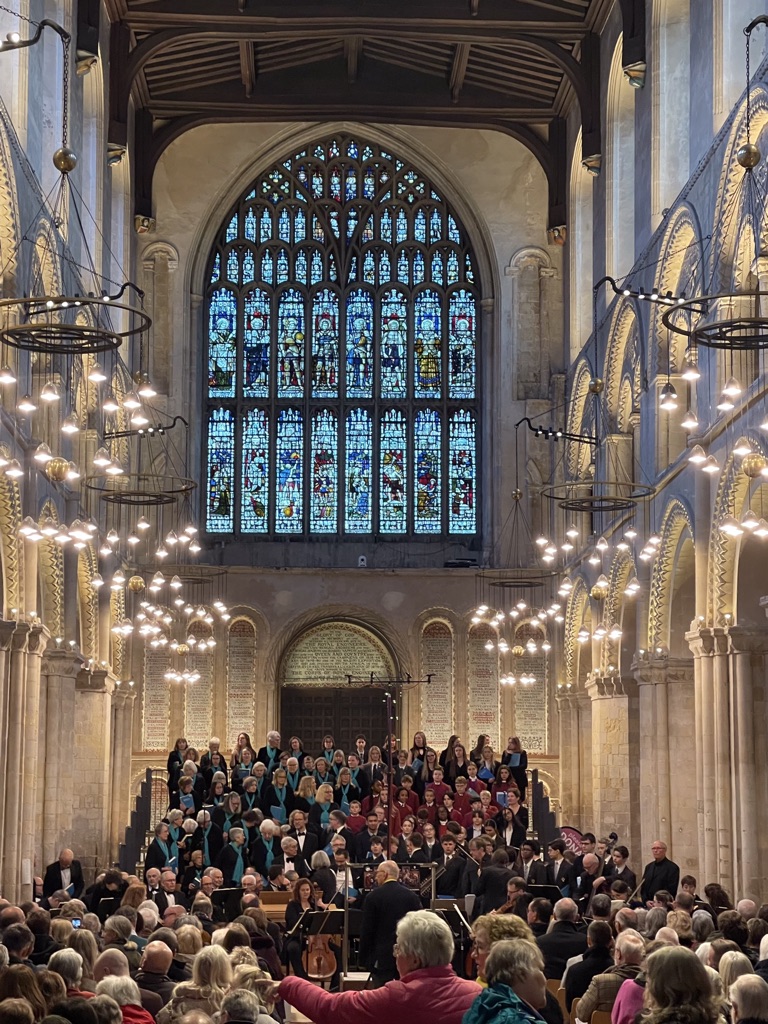
In 2023 the Rochester Choral Society commemorated its 150th Anniversary. To mark the event the Rochester Choral Society commissioned a new work – “Regards to Rochester” by Thomas Hewitt Jones. This cantata canters through the history of Rochester and its environs.
A performance of this piece can be viewed on YouTube – click link below image:
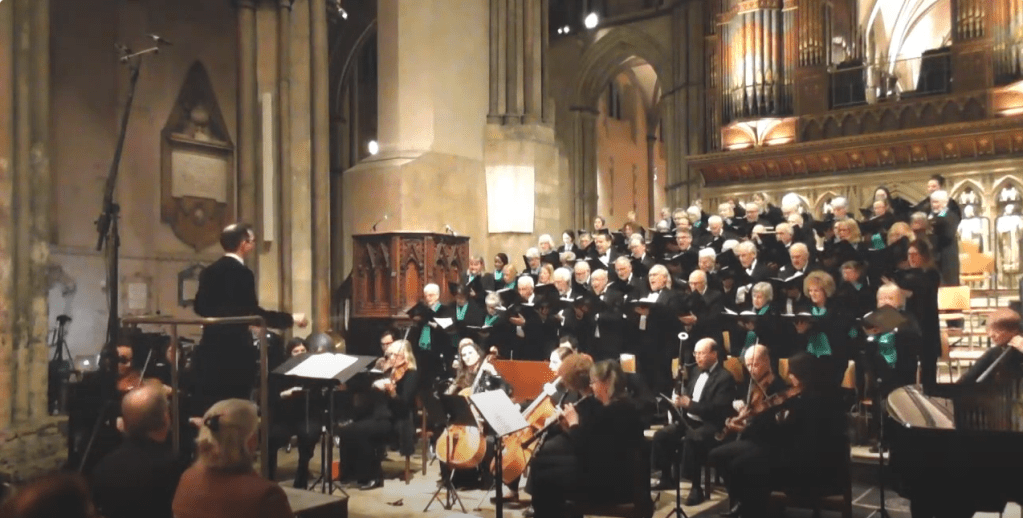
Whilst helping members of the Choral Society to familiarise themselves with the history they would be celebrating in song, it occurred to me that I knew little about the history of musical entertainment in Rochester. I did not have to dig too deep to discover that there was a lively, although perhaps a class ridden, music scene in Rochester that predated the current Rochester Choral Society.
This is what I’ve discovered thus far, but I’m sure there is a higher degree awaiting someone who researches this further. So, as ‘a starter for ten’, it appears that non-secular choral music and in turn the choral society, came into being through an ‘evolutionary’ process – possibly starting with street performers then clubs such as ‘Catch Clubs’.
Street Musicians – Waites or Waits
Perhaps the earliest the most accessible early musical performances would have been players in pubs, or on the street by musicians such as the Waites – these were referred to by Charles Dickens in his Seven Poor Travellers (1854).
These musicians were once know as the “Mayors’ Musicians” but were disbanded when local government was reformed by the Municipal Reform Act, 1835. However in 1854, William McGeorge a local musician and friend of Charles Dickens set up a group known as ‘The Christmas Waits’. The group played music on the streets of Rochester over the Christmas to raise money. Dickens may have been giving a ‘call-out’ to his friend when he mentioned the Waites in the Seven Poor Travellers. (See Blog – “Glimpses of Past Christmases in Medway“.)
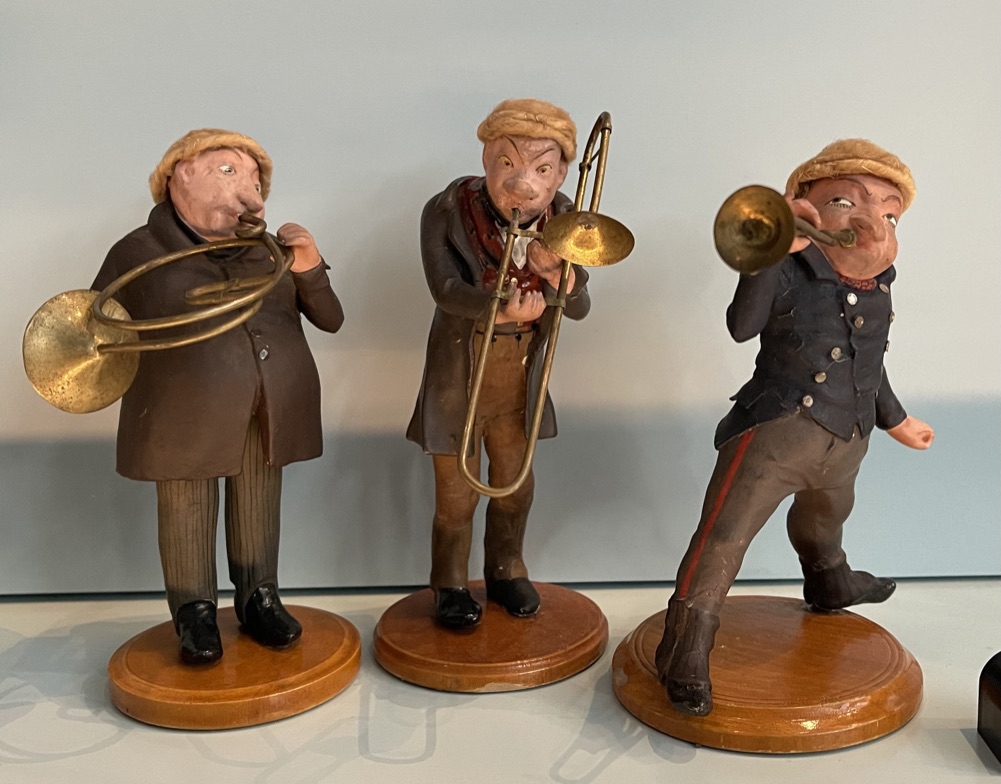
There was also military music that accompanied soldiers heading home or off to a deployment, as they marched along the high street. In 1841, for instance, returning soldiers of the East India Company deposited an immense quantity of luggage under the Guildhall before marching along the high street behind a band playing “Paddy Carey”.1 l suspect though this may not have appealed to what the press referred to as the “elite of the city” of Rochester! (The tune can be found on YouTube.)
Catch & Glee Clubs & Men-Only Concerts
Groups of men used to meet in the pubs of Rochester to sing as members of ‘Catch-Clubs’. I suspect their repertoire would have included some bawdy songs. They would periodically arrange concerts that could attend, to raise funds for their club. (Some concerts held in pub rooms were designated as being a ‘Smoking Concerts’ – this indicated that this was a men-only event as women would never be seen smoking in public!)
Catch Clubs singing Catches, Glees and Canons
(Catches are musical composition in which two or more voices (usually at least three) repeatedly sing the same melody, beginning at different times. Glees are similar to a Catch in that they are written for several voices but less bawdy. Canons are a similar musical form designed for small group singing where each voice, following the same melody, starts a little after the previous.)
These were music clubs for men who liked food, beer and tobacco with their music. They appear to have mainly met during the winter season – December to April. The club may have invited artistes but the ‘Catches and Glees’ sung were generally unaccompanied and sung by the members of the club. During the season the clubs held open concerts called ‘Ladies Concerts’. Any tickets not taken up by subscribing members were offered to the public.
The first Catch Club was set up in 1761. A number of noblemen and gentlemen, admirers of part singing, agreed to establish a society to encourage the composition and performance of Glees, Catches, and Canons. They called their club “The Noblemen and Gentleman’s Catch Club”.
The idea quickly caught on and Catch Clubs were set up across the country. One in Canterbury was set up in 1779. In addition to Canterbury I’ve found reference to clubs at Chatham, Dover, Faversham, Maidstone and Wateringbury, and a proposal for one at Gravesend – and of course there was one in Rochester. I do not know when the Rochester club was set up but probably well before 1844.
The Rochester Catch Club was expensive to join. In 1845 it was reported the subscription to this “excellent society” was upwards of £100; this was at a time when a labourer might be earning about £20/ann. Despite this high subscription the club ran out of funds in 1845 and needed to curtail its programme for that year. It seems the club had not realised the cost of booking a large orchestra.2 The club would also have incurred costs in booking artistes for their regular meetings.
The Rochester club held its meetings at the Kings Head 3 and at least one of their Ladies Concerts at the Guildhall.4 I suspect the ‘pub meetings’ could have been rowdy or bawdy affairs as it was suggested that the Ladies Concert was held in the Guildhall because the landlord of the Kings’ Head was not willing to host them because of this – a claim that was refuted in a letter to the press. If this was the case the landlord must have had a change of heart as the Ladies Concert had returned to his inn by 1853:
“On the evening of Tuesday last, the members of the Catch Club gave an open or ladies’ night at the large room at the Kings’ Head. A very fair number of visitors responded to the invitation of the committee. The principal vocalists engaged were Miss Forrester and Mr. Wilkins, the last-named individual keeping the audience in one continued roar of laughter by the manner in which he sang his comic effusions. The company separated about eleven, having spent a really pleasant evening.” 5
All the reports of programmes I’ve found in the press seem to suggest that the musical evenings always concluded with a comic song. The programme of the 1853 ladies’ concert arranged by the Rochester Catch Club opened with a glee for three voices ….. “the comic part of the entertainment was entrusted to that prince of comic vocalists, Mr. Penniket”. (Tom Penniket was a popular performer at this time.)
There are references in the press to the Rochester & Chatham Catch Club but I suspect that this could have also been the Chatham Catch Club. The Rochester & Chatham Catch Club was referred to as an “old established club”.6 This club may well have been established before 1808 7 and was supported by “officers of the garrison who gladly embraced the privilege of becoming subscribers; it being the only amusement for them in the town.”8 This club met in the Chest Arms Tavern at Chatham which benefited from having large stylish rooms. The Ladies’ Concerts of this club were held in a large room at the Proprietary Classical School, on the New-road, Rochester. The entertainers appear to have been gentlemen of this society.9
‘Acts’ for the Catch Clubs and their concerts appear to have been drawn from London artists but there was a local agency – The Phoenix Musical Agency that was located on Sanding Road, Maidstone.10 This agency appears to have provided various acts for many types of events across Kent & Sussex.
By the mid 1850’s Catch Clubs were in the demise. The Music Hall was becoming popular and was transitioning from being pub to theatre entertainment. Leading up to this time choral societies were also being set up. Both I suspect were more affordable and accessible than membership of Rochester’s Catch Club. Having noted that, the advert for the Simpson’s Royal Alhambra Music Hall, situated on the Brook, Chatham, promised extraordinary entertainment, and refreshments of the “best quality, at London prices”! 11 [My emphasis.]
Rochester’s Choral Societies
By the mid 1850s Catch-Clubs were in demise due to the Music Hall, and mixed gender choirs were becoming established. There was a choral society in Rochester established before 1846. It was known as the “Rochester & Chatham Amateur Choral Society”. The first concert of its 1846 season included parts of Handel’s Messiah. It was well received with a reporter noting how much the society had improved since the previous season. Despite its previous performance lacking lustre, this concert was still attended by upwards of 500 persons.12
Dress to Impress!
A member of this choral society later recalled that its concerts, that were held in the Corn Exchange, would be “crowded with everyone in evening dress, and Navy and Army Officers wearing full dress uniform.” 13
What’s the Risk of a ‘Lock-In’? Health & Safety!
There would have been many risks associated with attending one of these concerts at this time. The [Old] Corn Exchange would have been crowded. To the 500 members of the audience would need to be added the number in the chorus and the orchestra. In the 1840s the Corn Exchange would have been lit by candles – a report of a ball held in the Ball Room of the Bull Hotel in 1837, stated it was lit by more than 100 wax candles.14 The risk of fire would have been further enhanced by the flammable, voluminous, dresses worn by the women – and possibly the doors to the Corn Exchange being locked during a performance; more about that below.
The Coming of Choral Groups
The longevity of choral societies appears to have been short. They found it difficult to cover the costs of staging a performance from ticket sales alone. To last, as will be seen, societies needed a number of subscribing members – mainly the members of the chorus – wealthy donors in addition to well supported concerts.
In 1849 there was the Rochester Cathedral Choral Society. This would appear to have been a small group in that it was reported that it held a “truly classical meeting” in a room of the Cathedral Grammar School.15
Two hundred unable to gain admission to hear Handel’s Messiah
In 1861 the Rochester & Chatham Choral Society made an appearance in the press – albeit not a favourable one. It was reported that disappointment was experienced by a “crowded audience” when only a few of the members of this choral society supported a performance of the Messiah at the Corn Exchange. Just as today this was clearly a popular piece as the report of the concert mentioned that about two hundred were unable to gain admission.16
As mentioned above, the music scene seems to have been very class orientated. In 1863 it was reported that the Rochester Philharmonic Society gave a concert of vocal and instrumental music to a crowded audience in the [Old] Corn Exchange. The report stated that the audience included the “elite of the city and neighbourhood”.17 Interestingly the programme for this concert included glees and other part songs reminiscent of the programmes put on by the Rochester Catch Club. I’ve found no references in the newspapers to the Rochester Philharmonic Society after December 1869. This could add credence to the view of Vera Black that members of this now ceased society worked to set up a new choral society in 1873 18 – the Rochester, Strood and Chatham Choral Society.19 The Society dropped other towns from its name in 1933.
The Rochester, Strood and Chatham Choral Society – later to become the Rochester Choral Society (RCS)
In November 1873 the Mayor (C Foord) chaired a meeting at the Guildhall to discuss how to ensure that the Rochester, Strood and Chatham Choral Society that Rev. Nutter of the Cathedral had instigated, could be put on a more sustainable financial footing. All the ‘worthies’ present made a donation; further cheques of between one and five guineas came in.20 (£1 then was the equivalent of £140 today.)
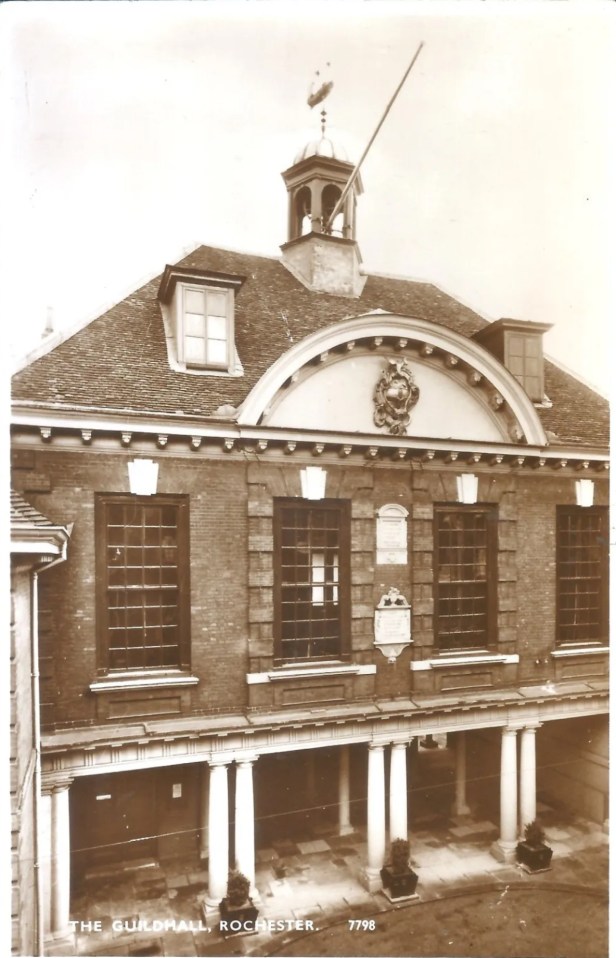
In addition, the Mayor also allowed the new choral society to rehearse in the Guildhall for no charge, and to use the Corn Exchange for performances. Whether a charge was made for this is not clear.
The next August supporters of the RCS put on a private fund raising theatrical performance in the Messers Aveling & Porter’s Lecture Hall, High Street, Rochester. The ‘actors’ included the “Earl of Rochester”, and various members of the Aveling family. 21 (Earl of Rochester? A reporting error? Probably Lord Darnley.]

A New Performance Space – the New Corn Exchange
Work on the New Corn Exchange started late in 1870 – the corner stone being laid in the October. The press celebrated the developed as the City would at last have a “spacious, substantial handsome place” suitable for the holding large scale meetings, entertainments and celebrations.22 It was though not long before improvements were sought.
In 1881 the RCS, along with the church, presented a petition to the Corporation comprised of 1,000 signatures requesting the enlargement of the [New] Corn Exchange and the installation of an organ.
The argument made was it would allow more people to be accommodated and the ticket prices to be lowered.23 As appears to have been the practice of the time, the pages of the petition were stuck together to make a roll. This petition was 61 feet long – impressive but a lot shorter than the petition presented to Parliament in 1845 by the Chartists – their’s weighted 300kg and even with the door frame being removed the roll could not be got into the House of Parliament!
The petition organised by the RCS did not lead to the extension of the New Corn Exchange or the installation of an organ – but some improvements were made. By 1909 Pump Lane had become Northgate from which people entered the Corn Exchange. Stewards then stood at the Northgate doors and summoned the carriages at the end of concerts.
The next August supporters of the RCS put on a private fund raising theatrical performance in the Messers Aveling & Porter’s Lecture Hall, High Street, Rochester. The ‘actors’ included the “Earl of Rochester”, and various members of the Aveling family. 24 (Earl of Rochester? A reporting error? Probably Lord Darnley.]
Support from the Military – Marines and Royal Engineers
Vera Black in her history is vague about the extent of the association between the RCS and military bands. News reports of the time suggests that the society had its own band / orchestra and its members included many from the military – indeed in the beginning they may have formed the majority.
In 1878 the RCS supported a concert put on by the Gravesend Choral Society. A report of the performance acknowledged “a score” of the Rochester society’s singers joined the choir, along with 17 performers from the orchestra – chiefly men from the bands of the Royal Engineers and Marines.24 In 1884 the RCS’s conductor was Herr J A Kappey of the Royal Marines.25 Not only did he provide musical leadership he was also a generous donator. A report to the RCS’s 1888 AGM recorded that Herr Kappey had given a “generous donation of 15 guineas” – in addition to the many pounds he had spent in the interests of the Society.
{Although Vera Black in her history of the RCS, refers to Herr Kapper as Mr Kapper, the press and the Musical Times all referred to him as Herr Kapper. Before WW1 there were many Germans in Britain. Britain was leading the industrial revolution during the Victorian era, and many German professionals came to Britain. During my reading in respect of Rochester during the Great War, I came across a German clock maker, pub landlord, and artist. Indeed Charles Dickens’s ‘Mr Durdles’ in the ‘Mystery of Edwin Drood’ may have been based on a German stonemason working on the cathedral.26 I wonder if, post WW2, Vera Black decided to mask the German heritage of one of RCS’s conductors who was also a respected musician and author?}
Mayor takes action re Health & Safety concern
As previously mentioned, attending a concert or ball at this time could have been a risky affair. Despite the risks associated by the Corn Exchange being lit by candles or lanterns, and the flammable nature of women’s fashion of the time, the management of the RCS directed that the doors to to the Corn Exchanges were to be locked once the concert started! This troubled the Mayor who instructed the Town Clerk in 1879 to write to the committee instructing them not to lock or bolt any doors during a performance. 27
In the minutes of the society’s 1888 AGM appreciation is recorded for the attendance of the Fire Brigade during the concerts – presumably the incendiary risks associated with candles and frocks was being address? 28
Staging Joint Concerts / Augmenting other Choral Societies
As in the previous incarnation of choral societies, members of the RCS supported other societies in their work and sung to raise money for good causes. In May 1876, 120 members of the RCS, along with the Gillingham Choral Society, provided “two grand concerts”. The concerts were to raise 300 guineas to purchase an organ for the Garrison’s chapel. The RCS sung on the first night to an audience of 900 comprised of the ladies and officers of the garrison and residents from the neighbourhood.29
“Snaps and Snarls” – Class divisions in the Chorus?
The Society had previously identified the need to ensure the musicality of all members of the chorus was up to standard. To achieve this it was determined that regular classes were to be held. By 1885 disquiet amongst the chorus had reached the press. Under the headline of “Snaps and Snarls” it was reported that the “la-de-lah” members of the chorus were reserving seats for others of their clan who come late”. They thereby were able monopolise all the best places. This disadvantaged those for whom the “talented conductor” [Herr Kappey] had arranged the special classes.”30
‘Traffic Management’
A chorus of 150+, plus an orchestra, and audiences in the hundreds, led to traffic congestion – and a rush for the door at the end – or towards the end – of concerts!
In 1876 a complaint was registered in the press of the number of people leaving the concert held at the Corn Exchange early in order to beat the rush for carriages. At this time Northgate was still the narrow Pump Lane, and the road between Chertsey Gate and the Kings Head had not been created.
By 1880 some arrangements were in place to try and reduce the congestion and perhaps ‘encourage’ the audience to remain in their seats to the end of the concert. These were detailed in the programme under “Carriage Arrangements”. These required members of the audience, and around 250 performers, to be dropped off at the High Street entrance to the Corn Exchange (presumably what is known today as the Old Corn Exchange). At the end of performances carriages hired from Mr Lloyd were to pick up from the Pump Lane (Northgate) exit, and all other hire carriages to pick up from the High Street entrance”.31 A steward would call the names of the owners of carriages, and their coachman would then appear.
Was attendance at RCS Concerts ‘elitist’? Perhaps.
The report of a concert given by the RCS in December 1894 gives an indication that concerts put on by the society remained well supported, showy and clearly not for people for the working classes – even if they could afford a ticket.
On Monday evening the large [New] Corn Exchange at Rochester, was again crowded to its utmost capacity with a fashionable and critical audience. Long before the door opened at quarter to seven a large number of persons had gathered outside awaiting admission, and an hour later, when the performance was timed to commence, at quarter to 8, there was not a vacant seat to be found; in fact many persons were sitting in the passage outside the new Exchange all through the evening. The scene from the balcony must have presented an extremely attractive appearance. There were the lanterns and other decorations reminding us of the brilliant oriental bazaar, and there were the bright dresses of the ladies and the scarlet uniforms of the bandsmen mingling with the more sombre evening dresses of the gentleman, received by only a broad expanse of shirt front.32)
20th Century – starts with financial woes
The last century did not start well. The staging of concerts was proving expensive and not covered by subscriptions, donations or ticket sales. In 1912 the committee needed to call upon its Guarantors to pay off its debts and to wind the Society up.33 Some members of the Society were not happy with this decision and took steps with the Rochester Orchestral Society to resurrect a choral society. They had hoped to merge with the Maidstone Choral Society but Maidstone declined this proposal but agreed to offer assistance.34
By July 1914 the reconstituted society had Lord Darnley as its president and was operating with a small surplus. However, all plans for the resurrection of the choral society were scuppered when Britain entered WW1. The Society gave no concerts during the war. 35 In 1919 it was decided to revive the Rochester Choral Society.
The option of starting a new society was discounted in preference to restarting the old Society – “It would therefore be a ‘thousand pities’ if after the war if it could not start again.” It was also agreed, as was the tradition started many years ago, that the conductor would be the organist of the Cathedral. It was hoped that as this was a ‘revival’ old members would consider themselves members. The first practice was fixed for Tuesday 21 January 1919.36
Political Pique – caused by a move to Chatham
As previously, concerts were held in the Corn Exchange …. until the 1923/24 season when a ‘neighbour problem’ arose. The problem was that the cinema in the ‘Old Corn Exchange’ had been restarted. At this time the films were silent and were accompanied by live piano playing – the playing of which could be heard during the concerts being held in the ‘New Corn Exchange’. So for the 1923/24 the Society’s concerts were held at the Town Hall, Chatham. This, all around, was regarded as a better venue. Not only was it on more transport routes the seating arrangement allowed for the selling of premium priced tickets for the better seats – something that was not possible in the Corn Exchange.
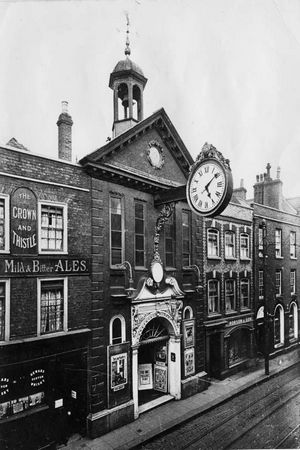
The Mayor of Rochester took exception to this. He said that if the Choral Society was to hold their performances in Chatham they may as well rehearsal there – and removed free use of the Guildhall for practices. Being unable to afford paying for rehearsal space concerts returned to the less than ideal Corn Exchange. 37 (The cinema had also closed by the 1924/25 season.)
Cathedral used for Concerts
Clearly the Mayor’s attitude rattled the RCS and it approached the Dean & Chapter in 1925 to hold its concerts in the Cathedral. This was approved but entrance had to be free. Adverts for concerts to be held in the Cathedral stated that “there [would] be a silver collection”. Clearly this was a parlous situation as donations many not cover the cost of putting on the performance. The Society therefore held concerts at other venues including the new Parochial Hall in Gillingham; concerts for which tickets could be sold.
In 1947 the Dean & Chapter allowed programmes to be sold at the door but still refused to allow tickets to be sold. In 1959 it agreed that tickets could be sold, but new fire regulations had kicked in that determined the maximum number of people who could be in a building. No more concerts such as those held in the 19th century where the Corn Exchange was ‘filled to the gunnels’. This inevitably pushed up ticket prices – not a good move during the post war recovery years.
The RCS however survived and continues to add to the cultural life of Rochester – for performers and audiences alike. Perhaps because so many of its concerts are now held in the Cathedral the programme is more sacred and less mixed than those of its ‘predecessors’?
Royal College of Music
It would be remiss to ignore the important contribution the RCS also made to the National scene.
In the 1880’s the then Duke of Edinburgh proposed the establishment and endowment of a Royal College of Music and for a foundation to provide scholarships. In 1882 a meeting held at Maidstone, attended by the Duke, and to which the Rochester Choral Society was represented.Lord Darnley moved a motion, seconded by the Dean of Canterbury, which “heartedly” [approved] the proposals. The meeting ended with “ladies” presenting purses which included £400 raised by Rochester Choral Society. 38 [c £40,000 today.] A further contribution of £81 2d was made the following year.38 The College opened in 1883.
In 1887 the Mayor convened, what turned out to be a poorly attended meeting in the Council Chamber of the Guildhall, to affirm support for the College. The Mayor recalled that when the Royal College of Music was started it was said “What has it to do with Rochester?” but the Rochester Choral Society was one of the first choral societies to assist in the funding, and everyone must feel that Rochester had experienced very considerable benefit from the establishment of the College. It had put forward fourteen names for the scholarship examination – none though were were successful.39 [Would Samuel Coleridge-Taylor have come to Rochester had there not been an affinity between the Royal College of Music and the RCS? – (See Coleridge-Taylor Blog]
The establishment of the Royal College was most certainly championed by George Watson. He had been a secretary of the RCS (1873 to 1882) and because of his enterprise in raising funds for the establishment of the College he was appointed as its first Registrar and Secretary to the College in 1882.40
The College has gone on to become one of the world’s greatest conservatories providing training to some of the most gifted musicians from around the World – thanks in part to the likes of the Rochester and Maidstone Choral Societies that very early got behind this visionary project.
Geoff Ettridge aka Geoff Rambler
10 April 2023
+++++++
- West Kent Guardian, 24 April 1841
- South Eastern Gazette, 4 March 1845
- Kentish Independent,19 January 1850
- Kentish Independent, 23 November 1844
- South Eastern Gazette, 1 February 1853
- South Eastern Gazette, 20 January 1846
- Kentish Weekly Post or Canterbury Journal, 22 January 1808
- South Eastern Gazette, 4 December 1838
- South Eastern Gazette, 20 January 1846
- Maidstone Telegraph, 9 May 1868
- Chatham News, 25 February 1860
- West Kent Guardian, 5 December 1846
- A History of Rochester Choral Society 1873 – 1973, Vera Black. p37
- West Kent Guardian, 22 April 1837
- Maidstone Journal and Kentish Advertiser, 21 August 1849
- Maidstone Journal, Tuesday 23 April 1861
- Chatham News, 21 November 1863
- A History of Rochester Choral Society 1873 – 1973, Vera Black. p7
- A History of Rochester Choral Society 1873 – 1973, Vera Black. p53
- A History of Rochester Choral Society 1873 – 1973, Vera Black. p8
- Bromley Journal and West Kent Herald, 21 August 1874
- Chatham News, 1 October 1870
- A History of Rochester Choral Society 1873 – 1973, Vera Black. P22
- Gravesend Reporter, North Kent ad South Essex Advertiser, 6 April 1878.
- A History of Rochester Choral Society 1873 – 1973, Vera Black. p81
- The Victorian Web. https://victorianweb.org/art/illustration/fildes/d112.html. Accessed 9 April 2023
- Kent Times, 24 October 1885
- Kent Times, 25 August 1888
- Naval & Military Gazette and Weekly Chronicle of the United Service, 24 may 1876
- A History of Rochester Choral Society 1873 – 1973, Vera Black. p17
- A History of Rochester Choral Society 1873 – 1973, Vera Black. p18
- Rochester, Chatham & Gillingham Journal, 22 December 1894
- Bromley & West Kent Herald, 9 February 1912.
- Kent Messenger, 17 February 1912
- Kent Messenger & Gravesend Telegraph, 1 August 1914
- 11 January 1919, Chatham, Rochester & Gillingham News
- A History of Rochester Choral Society 1873 – 1973, Vera Black. p45
- The Era, 21 July 1883
- Evening Mail, 9 April 1887
- AIM25, Achieves of London – accessed 8 April 2023. https://aim25.com/cgi-bin/vcdf/detail?coll_id=6135&inst_id=25
 Geoff Rambler's weird and wonderful Kent