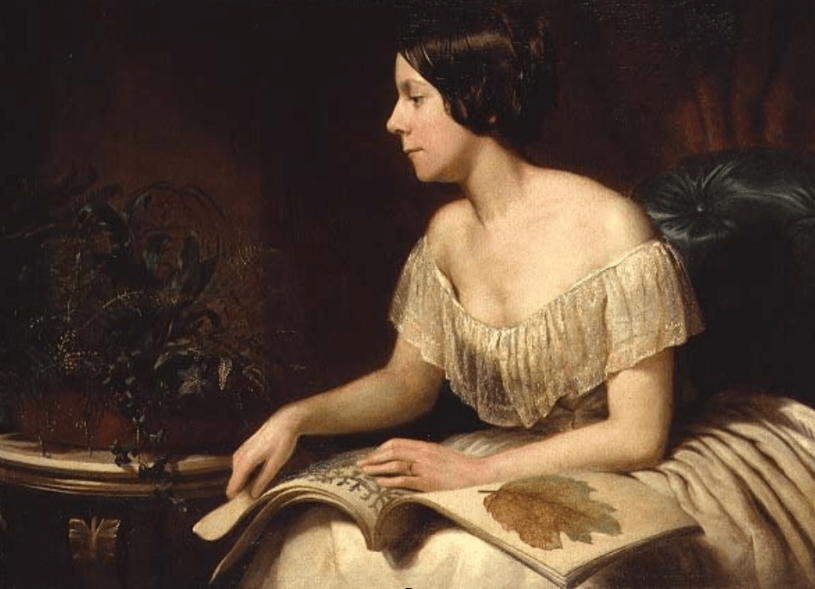
Anne Pratt (5 December 1806 – 27 July 1893) – Botanist and prodigious writer and artist from Strood, near Rochester Kent, and later a Plant Therapist. To this list I would add ‘educator’ as much of her writings were just for that – with some books aimed specifically at younger people.
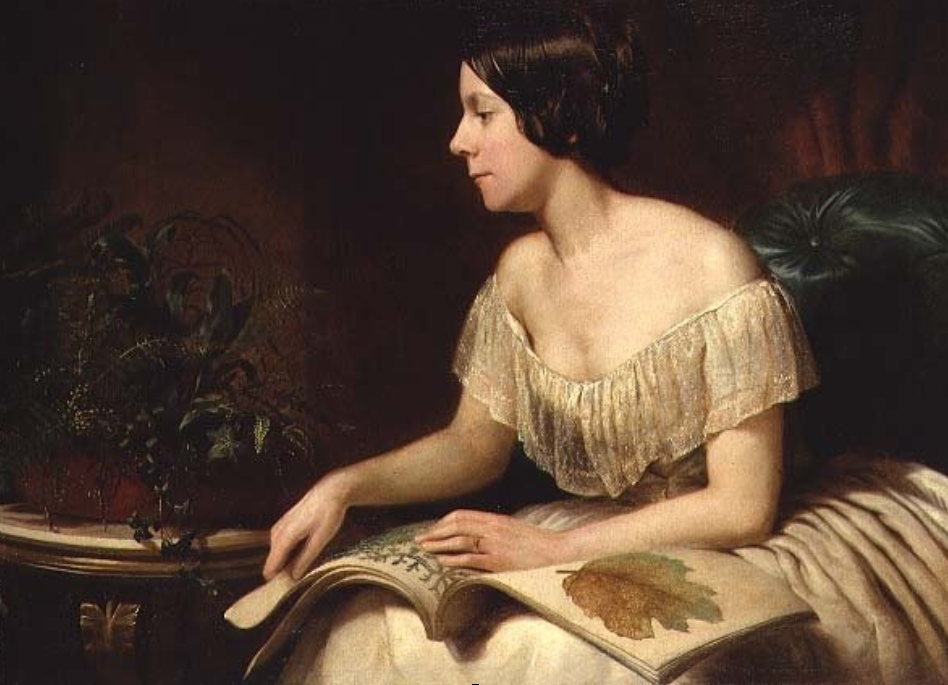
Anne, who may have been known as Annie(1), was born at Strood near Rochester. She was the second of three daughters of a local wholesale grocer, Robert Pratt (1777-1819), and Sarah Bundock (1780-1845). It was her mother who instilled Anne with the love of gardening and plants. Anne through her mother’s line maybe of Huguenot descent. (More of Anne’s bio at the end as this may help those investigating their family trees.)
Due to poor health and an injured knee Anne took up drawing. She was educated at Eastgate House, Rochester.
Anne’s Education
In July 1798, a Miss Baker placed a notice in the press to “acquaint … friends and the public that she had acquired a large and airy house” at Eastgate, Rochester, in which she planned to open a “young ladies boarding school”. The cost was to be sixteen guineas per annum.”(2) (Based on the Bank of England calculator about £1,200 in 2023.)
Earlier, in January 1798, a Miss Larkin made a similar announcement in respect of Eastgate House and she was still in residence in 1818 when it was announced that she had married a William Roffey. The Dictionary of National Biography states that Anne was educated by Mrs Roffey of Eastgate House.
From the 1830’s Botanical science was developing as a subject.(3) Anne was introduced to it by a Scottish family friend, Dr Dodds. Clearly enthralled by plants Anne went on to become a distinguished botanist, writer and illustrator of both plants and birds.(4)
Painstaking Researcher
Anne Pratt was regarded as a devoted student of Nature who was accurate and painstaking in all her researches. She was also a “gifted artist” who made exquisite sketches of plants.(5) She also included in her descriptions anatomical details that could be used to distinguish between species. (6)
Although Anne wrote about plants from around the Country a lot of her fieldwork and that of her older sister, was conducted in and around Kent. Together they collected plant specimens and Anne soon had an extensive herbarium from which she draw upon to illustrate her work. Anne also collected information about the plants such as their local names and uses to which the plants were put. By pulling this information together she created works that were engaging at many levels and thereby more memorable. [I’ve found on my tours that it’s the stories surrounding the ‘facts’ that people enjoy. These bring the ‘facts to life’ and in turn make them more meaningful and memorable.]
Local ‘Discoveries’
There is no doubt in my mind that Anne really studied the beauty of Kent. She wrote: “The olive grounds of Spain or Syria, the vineyards of Italy, the cotton plantation of India or the rose fields of the East … not one of them all equals our English hop garden”. (7)
Locally – in and around the neighbourhood of Rochester – Anne found (8) ‘whitlow grass’(9) on the cathedral and ‘clove pink’ on the castle.(10) At Kits Coty House she found ‘gold-of-pleasure’.(11) At Cobham and Higham she found ‘Deptford pink’(12) and at Wouldham the rare ‘small teasel’(13). At Higham she also found the rare ‘Blue fleabane’(14) and on Strood Hill, a mile from the coast, the ‘Blue Sea Starwort’ (15).

As Anne left Medway for London when aged 20, she would presumably have made these discoveries as a young person?
Old Wives Remedies and Uses (16) (I have drawn this material from others who have drawn from Anne Pratt’s books. Some of the things below – which could be questionable – could be a misinterpretation of her writings – but I don’t know.)
In addition to collecting local plant names Anne spoke to villagers across Kent to discover remedies associated with different plants. From her work we ‘discover’:
- A Spring tonic made with the juice of scurvy-grass(17) added to water was thought to be beneficial – so named as it helped prevent scurvy on ships.
- A salve made of ‘St. John’s Wort’ (18) was used to sooth irritated skin . In her writing Anne recorded that the wild species of St John Wort was gathered by “our forefathers to be thrown onto bonfires which were lit in London on the Eve of St. John (19). (It was believed that leaping over a fire whist this herb burnt would help cleanse the body of evil spirts.(20))
- Garlic placed in the stocking of a child was thought to be curative for a child with whooping cough.
- Kentish fishmongers in the 19th century would give a branch of fennel to customers who purchased mackerel, to make a sauce.
- Anne herself made a sauce of ‘hedge garlic’ (21) and vinegar in the manner of mint sauce. [Hedge Garlic has had medicinal uses; could Anne have made this for a remedial or culinary use?]
- Anne recorded that 19th century school boys used the hollow stems of clematis (Old Man’s Beard / Travellers’ Joy) for smoking tobacco(22) and then whitened their presumable stained teeth with celandine leaves (23).
- In her book “Poisonous Plants” Anne wrote that children would tear away the petals of monkshood to make ‘Venus chariots drawn by white doves.” [This naming refers to a Greek myth.]
- Children used to chew on the root of ‘Rest-harrow’ / ‘Liquorish Plant’ (26) or as Anne Pratt recorded ‘Wild Liquorish’ for its flavour. It’s also recorded that farm labourers sucked it as a means to quench their thirst (27).
- Before hops Anne reports that various wild flowers such as wood sage and ground Ivy was mixed with ale to make it less sweet. She also reported that the Tamarisk, also known as salt cedar (scientific name: Tamarix), could be used to improve the flavour of ale. The smoke from this scrub also gave excellent flavour to the meat roasted over it (28). [Anne was of the view that hops were introduced into Kent from Flanders during the reign of Henry VIII – but were not used in beer-making because they were thought to be unwholesome (29). Hops were quite probably imported from Flanders but before the time of Henry Vlll.]
- Borages used as fertilisers. Anne recorded that lungwort (30)– a member of the borage family – was a valuable source of nitrogen (nitre) she reported that when this plant is burnt it yields one-seventh of itself in ashes (31).
- According to Anne the Pimpernel (32) was a reliable predictor of rain: “The flower never opens on rainy days and long before a shower is coming it is conscious of its approaching and closes its petals.”(33) The old saying goes – “Pimpernel, pimpernel, tell me true, Whether the weather be fine or no.”
- And a warning: Carrying ‘deadly nightshade’ for a length of time can cause paralysis in the hand(34). Anne went on to issue other warnings in block capitals about the dangers of this plant, but also recorded some uses for which only “medical men” should administer (35).
Old Kent Plant Names (36) Names as linked by Anne Pratt – the name after the = sign being the Kent name as she identified. In the spirit of Anne I’ve added ‘notes’ of interest to her work.
- Common fumitory = wax dolls. (Fumaria officinalis). Was used medicinally for centuries to aid digestion
- Gean cherry = gaskin. A wild cherry said to have been brought here by Joan of Kent from France.
- Wild service = chequers. (Sorbs torminalis). In the 19th century, the fruits were sold as chequers as the tree was commonly known in the Weald of Kent. Seeds were fermented to make a type of beer.
- Wild black currant = gazel. Gazel is the Kentish word for the black currant (Ribus Nigrum) but also wild plum and blackberry.
- White current = gozill. (I’ve found reference to Ribes Grossularia and R Rubrum both having gozill in a thesaurus of alternative plant names (37).
- Red rattle = snaffles. Name linked to Rhinanthus Crista-galli in Kent by Anne Pratt (38).
- Dog’s mercury = Kentish balsam. (Mercurialis Perennis). Toxic. Has been used to control pain and to treat warts, sores and eye problems.
- Ash keys = spinners. Many trees produce winged spinning / helicopter seeds. One can assume that Anne linked it to the Ash tree but could equally be applied to the maple, elm, and sycamore.
Author
Anne published her first book when she was 20 years old – “Flowers and their Associations” (1826). The Times in its memoir of Anne stated that her work was characterised by elegance of thought and refinement of diction, qualities that marked all her numerous and subsequent writings. She went on to publish more than 20 books on plants and birds, illustrated with chromolithographs, on which she collaborated with artist William Dickes who specialised in illustrating books on natural history.
Her magnum opus was “Flowering Plants and Ferns of Great Britain” (1855-1866). It was comprised of 2,000 pages bound in six volumes and illustrated with 313 colour plates. She revised this publication when she was 73 (39, 40)(Copies of this work can still be found for sale on the internet – not cheap!)
Selected Bibliography
The subtitle Anne gave to some of her books gives a indication of her populist approach – not scientific but based on science
- The Field, the Garden and the Woodland – or Interesting Facts Respecting Flowers and Plants in General. ‘By a Lady’. 1838. eBook available. [Not sure why the authorship was not ascribed to Anne as the writer was clearly identified as female. Could have been to avoid drawing ‘personal attention’ from the ‘academic elite’? ]
- Flowers and their Associations (1840). eBook available.
- Dawnings of Genius etc. (1841) eBook available. {Not a plant book – see section below on Anne as an ‘Educator’.}
- The Pictorial Catechism of Botany (1842). This is a young persons textbook introducing botany. Each section ends with questions to affirm what has been learnt. eBook available.
- The Excellent Woman, as described in the Book of Proverbs. (1846). Briefly the book is about the importance of education in developing the role of women, which in turn would benefit society. eBook available. Not a plant book – see section below on Anne as a ‘educator’.}
- Chapters on Common Things of the Seaside (1850). Published by SPCK. eBook available.
- Wild Flowers of the Year (1852). eBook available. With the publication of this book Anne became an established as household name. With Queen Victoria’s permission Anne dedicated this book to her. The Queen was so taken with the work she personally requested future copies of her works (41).
- The Green Fields and their Grasses (1852). eBook available.
- Our Native Songsters (1852) – with 73 coloured plates. eBook available (42).
- The Flowering Plants, Grasses, Sedges, and Ferns of Great Britain and Their Allies the Club Mosses, Pepperworts, and Horsetails. In six-volumes Anne assessed more than 1500 species. It was published over a decade between 1855-66 and contained 238 coloured plates. Revised in 1873. The individual volumes were sold separately. eBook copies can be found on the HathiTrust Digital Library, also on the Internet Archive (43).
- The Ferns of Great Britain and their Allies, (the Pepperworts, Horsetails, and Club Mosses)(44) (1855) with 41 coloured plates. It was priced 12s in the 1857.
- The Poisonous, Noxious, and Suspected Plants of Fields and Wood. (1857) Ann stated that the object of this book is to prevent the use, by mistake, of any unwholesome herb in cookery .… or the inclusion of noxious plants in herbal medicines. eBook available.
- The British Grasses and Sedges etc. (1858). eBook available.
- Haunts of Wild Flowers (1863) – Illustrated by Noel Humphreys. 1s 6d (45). eBook available.
Anne as an Educator of Young Minds?
Quite rightly Anne’s contribution to Victorian society as a botanist, writer and illustrator needs to be fully recognised. I wonder though if she would like to have also been recognised as an educator?
The two books that Anne wrote that were not about plants or birds, could be best described as being about ‘self-improvement’: “Dawnings of Genius, or the Early lives of some Eminent Persons of the Last Century” (1841) and “The Excellent Woman, as described in the Book of Proverbs (1846)”.
Anne only included one women in her “Dawnings of Genius” – Jane Taylor who is probably best known for the lyrics of Twinkle, Twinkle, Little Star. Anne offers no reason for this but I suspect that both women recognised the importance of shaping the young mind.
Twinkle, Twinkle, Little Star was published in 1806 and could well have been read to Anne as an infant who was born in the same year. Anne noted in the chapter on Jane Taylor that particular skills are required when writing for the amusement of infants. In her “Dawnings of Genius” Anne argues that writing conveys good moral lessons, cultivates taste and although providing temporary pleasures for the infant it can have a lasting effect on the mind.
It was said by Jane Taylor’s sister that before she put pen to paper Jane would try to conjure some child into her presence and to address her as suitably as she was able (46). I wonder if Anne similarly envisaged a lay or young reader when sitting down to write?
Criticised by the ‘Established’ (male) Scientific Community.
Obituary writers credited Anne with generating wide public interest in British flora by combining “easily digested science with miscellaneous romantic flower-lore” (47). In adopting the style of writing simply and interestingly, she would have appealed to many, including children; indeed some of her books were directly aimed at children.
It may also be worthy to note that a number of her books were published by or promoted by, the Society for Promoting Christian Knowledge (SPCK). This charitable publisher of Christian literature also founded charity schools for poor children aged 7 to 11. It also provided teacher training. This adds to my thought that there could have been a synergy between Anne’s work / possible mission, and that of the SPCK.
Despite the popularity of Anne’s publications the scientific community – comprised mostly of men at that time – criticised her for her lack of scientific knowledge, and others credited the quality of the artwork to the printer, who needed to copy her paintings onto printing blocks (48). However in her introduction to her book on the Common Things found at the Seaside she makes the point that the ‘alphabet of literature’ is as important as the ‘alphabet of science’ and her aim was to impart a partial understanding as a means to laying the foundation of further study.
One has to wonder whether Anne’s engaging treatises on plants did more to inspire others to take up botany and associated sciences, than the papers written by the academics who criticised her work?
An art historian wrote in 1950 that “the drawings which illustrate her book are her own work, though in their published form no doubt owe a great deal to the artists of the firm W. Dickes and Co. who redrew them on stones’. Apparently the only basis for these remarks was that Anne was a self-taught woman and therefore not a trained ‘professional’, despite the fact that she clearly demonstrated a vast knowledge, passion, and talent for botany and illustration” (49).
Despite these criticisms Anne’s work became well recognised and appreciated during her lifetime and consequently found financial success.
Final thought?
Many women of the Victorian era undertook botanical drawings. But perhaps none did more to explain and set plants within their biological and cultural habitat. I’m also wondering whether she was ahead of her time as an educator? She described and explained, and like eLearning today, she ended each chapter in her Pictorial Catechism of Botany with questions that would have affirmed learning.
I hope in this blog I have brought together in one place much of what I’ve found about a remarkable women who’s story was spread widely across the internet or ‘hidden’ in some of her writing.
Biography
Not much is known of Anne’s personal life but knowing something of someone’s life and family experiences can help get a sense of that person after they’ve died.
The following information is drawn from the Dictionary of National Biography – unless otherwise indicated. The information for the entry was provided by Anne’s niece, Mrs Wells.
Anne’s father was Robert Pratt (1777 – 1819) and is described as a wholesale grocer of Chatham and Strood where he and the family lived. Her mother was Sarah Bundock (1780-185) who was of Huguenot descent.
Anne was born and baptised in Strood but the family moved to Chatham.
Robert Pratt appears to have been a highly principled man. In 1811 he regarded himself as being maligned by a William Beard who ran the North Canteen Shop in the upper barracks at Chatham. Legal action appears to have been threatened.
To make amends Beard agreed to cover Pratt’s legal costs, to place a notice in the press and to purchasie £8 of bread. This bread was to be distributed amongst the poor of Chatham, with the residual being distributed in Strood (50).
Anne left Chatham and moved to Brixton, London, in 1826, [The Dictionary of National Biography states she left in 1846] it was here that she developed her skills as an illustrator – publishing her first book in 1828. In 1849 she settled in Dover where she wrote her principal work “The Flowering Plants d Ferns of Great Britain”. She moved to East Grinstead in 1866 where she presumably met her husband to be.
At the age of 60 Anne married John Pearless from East Grinstead, at Christchurch, Luton, Kent (1867) At this time Anne was living with her sister just off Luton Road – as we know it today (51). After this date ‘adverts’ for her books stated they were by Anne Pratt (Mrs Pearless) (52).

The first church on this site was built in 1843.
In the 1871 Census Anne was living with her husband as lodgers in Sydenham.
The couple then moved to Shepherds Bush, London. Here Ann practiced ‘plant therapy’ [not defined but possibly a herbalist – she had the knowledge that linked plants with wellbeing.] Anne also wrote on flower-lore for women’s magazines (53).

Anne died at Shepherds Bush in 1893 aged 87. She is buried in Queens Road Cemetery at East Grinstead(54).
In her obituary Anne was described as a gifted artist and a devoted student of nature who was accurate and painstaking in her research. Other notices of her death titled her as Mrs John Pearless who under her maiden name wrote many books on botany (55). This not only denied her name (Pratt not mentioned) it diminished the importance of her contribution to botany and its popularisation.
At least the Dover Express offered some redress. It described her as a “distinguished botanist” who was better known as “Miss Anne Pratt” who was born near Rochester.
Geoff Ettridge aka Geoff Rambler
23 July 2023
References & Sources
1 findagrave.com. Access 20 July 2023
2 Kentish Gazette – 6 July 1798
3 Ann B Shteir, Gender and “Modern” Botany in Victorian England. https://www.jstor.org/stable/i213338
4 https://www.fieldmuseum.org/blog/popular-and-prolific-ms-pratt.
5 Dover Express – 11 August 1893
6 Folkestone Express, Sandgate, Shorncliffe & Hythe Advertiser – 14 June 1879
7 Kentish Express – 19 August 1966
8 Kentish Express – 9 March 1956
9 Draba verna. Small spring growing annual found on walls and pavements.
10 Clove Pink identified by Anne as Dianthus caryophylus.
11 Gold of Pleasure (Camelina sativa) also known as false flax
12 Dianthus armeria. This is a rare plant. It is classified as endangered on the Vascular Plant Red Data List for Great Britain. It is now known to inhabit only about 15 sites in the UK, mainly in the south.
13 Small Teasel (Dipsacus pilosus). Still rare – it’s on the Rare Plant Register for Kent
14 Blue Fleabane (Erigeron acer). Inhabits dry grassy places, stone walls. Doesn’t seem to be regarded as rare today.
15 Sea Starwort (Aster tripolium) is an Aster generally found on salt marshes.
16 Kentish Express – 9 March 1956
17 Scurvy Grass (Cochlearia officinalis). A coastal plant now being found on road margins due to the salting of roads.
18 St John’s Wort (Hypericum perforatum). A salve made of the oils from this plant was used to help overworked muscles heal gently and quickly. Today an extract of this plant provides a herbal remedy for mild or moderate depression.
19 Hampshire Advertiser – 31 August 1935
20 https://www.mjpettengill.com/post/the-magic-of-st-john-s-wort.. Accessed 18 July 2023
21 Hedge Garlic (Alliaria petiolata). Tastes like mild garlic and mustard. has been used in the treatment of asthma, eczema, bronchitis, and skin irritation.
22 Other sources suggest that it was the stem of the plant that was smoked as an alternative to tobacco. This may be more likely as the plant also had the common names of “Smoke Wood” and “Boy’sBacca”. https://atrampinthewoods.wordpress.com/2014/12/. Accessed 18 July 2023
23 Kentish Express – 9 March 1956. Report details other plants she found from around Kent
24 Monkshood (Aconitum napellus). Also known as wolfsbane, common aconite and Venus’ Chariot. Highly poisonous – would children have played with this plant? Today horticulturist advise against growing this plant if you have children and pets.
25 Liverpool Daily Post (Welsh Edition) – 1 October 1965
26 Common Restharrow (Ononis repens). The roots contain a substance that tastes very like liquorice
27 Taunton Courier and Western Advertiser – 21 August 1948
28 https://www.fieldmuseum.org/blog/popular-and-prolific-ms-pratt Accessed 22 July 2023
29 Uxbridge & W. Drayton Gazette – 18 September 1953
30 Lungwort (Pulmonaria spp.) Although I’ve found no other reference to using the ash of Lungwort as a fertiliser many gardeners make a liquid fertiliser rich in nitrogen from Borage leaves.
31 Taunton Courier and Western Advertiser – 29 January 1949
32 Pimpernel Poor-man’s or Ploughman’s weather glass
33 Taunton Courier and Western Advertiser – Saturday 17 July 1948
34 The Queen – 8 December 1909
35 The Queen – 15 August 1908
36 Kentish Express – 9 March 1956
37 A Dictionary of English Plant Names. Britten & Holland 1886.
38 A Dictionary of English Plant Names. Britten & Holland 1886.
39 Manchester Courier – 1 August 1893
40 Editions published after Annes death were revised by the publisher Edward Step
41 https://gardenmuseum.org.uk/ferns-of-great-britain-anne-pratt/. Accessed 19 July 2023
42 https://catalog.hathitrust.org/Record/100590290. Access 20 July 2023
43 archive.org. search for Anne Pratt. Accessed 20 July 2023.
44 Full title of publication in – Morning Advertiser, 3 April 1856
45 East Kent Gazette – 7 March 1868
46 https://www.bl.uk/collection-items/first-publication-of-twinkle-twinkle-little-star. Accessed 22 July 2023.
47 Blunt, Wilfrid, and William T. Stearn. 1994. The Art of Botanical Illustration. Woodbridge, Suffolk: Antique Collectors’ Club in association with the Royal Botanic Gardens, Kew.
48 https://blog.biodiversitylibrary.org/2019/03/anne-pratt.html. Accessed 14 June 2023
49 Royal Botanic Garden, Edinburgh: https://stories.rbge.org.uk/archives/30875. Accessed 18 July 2023.
50 Kentish Gazette – 26 February 1811
51 https://www.cabbageisland.co.uk/luton-arches-local-history. Accessed 18 July 2023
52 e.g Kent & Sussex Courier – 13 December 1876
53 Royal Botanic Gardens, Edinburgh. https://stories.rbge.org.uk/archives/30875
54 Findagrave.com. Accessed 20 July 2023
55 Illustrated London News – 5 August 1893
56 Dover Express – 11 August 1893
 Geoff Rambler's weird and wonderful Kent
Comments are closed.